



From the day he arrived, Petra was clear about one thing: he was mine. He appeared magically in the doorway one day in August, my boyfriend Neil grinning behind him, and came to sit by my outstretched hand as though accepting an invitation. I cried like a child, big sobs knocking the sense out of my mind, leaving me only a body. He had calm brown eyes, my reflection floating in their centres. I was already anticipating the pain of one day being without him. When I tell you this dog changed our lives, I don’t mean he tore down the curtains and ate our shoes. I mean he taught me who I was. He made me whole. And this, in its way, broke us to pieces.
We’d had a dachshund when I was young, in India, with a worried face and a propensity for biting. He was long dead, buried by my mother under an almond tree in our dusty courtyard. Petra was different, big as a wolf, the platonic ideal of dog, even with patches of his head and tail shaved by the humane society to treat his injuries. I asked where he came from, whether he was lost, looking for his family.
“There’s no way to be sure,” Neil said. He’d been found by a hiker in the woods east of the city, covered in scratches, without a chip or collar. He was ours now, with a license to prove it.
“Why?” I asked, disbelieving.
Neil only said, “I thought you’d like him, Mina.”
I did like him. I held him for warmth when I slept, fondled his black, rabbit-soft ears on the couch, and walked him with pride. It was immediately clear to me that while the adoption forms said he was a large shepherd mix, Petra was not quite a dog. He displayed no real curiosity for other dogs, sniffing their tails half-heartedly at the park before returning to sit by my side. He ate whatever I gave him without preference or urgency. He ignored toys and expressed mischief by licking my elbows when I worked at my desk. He was well-behaved—trained, I assumed at first, by someone who’d raised him—but as time went on, I understood that no one could interfere with his will. I leashed him for the sake of courtesy outdoors, though he walked at my heel, his nose bumping the back of my thigh. He wasn’t distracted by squirrels or fire hydrants. He shat like a dog, but that was the only time I recognized vulnerability in his shape. He was programmed to a different channel than other dogs, attuned with an unnerving precision to my own thoughts and movements. It was strange, after so much time, to have another thing living in my mind with me.
Neil was not someone who knew me well. After four years in our apartment, which I’d painted and repainted with a tired insistence, one room at a time, he still didn’t understand why I had to have clean counters before I started cooking, or how to embrace me so I felt completely safe. He wanted, I think, to learn these things, but I didn’t want to teach them anymore. It became a reflex to disagree with each other. When I named the dog Petra, he said that sounded girlish. He was right, but I didn’t care.
“It’s the Greek word for stone,” I said, and hugged my boulder of a companion.
My mother called every few days to complain and ask that I bring her groceries. Instead of taking Neil with me, as I once might have done, I now took Petra. She had been unwell for years with some unidentified malaise, constantly predicting its spread through her innards.
“I’ll die this year, I know I will,” she repeated every birthday.
The doctors suggested arthritis, fibromyalgia, Crohn’s disease, but she never let them run tests. Once a strong, reasonable woman, she sank into internet forums about naturopathic medicine and essential oils, feeding herself gruesome quantities of turmeric and ginger. The armpits of her clothes turned yellow and stank.
I always found myself cleaning her apartment. Hours passed as I crouched in her bathroom with Petra at my side, scrubbing the tiles with a toothbrush to avoid talking to her. I couldn’t decide if she hated her illness or loved it. She’d print out discussion threads of strangers discovering their deadly allergies to mold, their suspicions of intestinal parasites or viral meningitis. She ranted about a new silent killer every time I came by to empty her garbage cans and drop off groceries. This fixation gave her something to do, and she was as grateful for that as she was resentful of my efforts to help.
When Petra entered her apartment, she shooed him away from her bed like he was a nuisance. She hated that I brought cleaning products into her space, calling them deadly chemicals. More than once, she raised her voice and Petra drew his lips back from his teeth in a silent snarl. In those moments, I’d feel it before I understood it, the heat spreading through us both.
After those visits, he remained restless for hours at home, his tail anchored down and hackles raised. I’d sit in our bedroom with the door closed, unable to stop my thoughts racing over my mother’s decline. It was maddening that a woman who’d been loving and patient—enough to search for shells on the beach with me, to teach me how to braid my hair and pluck my eyebrows and cook my favourite dishes—could no longer speak a kind word to me. Every time this helpless despair rose in my throat, Petra scrambled to nudge me as though I’d screamed aloud. He pushed me with his snout, then his paw, throwing his weight into me until I bruised. My anger moved through him, propelled him. If Neil came in, Petra positioned himself between us, his barrel chest growing larger to shield me from scrutiny.
One day, I entered my mother’s apartment with a distinct dread. The smell raised Petra’s fur like an electric current. He immediately went to her bed, where the unwashed sheets had tangled and fallen to the floor. She was pale, greyish, bloated, and for a moment I thought she was already gone. My stomach turned when she moved.
“Why did you do this to yourself?” I asked. I saw the empty bottles of unlabelled medications and tinctures on her nightstand. She’d bled from some orifice onto the mattress. Petra sat at her bedside, watching me. His eyes burned.
My mother’s body convulsed and vomit bubbled at her lips. I clasped my hands over my own mouth, desperate to contain myself. My face was wet and hot, as if I had a fever. Petra placed a paw on the bed, and then on my mother’s throat, as though to comfort her. He panted, and I understood that he, too, was exerting a great effort. I turned away, but I could hear his weight shifting, bearing down on her neck. I closed my eyes tightly and willed her gurgles into silence. A long minute ticked by.
Instead, she coughed, gasping. Her eyes flew open and I moved Petra off her body. I called an ambulance, my voice hoarse, and told them she was conscious but barely breathing. Panic and disappointment moved through me in waves of heat and cold.
Two young men and a woman in uniforms arrived and took her away on a stretcher. They said there was room in the ambulance, but I shook my head. I would follow soon, I promised. I spent some time scrubbing the blood out of the sheets. The fridge had grown rancid, liquified food in the ridges of the crisper drawers. My hands grew dry and stiff as I cleaned. I was numb with anger. I didn’t want to grieve her, but neither did I want to continue our lives as they’d been, rattling onward on miserable, parallel tracks that ever met and never ended.
I gathered some clean clothes to replace the dirty ones she’d been wearing and took them to the hospital after dropping Petra off at home. In the waiting room, they questioned me about her symptoms and her history, asking what had taken me so long to arrive. I couldn’t come up with anything. I just looked at them, exhausted. The nurse told me she was in surgery, that it was very serious, furrowing her brow like she couldn’t quite tell what was wrong with me. Hours later, at dawn, they called me to declare her condition the result of a bowel perforation. She’d nearly died, the doctor said. All her useless research couldn’t excise her rotten insides like a simple surgery.
All three of us went to see her after she was cleared to leave the hospital. We’d arranged for her to be moved to a care and rehabilitation home for a few months. It smelled of persistent damp and chlorine from the aquatic therapy pool. They had her set up in their visiting area, a small, dark room in the basement. We passed a janitorial closet to go downstairs, and I caught a glimpse of a mop bucket sludgy with dirty water.
Petra’s paws padded onto the brown carpet. A few foldable chairs were arranged in front of her moveable sick-bed, where she sat upright with pillows arranged behind her. Neil bent to give her a hug, and she smiled at me over his shoulder.
“We’ve been so worried about you,” he said.
“Oh, I had neighbours come by yesterday, before you,” my mother replied. Her gaze travelled over me, my black t-shirt and threadbare jeans. I wondered if she could sense the shield Petra cast over me, even though she never acknowledged him. I kept his leash wrapped tightly around my hand, though he stood so close he was practically on my feet. The wadded-up canvas gave me something to squeeze.
“I sorted stuff out at your place,” I said, “So it’s ready for you whenever you go back.”
“I’m not going back,” she said casually. “I’m half dead already, I don’t think I will ever make it out of here.”
“Of course you will,” Neil said, tilting his head with sympathy. “You’re here just for a while to get better and recover from your surgery. They’ll show you how to be independent again. It takes time, that’s all.”
“With all the treatments and chemicals they’re pumping into me, I’m sure to die faster.”
I sat down while she and Neil went on like this. Petra put his face on my knees, as if to ask me when we could leave. In the doorway, a man appeared and waved, and I recognized him as one of the neighbours in her building who, along with her long-suffering ayurvedic masseuse, were the only people my mother saw regularly aside from myself.
I asked about the last time he’d seen my mother.
“I went over to return her Tupperware containers just the other day,” he explained. Curiously, she’d always managed to make enough extra rice and daal to bring him, even as she complained she couldn’t stand to leave the heating pad in her bed. “It took her a long time to answer the door. She said she was in the washroom, something about blood in her—” He paused, embarrassed.
“Oh, no,” I said. “I’m sorry. That must have been awful.”
“She’s a nice lady,” he said, shifting awkwardly. He was clean-shaven, probably in his forties, wearing a puffy red vest over his sweater. “I didn’t know she would have this incident so shortly afterwards, or I would have insisted on calling a doctor for her.”
“I have something for you, Birlal,” my mother broke in. She asked me to search her purse for a small bag and withdrew from it a series of plastic pill bottles. “These will help with your allergies. My cousin’s wife sent them from India.” Poor Birlal clasped her hands with gratitude. “Thank you. You shouldn’t be thinking of me at this time, you should think of your own health.” She waved him off. “They’re completely natural, just follow the label. The naturopath there is very good.”
I rummaged in her purse to distract myself. I focused on the warmth of Petra’s body, his rhythmic breathing. My fingers closed on a laminated photo at the bottom of the bag, among crumbs and shredded tissues. It was a picture of my mother, heavily pregnant with me. She was laying back on a straw chair in the sunshine, a cotton tunic with a hand-dyed red print stretched tight across her belly. I hadn’t seen the image in years. My father had also loved it—I remembered the photo in a small frame on his desk at work. He had died in my teens. That, at least, had been fast. A heart attack at the office, where he spent most of his life, a single sad hour in the hospital, and he was gone.
Maybe we’d made a mistake, Petra and I. The thought had pulsed through me during the 5 a.m. car ride to the hospital after her surgery, across the city’s empty, arterial highway, the skyscrapers flashing by in a tunnel of light. I’d signed the forms in the hospital’s waiting room with a borrowed pen as alarms rang out at random intervals. I’d sat with her before she’d really woken up, her eyelids fluttering, and wondered if there wasn’t still some way to end her life quickly, if that wouldn’t be better? Or was I deluded, possessed by a force darker than pain and frustration, something more like a malicious god?
The fall turned to winter. I’d kept the photo from my mother’s purse and it sat in a velvet box on the corner of my desk, with my father’s ashes. By March, I’d almost forgotten what it was, so accustomed was I to the sight of the dark box in its regular place, the thin film of dust on its clasp a sign that it belonged there, like the rest of the knick-knacks scattered around it. It was Petra who reminded me, tipping it onto the floor with his nose while Neil and I were in the middle of an argument. He was angry that I spent all my time with the dog, that I slept on the couch next to him, shared my meals with him. I refused, as he put it, to draw any boundaries between myself and our pet.
It was true that without my noticing, I had stopped spending any time with Neil at all. I didn’t try to earn his affection in small and considered ways, as he did for me. I’d stopped feeling the desire to keep our lives entwined. Weeks passed without any real conversation. Petra filled the gaps in my days before I could name them. He was beside me before I knew I was lonely. I only had to glance at his enormous silhouette to feel entirely understood, to feel accepted and wanted. I needed nothing else.
“I don’t know how we can have a real relationship again, not while he’s here,” Neil said. We both turned at the sound of Petra knocking the box to the floor.
“The thing is,” I said, “he is the only part of my life that feels real now.” My voice was quiet, but the words hung in the air. There was nothing else I could do, though I knew, without looking, that Neil was crying. My mind was made up.
Later, Petra and I hiked up the bluffs in the same woods where he’d been found. His breath warmed my side, even through my coat. It would have been a mercy, wouldn’t it? To end her suffering. As it is now to end his, to let him go. At the top, I stared out over the cliff face at the churning lake. The shoreline was still dotted with chunks of ice. The wind blew through the naked trees and chapped my knuckles as I opened the box with my father’s remains. The photo of my mother, my whole being within her, three decades old, fluttered out and over the cliff, dancing its way to the water.
Before I could reach for a fistful of ashes, Petra lowered his head. He sniffed deeply, and then his tongue emerged, and with his beautiful long snout dipped into the box, he consumed them. Watching, I realized he’d one day consume me too, not so delicately but with a determined violence, his jaws working with power and relish to stop my heart—the greatest sacrifice of his love, all so that I’d never have to be without him, never have to experience his death or a crushing reality devoid of his attention. He would take care of me until the very end, I knew, and that was a relief, that was everything I could have asked for.
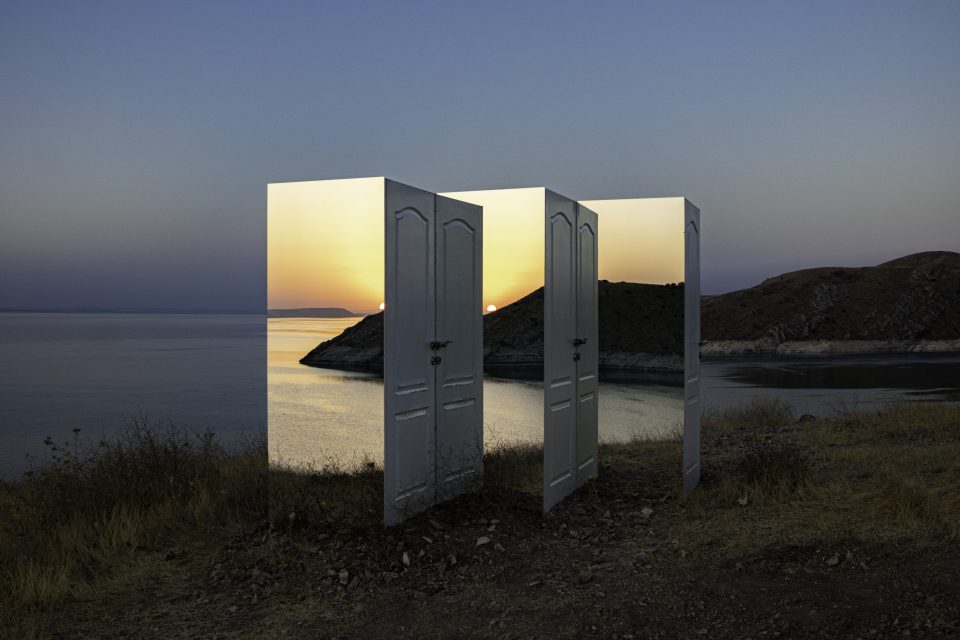
Shirin Abedinirad, Tide, 2019. Land art, Currumbin, Australia. Presented at the Swell Sculpture Festival, the work draws on Attar’s Mantiq al-Tayr (The Conference of the Birds) and its mystical valleys of self-realization, placing a mirrored door in the sand as a threshold where sea, sky, and viewer meet in reflection, quest, and transformation. Artwork courtesy of featured artist Shirin Abedinirad.