


Submit from September 15th-October 31st 2024
Issue 10 of Rowayat explores “borders” in all their forms: from the physical, heavily guarded borders that divide the earth, to the intangible but equally real psychological, cultural, and socio-economic borders that delineate our interior and exterior worlds. In our upcoming issue, we delve into the lines that shape and limit the human experience, challenging and redefining them through the lens of prose and verse.
Submit prose and poems that reflect your best-polished work. We’re looking for immediate, fresh writing that reflects your deepest experiences of borders and how they affect your view of the world. We seek well-crafted poems, prose and nonfiction that attempt to reappropriate the hardest borders, be they cultural, linguistic, or bureaucratic in nature. Writers may submit poems or prose responding directly or indirectly to the issue’s BORDERS theme.
Masthead
Wael al-Mahdi is the Managing Editor of Rowayat’s Issue 10: Borders wael@rowayat.org. He is a poet, translator, and healthcare professional from Bahrain and the recipient of a High Commendation from the Stephen Spender Poetry Prize. His Arabic translations include works by the National Poet of Wales, Lewis Carroll’s Jabberwocky, the Centennial Scriptures of Won Buddhism, and literature for the 2024 Diriyah Biennale. In recent years, Wael has explored the terminological and thematic impact of Arabic and Persian literature on Islamicate cultures. This exploration has culminated in his forthcoming poetry collection, A Breeze From The East, which showcases Mashriqi English, a novel poetic register that blends the rich Perso-Arabic literary tradition with the full expressive power of Modern English.

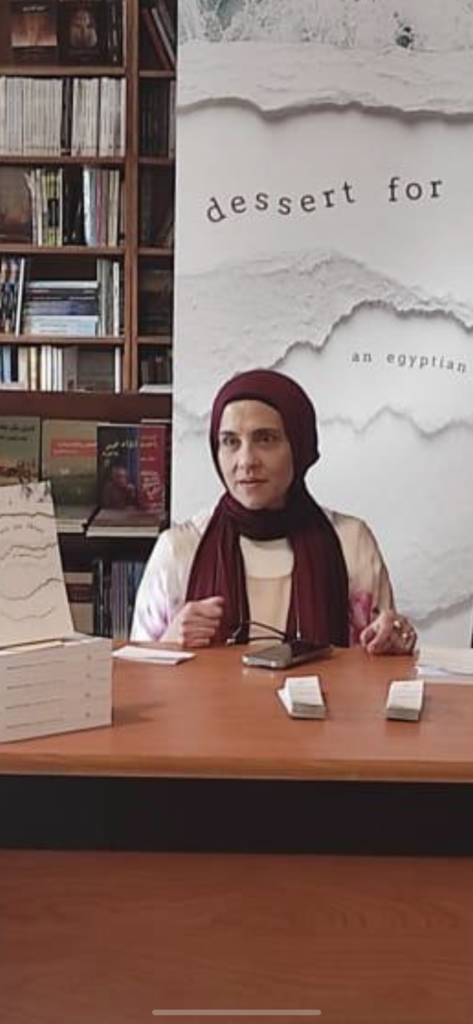
Fatima ElKalay has been captivated by poetry since the age of six, and her journey as a poet and editor has spanned over two decades. As Rowayat’s Poetry Editor, fatima@rowayat.org, she brings a wealth of experience, passion, and creativity to her role. Fatima holds an M.Litt in Creative Writing from Central Queensland University, where she honed her craft as a storyteller and poet. Her work has earned critical acclaim, including being shortlisted for the London Independent Story Prize and the ArabLit Story Prize for short fiction in translation.
In 2022, Fatima published her first collaborative collection, Dessert for Three, blending fiction and memoir in a rich exploration of human experience. She is also the author of Basel’s First Trip, a children’s story featured in Rowayat’s Young Readers Edition. As a prolific translator of Arabic literature, Fatima’s contributions span poetry, fiction, and nonfiction, making her a dynamic voice and advocate for cross-cultural literary exchange.
Hammad Rind is Rowayat’s Fiction Editor, hammad@rowayat.org. He is a multilingual Welsh-Pakistani writer and translator, working across English, Urdu, Persian, Welsh and more. His debut novel Four Dervishes (Seren Books, 2021) was longlisted for the British Science Fiction Association Award. In 2022, he translated Knotted Grief by poet Naveen Kishore into Urdu (Zuka Books). Hammad was part of the 2023 cohort of the Representing Wales writing programme and the 2024 cohort of the Hay Literature Writers at Work programme. His stories and articles have appeared in various publications, including Poetry Wales, James Joyce Broadsheet, The Aleph Review, The Madras Courier, and Y Stamp. Hammad holds a BA in English and Persian literatures from the Punjab University, Lahore, and an MA in film making from the Kingston University, London. A passionate language enthusiast, he teaches Persian and Urdu, and has led workshops on creative writing and Eastern literature. He is currently working on his second novel.

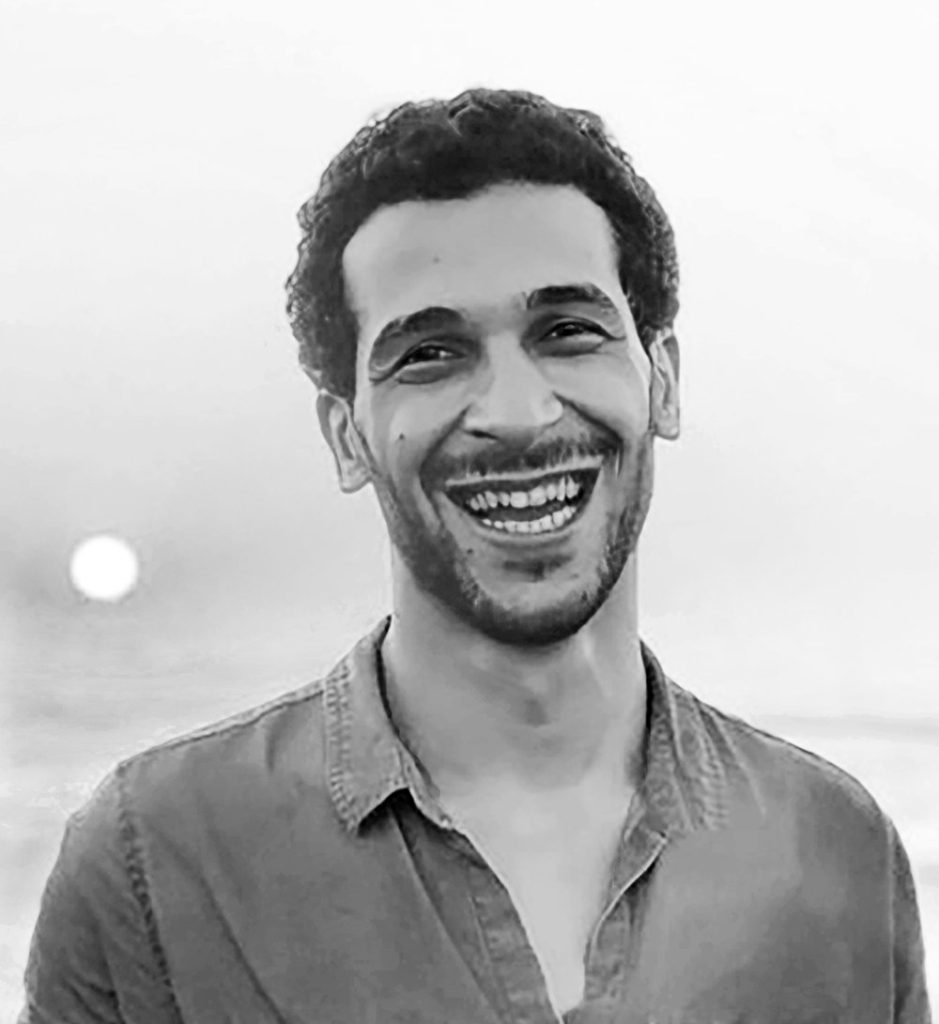
Mohsen Mohamed is Rowayat’s Arabic Literature Editor mohsen@rowayat.org. He is an award-winning poet whose works have been featured in prominent journals and magazines such as Cordite, Poetry Magazine, Media Part, NRC, and others. He’s an Arabic in translation editor at Rowayat and has participated in numerous literary festivals. In 2014, Mohsen was arrested on the fringes of a protest on the campus of Mansoura University, where he was a first-year student. Although he had no involvement with the protest, Mohsen spent five years in the Egyptian prison system before being released in early 2019. During his time inside, he completed his university degree and wrote his first poetry collection, Mafeesh raqam birudd مفيش رقم بيرد (No One Is on the Line). Despite his imprisonment, this collection won the Sawiris Cultural Award and the Cairo International Book Fair Prize for vernacular poetry under the auspices of the Ministry of Culture. He is currently working on another collection of poems around the theme of identity and exile as well as having published several articles around these themes. When Mohsen is depressed, he tries to solve a mathematical problem which he can’t, and he gets depressed even more. Mohsen loves to travel; he says, “He was a bit incarcerated, but he is, now, so free.”
Taher Adel is Rowayat’s Poetry Editor, taher@rowayat.org. He is a British-Bahraini poet and spoken word artist, holds an MA in Creative Writing and Poetry from the University of East Anglia. He has served as a judge for the Stephen Spender Poetry Prize and was appointed the Poet in Residence for Wells-next-the-Sea in 2019. His literary contributions include titles such as ‘I Don’t Know What Language I Dream In’ (Burning Eye Books, Sept ’23), ‘The Names’ (translated into Arabic by Rewayat Reads), ‘The Chosen Names’ and ‘The Divine Names’ (both from Sun Behind The Cloud). Beyond his books, Adel’s works have been showcased in various esteemed publications and platforms, including Ambit, SMOKE Magazine, The New European, Gulf Daily News, Glassworks Magazine, Tedx, BBC Radio 4, Poetry London Magazine, and Poetry Salzburg Review.

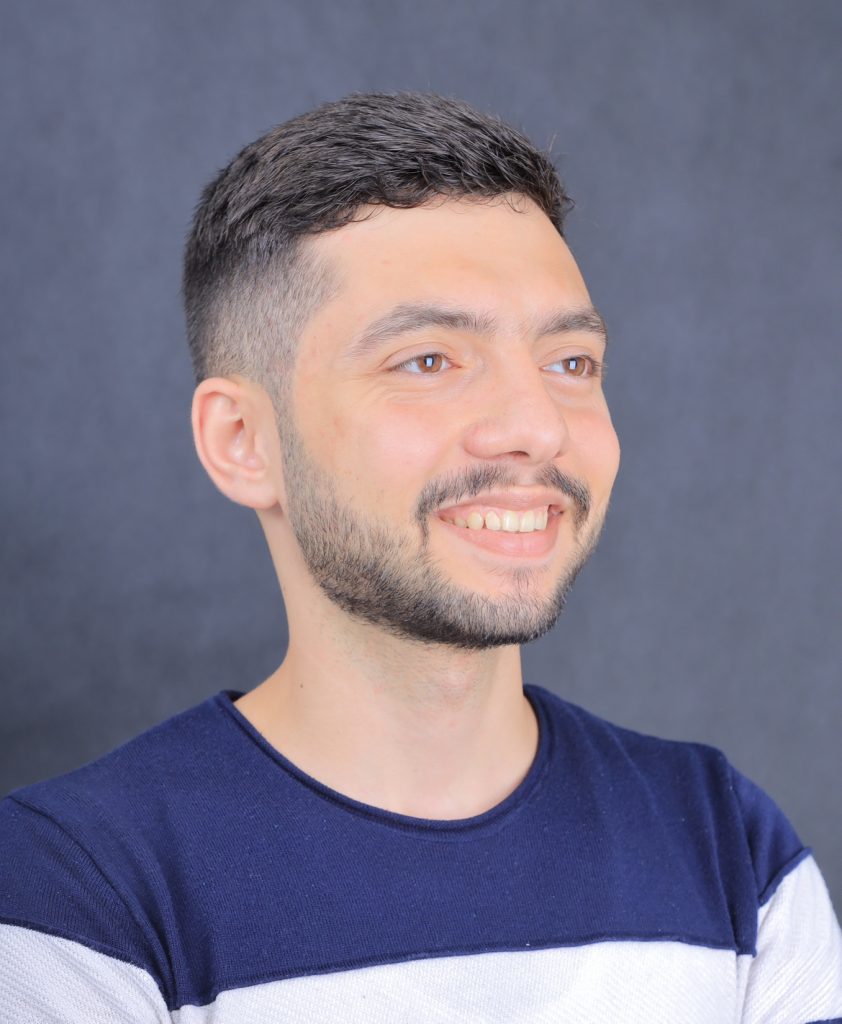
Fahed Mohammed Shehab is Rowayat’s featured artist for Issue 10: Borders, a Palestinian born in Gaza City. He has been passionate about visual arts for over ten years. Early on, he recognized how art could be a gateway to building a bridge for knowledge and learning. He studied various art movements and pioneers from different periods of artistic history, striving to develop his own unique experience and style of expression. Driven by passion, Fahd sought to showcase his inner artistic voice in every possible way.
He firmly believes in culture’s significant role in shaping a community’s experience. In light of this belief, he has worked on several projects and volunteered in various community campaigns to connect more closely with people and understand how he could document both his life and theirs. He learned that the more genuine we are in what we present, the easier it is for it to resonate with the world.
He has participated in several local and international art exhibitions and was one of the representatives of Palestine at the 10th Palestinian Cultural Forum in Beirut, Lebanon. Fahd carries his artistic journey and passion wherever he goes, believing that art will be his lasting legacy, as it expresses what we truly desire.
Many of his paintings show hope and joy in children’s eyes. Recently, Fahd began working on one of his most significant projects, which reflects how enlightened Palestinians are and how they have always been a forward-looking society. In this project, he explores the concept of postage stamps, which encapsulate a society’s experience over more than 100 years, summarizing culture and creating a narrative worth sharing with the world.
Ibrahim Fawzy is Rowayat’s Editorial Assistant, ibrahim@rowayat.org. He is an Egyptian literary translator and academic who holds an MA in Comparative Literature. He was awarded a mentorship with the National Center for Writing, UK (2022/2023). His translations, reviews, interviews and articles have appeared or are forthcoming in ArabLit Quarterly, Words Without Borders, The Markaz Review, Modern Poetry in Translation, Poetry Birmingham Literary Journal and elsewhere. He also podcasts at New Books Network. His debut book Belonging to Prison will be published by Cambridge Scholars this summer.

Rowayat Editorial Interns for Issue 10:
- Mai Khaled is a Cairo-based writer who graduated from Cairo University with a BA in English Language and Literature in 2022. She is currently pursuing her MA in English Literature and balances her academic work with writing for her Substack newsletter, The Ibis Tongue. Her writing delves into themes of language, silence, and identity. Beyond the written word, she enjoys music, cinema, birdwatching, and tarot reading.
- Abdullah O. Jimoh(He/him) is a linguist and poet from Lagos, Nigeria. His works have appeared or are forthcoming in Tab Journal, Radon Journal, Broken Antler Magazine, South Florida Poetry Journal, Modern Poetry in Translation, A Long House, Mudroom, Tint Journal, Gyroscope Review, Efiko Magazine and elsewhere.