




a conversation with Tarek El-Ariss about his memoir Water on Fire: A Memoir of War
I can see how the beach holds so much significance in your memoir. Each chapter expands and retracts that metaphor beautifully. What inspired you to focus on it?
Beirut was synonymous with the beach for me. I wanted to talk about the beach because I grew up on it, and we would go to the beach every day during the war, and I wanted to understand that phenomenon.
There’s something about the beach and how it’s a space of freedom. The whole city is there, they jog, they run. The beach wasn’t just a day activity; even when we went out at night, my friends and I would have dinner and walk down to the beach boardwalk, or we’d park the car and stroll along the corniche, even if it was 11 o’clock.
The beach and war seem like such polar opposites, and yet, how can a place of serenity and peace also be a site of refuge?
During the war, the beach was the only outlet for the city, and this is how this idea of wanting to write about the beach came about.
I felt the need to write about the beach physically and metaphorically, about what kind of space the beach occupies in our minds and souls. The beach occupied many of my favourite movies, Stanley Beach in Youssef Chahine’s Alexandria… Why? was one of my biggest inspirations because Chahine also understood the significance of the beach in how he depicted Mahmoud Al Meleji fishing every day.
This is how we grew up, too; it was simple and mundane, where people would sit on rocks by the beach or on the concrete, lay a towel down, and go for a swim. It wasn’t this luxurious outing like St. Tropez or what was depicted in advertisements; it was an activity for all social classes. I wanted to understand and unpack the significance of the regularity of going to the beach. I had to think of what it meant to develop these rituals and connections to the beach. This led me to deeply reflect on the everyday significance of beach outings, pondering over how such simple activities could hold profound meaning in our lives.
How did the beach become as vital as any other site in the city through which a person’s identity is shaped and formed?
As I delved deeper into the significance of the beach in my life and the lives of those around me, I began to reflect on the process of capturing these memories and insights in writing. This led me to consider how the words and stories came together to form a narrative that would do justice to the beach’s enduring impact.
In thinking about these memories of the beach, the question arises: how did the writing process develop? Was the memoir a sudden inspiration, or was it a gradual unfolding?
A lot of it came together during COVID, but several chapters came before. In 2017, the Sharjah Art Foundation in collaboration with Ashkal Alwan with whom I have a longstanding relationship invited me to give a talk about Beirut. They asked me for a text that combined keywords and places: Water-Dakar, Crops-Ramallah, Earth-Istanbul and Culinary-Beirut. I didn’t want to do something historical, nor did a literary angle appeal to me. This is when “Mfattqa: Toil and Trouble” emerged and presented both as a talk in The Ties that Bind and as an essay at Upon a Shifting Plate, Sharjah Biennal 13 Act II, Beirut (2017). The text was about the boiling cauldron, the fourth chapter in the memoir. I delved deep into research about this famous مفتقة Lebanese Turmeric Rice Pudding through this one dish, I uncovered a history of the entire coast, a Pandora’s box of information and diverse cooking techniques and with different ingredients like in Egypt, for example, it was cooked with molasses. This single recipe led me on a journey to the First World War, and Ayoub, It was as if doors had swung open, revealing a treasure trove of stories.
“In Beirut, mfattqa is traditionally consumed on Arbaat Ayoub (Wednesday of Job). On the last Wednesday of April, Beirutis flocked to the seacoast at Ramlet al-Baida to picnic, bathe, and eat mfattqa.” (Water on Fire, 58)
The earlier version of Chapter 2: “The Beachcombers,” was published in Dɪ’van: A Journal of Accounts, 34–43, University of New South Wales Faculty of Art & Design, 2018. How did you transform these initial writings into a fully fleshed-out memoir, and how did you shape your stories into a cohesive narrative?
After I had written these two pieces, I realized that I had a memoir between my hands and needed to build a structure; I did a little outline and worked on it for almost a decade to turn it into this memoir.
The outline is how I realized that I had to write about my childhood, the beach, my school and its mysterious principal, Monsieur Lavide.
“M Lavide was tall and fit and had a military crew cut and a silver tooth that shone in the Beirut sun. He had a round, flat face and a mole that had slipped from an eighteenth-century painting and stuck to the side of his right eye. He lived in a house on the school premises with a little garden and beautiful flowers. Some teachers used to take us into the garden to catch butterflies with a net, just as in George Brassens’s song “La chasse aux papillons.” M Lavide had a little dog as well, a white bichon or some similar breed that chased after the kids with great excitement. I think it belonged to his wife or girlfriend, who was tall and blonde and who used to tan in the garden, surrounded by kids and butterflies.” (Water on Fire, 80)
I loved reading your vivid portrayals of him. It’s as if we all had the same Monsieur Lavide in our schools, pointing fingers at us for our misdeeds. Did the writing just flow out at that point?
I wish, but as academics, we must publish regular scholarly essays, and reviews, which is a tough, time-consuming cycle. Then I became chair, so the administrative tasks piled on, and there were committees and many responsibilities.
I tabled my memoir and thought of it as a future project, because I was writing a book on monsters, about the idea of the beast wahsh. It was a subject that I had been very interested in for the longest time, and what it meant in language and its derivatives across the region. It means I miss you in Egypt وحشني and in Morocco توحش, which led me to think about al-ins الانس, and the non-ins. I wrote an article on Hoda Barakat and the tawahhush. “The Lebanese Civil War, with its violence and forced exile, pushed authors and artists like Hoda Barakat into the spaces of wihsha or beastly wilderness that al-Shanfara also occupied.” This was my focus, and this was the topic, how it’s used in the community and how it was developing.
But then, when COVID happened, when the lockdown started, the anxiety of the war that I experienced when I was a young boy returned to me because we were not able to leave; we had limited access to essential utilities, we didn’t know what would happen, the uncertainty unleashed not just the memories but my emotions too. This was very much how we lived during the war, so I sat down and wrote “Sediments,” the third chapter of the memoir, about how we used to collect water during the war.
Covid freed my time from various academic responsibilities, but being confined and being in this heightened emotional state made my own beasts come to roost. I had to deal with them, and I realized this was the time to complete the memoir; the truth was, it was the only thing I could write.
Let’s talk about place. It’s a memoir mostly centred in Beirut, but you bookend it with New York. There is also a chapter on Abidjan, and London makes an appearance, too. Why end with 9-11? Why not continue after? Did you know from the start that you would end it with 9-11?
It came naturally. I was writing a book about Beirut and my life.
But then, it became clear that I was writing a book on how we live with war.
9-11 was traumatic; New York had been my safe haven, and suddenly, “Oh my God, the war is back in New York.” It hit me both physically and psychologically; I was teaching at NYU, and my neighbourhood became a military zone. I never imagined the Village could be transformed and filled with military vehicles. C’était du jamais vu, it was a nightmare. To end with it felt natural in how it affected me and transformed all diasporic lives.
Beirut and New York aren’t the only cities that surface in the memoir; there was going to be a London chapter. Initially, it was called “Bye Bye London,” although there is no London chapter, London was vivid in my memories, in how it was the perfect contrast to Beirut, a refuge to many Lebanese. There, we were physically safe yet emotionally incapable of escaping our reality.
“One day, I woke up in our hotel room in London to the anguished voices of my parents. My dad’s face was grim, and my mom was crying. There were images of an explosion on TV. A big blast followed by tanks and soldiers on the move. Did the war start again? My mom explained to me what was happening as I was waking up. My eyes were still half-closed, and my head was slowly coming into its upright position. (…) The Israeli army that was besieging West Beirut decided to enter the city. We were now stuck in London, not knowing when or if we could return.” (Water on Fire, 147-148)
But my formative experiences were in Abidjan, and there was no doubt in my mind that I had to devote a whole chapter to it “Hotel Ivoire.”
Have you ever visited Abidjan again? Or was it all from memory?
It was all from memory. I wanted to go back, but it didn’t work out, and it probably changed so much from when I was there.
You were so young to travel alone?
I remember the details so well.
“After I said goodbye to my mother in Amman, I boarded a flight to Cairo, where I would spend the night. Having no visa to enter Egypt, I had to sleep at the airport, in a room that might as well have been a detention cell. The room’s door didn’t lock properly, so I was terrified that someone might break in in the middle of the night. My plane left the next day, heading to Abidjan but making stops in Kano and Lagos in Nigeria.” (Water on Fire, 167)
I was in Abidjan with my older brother, but he was always travelling. No mother, no father, in a completely new environment. Surrounded by the French at school, in the streets, and the missionaries, I had to figure out who I was, so I started reading; I discovered 18th-century literature, theatre, Descartes, and Pascal; there was this bookstore next to the house, Librairie de France where I would buy books constantly, whatever they had, not because I was sympathizing with colonials, but because it was the only outlet available. I believe this was the formation of my modern self, who I am today, began at that point.
It’s also when my desires as a human being began. It was so painful to have to go through all this alone, and I was so angry at my mom. I felt like she had abandoned me. So I took her radio—this intimate portable radio that she listened to constantly and put near her pillow when she went to bed–the ultimate revenge.
“Before leaving the house, I asked my mom if I could take the radio-cassette player she had by her bedside. A small, silver-colored player with a wide handle, it ran on either electricity or batteries. It was made by National, a Japanese brand that was part of Panasonic. This radio-cassette was her most precious object, her closest companion. And I wanted it. I had this crazy idea that I would use my headphones to transform it into a Walkman and listen to my music during the long journey. She couldn’t understand why I wanted it. She felt that I was ripping away a part of her. She fought back. I insisted. She relented in the end.” (Water on Fire, 165)
I wanted to take her child away because I was her child, and I was being taken away from her, so I wanted her to feel that pain. Of course, I didn’t know how aware she was of my feelings; she was guarded محصنة نفسها, she had lost her husband, and the war was raging, and she did what she needed to do to survive; she felt she had no other option. As a young man, I had needs. I didn’t know how to express my needs; I couldn’t understand her actions the way I do now.
We love each other. We’re best friends.
But she hurt you.
She had no concept that that had happened; she was overwhelmed and didn’t see any other way. She didn’t see any other possibility.
This is water on fire. Really, this is her.
In her eyes, she gave you a good opportunity, a way out of the war, a path to a good education.
But that forced displacement in Côte d’Ivoire from everything and everyone I knew forced me to rethink everything and who I am. That’s why I keep saying it’s the origin of my modern self because it is this experience of déracinement, without family, without anyone, that I had to reinvent myself.
Sometimes, I say I was reborn; I was giving birth to myself in Africa.
We discussed how some chapters came first; after that, did you follow your outline and fill in the blanks?
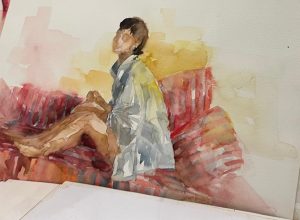
I sketched the outline. Whenever I was blocked or had too much anxiety, I would draw. These memories were challenging, and I tended to go off on too many tangents. I don’t really consider myself an artist, but I drew to help unpack my life. I sketched each chapter.

These sketches allowed me to explore all my tangents, to expand and really let loose, which allowed the memoir to emerge. They also allowed relevant tangents to develop and become part of the manuscript. Others didn’t make the cut; for example, I was going to write a chapter that starts with Nazik El-Silahdar as an icon in Beirut; I started sketching; I drew her eyes because of her intense ability to convey emotions with them. Elle a les yeux revolver, elle a le regard qui tue, as in Marc Lavoine’s song. This led me down a rabbit hole of researching the history of the Silahdar family and how they were the guardians of the armory خزانة السلاح during Muhammad Ali’s reign. Very interesting, but then I realized it didn’t really work, and I slimmed down and trimmed so that what remained in the memoir was only what was really impactful.


I’m very impressed at how you allowed yourself that freedom as a writer and as an academic to go into this exposed space that is not just highly vulnerable, but even the process itself is extremely challenging; it’s not linear; it’s not like academia, your prolific academic career and numerous publications speak for themselves, but creative writing, especially memoir is a different journey, Right?
It’s a different beast altogether. The process of overcoming the psychological hurdles of memory and then allowing myself the freedom to understand them in my own way by delving into and connecting my journey with language, history, philosophy and academia.
When I overcame all these hurdles, the water metaphor emerged and linked everything together. I realized it had been the underpinning of the memoir all along: water is the feminine; it’s the women of my life.
I fell in love with all the women; they are so well depicted: your mom, Aunt Shafiqa, your grandmother Khayrieh, Bahieh the nanny, your sister, even your therapist is a woman. There are so many women; they aren’t flat characters; you capture all the women in their fullness. Which ones came quickly, and which were harder to capture or bring to life?
I was going to call the book All the Women in My Life! Believe it or not, it was one of the titles I floated around, basically, because I was raised by them; they occupy the space, they expand and retract in my life.
Through my memoir, I also explored my relationship with the feminine. I even started the book with a quote by Bruce Lee: “Be like water, my friend.” The women in my life moved me and pushed me, but I was also hurt and abandoned by them, so through them, my vulnerabilities came out.
Water is the element of the book which is a feminine element too. How does using water as a metaphor shape the narrative and explore feminine experiences?
The metaphor of water as feminine is something I know of from feminist theory, such as Speculum of the Other Woman by Luce Irigaray, who speaks to the concept of liquids and liquidity to disrupt traditional notions of identity, boundaries, and sexuality. Many feminists worked a lot on the idea of liquids as a feminine power, something that the patriarchal structure cannot contain, like the French feminist theorist Helene Cixous, who uses liquid metaphors to elucidate gender differences in relation to language. Water gives women the freedom, mobility, and flexibility to be who they are, to change, evolve, resist, and be strong, reflecting women’s diverse experiences, adaptability, and resilience, just as water’s various forms – vapours, ice, liquid – embody the multifaceted nature of femininity, defying rigid definitions and embracing constant transformation.
Water is also linked to the two places I began and ended the memoir with, Beirut and New York, both connected to water.
I also find that Arab culture is surrounded by women all the time: the aunts, الطنطات the caring ones, the supportive ones, the judgmental ones…especially the judgmental ones (laughs). I had even named a chapter after them, but it didn’t make the final cut.
How did you experience the presence of the women whose stories you included, and did they ever seem to take on a life of their own during the writing process?
It’s my story, but sometimes, I felt almost like they took over the narrative. When I was writing the Boiling Cauldron chapter, aunt Shafiqa came to me. I heard her tell me her name. I remember hearing it. “My name is Shafiqa.” Twice. “My name is Shafiqa.” I swear to God, I was still in Austin and had not yet come to Dartmouth. I was going to the gym and thinking about how to begin the chapter? I knew I wanted to talk about the mfattqa and its relation to language because I come from psychoanalysis,
“Rooted in a process of ripping ( f-t-q), the word mfattqa belongs to the register of fabrics and tailoring as well as medicine. The Arabic root f-t-q has given us the word ftaq (“hernia”), denoting a ripping at the seam of the body, within its membranes. It has also given us the word tiftiq, which means “craving.” Mfattqa is thus about ripping and craving, about being ripped apart by one’s own craving for something or someone, a lost parent or a lost generation that perished during a Great War and is almost forgotten.” (Water on Fire, 57)
However, I still struggled with how I would start this section. And that’s when I started hearing that sentence in my mind. My name is Shafiqa.
Shafiqa came to my rescue and was exactly as I described her. She came and called out, “Tarek, it’s about me. This chapter is mine. I’m the one who will get you to know your father and grandmother.” I allowed myself to succumb to her will. In the same way that she used to visit us and stay with us during Ramadan, she came and visited me while I was writing, and that’s why I say she was bringing the spirits.
“Her name was Shafiqa (pronounced Shafi-ah). I see her stirring a large pot, a wooden spoon in one hand and a cigarette in the other. Occasionally she turns and drops a glance at me from the side of her left eye. Then she mutters some strange words that sound familiar but that I can’t make out. Her words are gobbled up, as if spoken by people who died a long time ago.” (Water on Fire, 43)
It makes sense now how all the women are three-dimensional. It’s almost like Shafiqa inhabited you, and that’s why she is so real on the page.
It wasn’t just her; I had a dream about Etel Adnan, too. We had been friends throughout my academic life. I invited her to NYU and stayed in contact with her. Two years ago, when I started the chapter on the 1982 war, the great trauma. I dreamt that Etel would guide me in writing the chapter. In my dream, there were her colours, I was in a dark hallway, and then her colours started to appear on the wall. I felt at ease. Do you know how they say we dream of the light of the dead?
She came to you because you needed her; somehow, she is a part of who you are.
Absolutely. And that’s why I started the chapter on the war with the colours in the same way that Etel started The Arab Apocalypse.

“Orange. White. Red. Black. White with orange spots. White with red spots. Black with bulging eyes. Orange with puffy chin. A dozen or so of them. Going round and round and up and down. Reacting to motion and light and food. Little flakes dropped once or twice a day float on the surface, causing such commotion in that little tank.” (Water on Fire, 131)
I remember this is the Fish Tank chapter. You also manage to weave the Palestinian trauma together with the war symbolized in the fish tank, which is a very moving and impactful way to explain how you felt, feeling trapped and continuing with the water metaphor of the memoir.
The water was my saviour during the war. Water was life; it was my will to live and prevent the war from killing us. This feeling of entrapment, where the only refuge is the water.
The water’s embrace offered me solace during the war, a reminder of the resilience that would carry me through even the darkest times. And it was this same resilience that I came to explore in my father, a man whose warmth, charm, and gentle spirit belied his patriarchal stature, leaving an indelible mark on my life.
Losing him at 14 must have been extremely difficult. A highly successful and well-educated gynecologist has this really warm side to him; he is so charming. A patriarch who’s also feminine and soft. How did your father’s unique blend of strength and sensitivity shape your own personal growth?
My relationship with him was complicated because I was young when he passed away; he had to deal with a lot of things. I was angry that he had left me, I felt abandoned, I didn’t understand why I hadn’t had enough time to spend with him as I would have liked. So, in a way, this memoir was healing in that it forced me to get to know him in the way I would have wanted, to connect with him, to delve into his life and really understand his upbringing and relationships. In bringing him back, I also forgave him. Of course, there was nothing to forgive, but the child in me needed to forgive him for that abandonment and let go of that anger.
“This is how I learned how my dad went to meet my school principal—Monsieur Lavide’s predecessor—to convince him to let me in. He explained to him the circumstances, emphasizing what a precocious little fellow I was, and how I was already speaking and maturing so rapidly because I was surrounded by older siblings and adults at home.” (Water on Fire, 71)
Then, there’s your move to study in the West, to New York state, where you find yourself in a different way; you find your path as an academic, although perhaps it came as no surprise since you had found such a love of reading in Abidjan.
My books in Abidjan had the same effect on me as going to the beach in Beirut; both of these spaces saved me.
I went to the beach every day to deal with the horror of war that surrounded me. Literature helped me deal with my emotions by inhabiting the world in these novels. These multiple worlds that we live in sometimes parallel or intersect with our own, but in either case, they helped me escape the reality of the world forced upon me because of my circumstances.
It’s something that really fascinates me: How do we inhabit a world? The rituals of intimacy that we indulge in, how with water, it’s something that touches your skin, and this closeness exists with items, like my mother’s portable radio for her, or books for me, which I carry to bed, to the beach, or to a coffee shop – a constant companion.
Another question that I like to ponder is, how do we create structures of care, practices of intimacy, that are able to take care of us when we feel the world has abandoned us, has been unjust or has been sending us, all kinds of horrors and violence? How do we take care of ourselves by inhabiting these worlds and developing these practices of intimacy and care?
It’s almost like we have to find a way of healing ourselves. And it’s definitely how many of us cope without maybe realizing this is what we do; we cope by inhabiting these worlds and these books and helping ourselves.
This memoir provided that healing space for me, especially during these traumatic days, and I cannot thank you enough for sharing your journey with us.