




For the third Friday in a row, I wake to the men’s call to prayer fighting against the sound of the roaring sea. I sit back and eye my few belongings: Diaa’s backpack, a blanket that smells like someone else’s family, and my two shoes beside the entrance. My own family’s scent has been washed away with the waves and the cup of laundry detergent we had borrowed from the tent next door. The word borrowed seems so pointless now – I can’t even imagine the day I’ll have something to offer in return.
I had packed my duffel bag three days before the warning call. It had taken me two hours of impossible decisions: which jacket, which pictures, which memories. I remember I’d thrown in my black fountain pen and a brand-new journal I had been saving for some unknown special occasion. Now is the time, I’d thought, like the end of my world is what it takes to justify tainting the clean white pages. But when the call came, I decided I had left too much behind for anything else to have any value. I took my little brother’s hand and skipped down the stairs, leaving the duffel bag on my bed solely out of spite.
I shake my head at my past self’s idea of resistance. I had found children’s notebooks in a cabinet in the classroom we’d stayed in during the first few weeks. Diaa had busied himself for hours by flipping through the older kids’ workbooks and cutting out pictures of planets and stars. There were stacks of them, filled with the sharp-cornered Arabic lettering of last year’s second graders. I had ripped the remaining empty pages out of each one and stapled them together to make a notebook of my own.
After every shelling, Diaa would run to the classroom balcony and try to estimate how far away the smoke was. At night he would shake on his thin mattress because ‘the moon isn’t bright enough for me to see the smoke’. When he was a baby, our mother used to rub her thumb over his eyebrow until he fell asleep, so I did the same. I told him the names of all the constellations I knew and traced them on his forehead until he giggled and went still.
Ever since we came to the beach, I’ve been writing letters. I write to childhood friends, to my cat, to cousins estranged by war. I write to my mother as she sleeps inches away from me. Sometimes they write back to me. They will stumble toward me in a dream, but I always wake up before they tell me where they are. Mama says I’m the one speaking the words in my sleep; switching roles, and adjusting my vocabulary to match the way they used to talk. To me, this is irrelevant – does anyone really know how to act in the presence of death?
Even on these shores, there is no time for mourning. The hours pass us by between searching for firewood and water from anywhere but the sea. We search for Diaa, then remember, then search for each other instead. Before we know it, the sky is glowing red with the airstrike fires dancing over everything we left behind, and the sunset already simmering over the horizon.
I inspect each page of my makeshift stationery. Will you come if I write to you? I don’t have many pages left.
Dear Diaa,
Do you remember the time I took you to the beach? You had said you wanted a closer look at the moon. You begged and begged until I gave in…
I still don’t know what made you think the beach is closer to the moon than any other place on this earth, but I looked into your eyes and saw the light and splendour after which you were named. It won me over every time.
Once we set foot in the sand, you let go of my hand and sprinted toward the endless blue. You had looked at the stars and said, “I want them.” He had reached his tiny arms towards the sky, his voice barely audible over the deafening fizz of the seafoam. “I want them all to be mine.”
The missile that took Diaa away had left an entire moon crater in the schoolyard. After the initial midday disturbance, the other children brought pieces of cardboard and used them to slide down the tilted concrete. Sliding and climbing back up, sliding again. You would have loved it, Diaa. It had left me empty and nothing less. Mama and I had left for the shore and never gone back.
I sit outside and lean my head back against the tent pole. It’s my twenty-first December under the Gazan moon. I came here for a closer look at you. Your stars are long gone. I promise I’ve been patient. Is it time yet? Is it time?
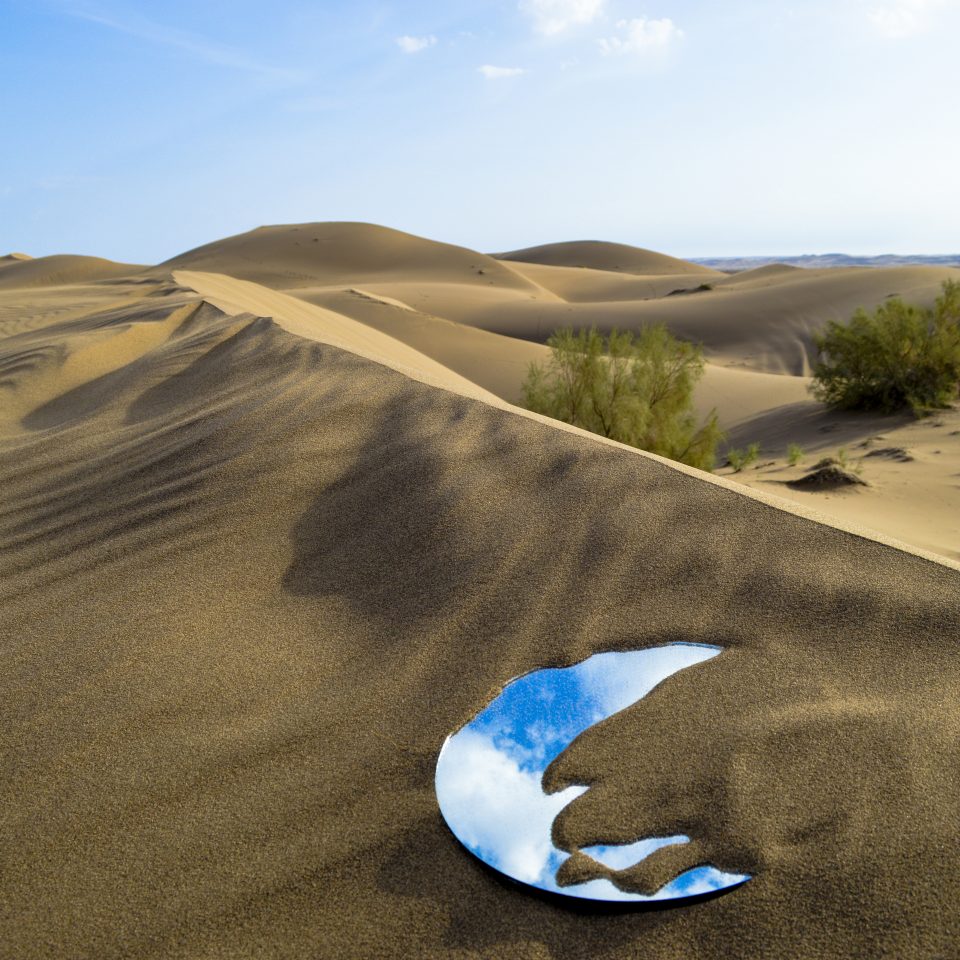
Shirin Abedinirad, Evocation #2, 2013. Land art, Central Desert, Iran. Using mirrored circles partially buried in sand, the work creates the illusion of pools of water that reflect the sky across the dunes, challenging our perception of nature, absence, and desire. Artwork Courtesy of our Featured Artist Shirin Abedinirad.