

“These letters in their fictional form are not delivered, but as a book, they are delivered. So as the meta-reader, you are… being asked to respond.” – Mai Serhan
Three events. Two cities. One collection. CAIRO: the undelivered letters.
Through these three in-person events—at Diwan Bookstore, Tamara Haus, and Barzakh in Beirut—these poems were delivered. They found their audience. And the audience found itself, uncomfortably, loudly, publicly. What began as a series of unsent letters became a lived experience: performed, dissected, and absorbed. This is the story of how Cairo spoke, and how we listened.
The poetry collection began as an act of subversion: a poetic reckoning with the inherited structure of famous advice columns like Al-Ahram’s Bareed el Gomaa, which was Serhan’s initial inspiration—letters that were once filtered, censored, and moralized by a male editor.
“Let’s get rid of the editor completely,” she said, “Now I have creative license.”
That act of removal becomes an act of political imagination. What she writes is unfiltered. Not seeking permission. Not trimmed to appease. Letters too painful, too raw, too politically inconvenient to print—by doing so. She gives the silenced back their voices.
“They would be undelivered because they are too dangerous to be published, they’re too dark, they’re too seedy, they’re too gritty.” — Mai Serhan
Serhan doesn’t moralize. She documents—permits rupture.
This is not Bareed el Gomaa reborn. It’s Bareed el Gomaa hijacked. Their self-expression flips the patriarchal structure of the advice column on its head.
The collection comprises thirty-four poems, including sixteen written by women, ten by men, and eight from voices of unknown gender. It isn’t simply a gender balance—it’s a redistribution of narrative power. Women speak unapologetically. Men speak from collapse. The anonymous speak from absence. All are undeliverable. All have arrived.
This choice also reflects how the city of Cairo—like many power structures—often erases people’s names, faces, and individuality. These anonymous letters could come from anyone. And so, they come from everyone.
So, what happens when these letters, meant to remain unread, are performed, discussed, and physically shared?
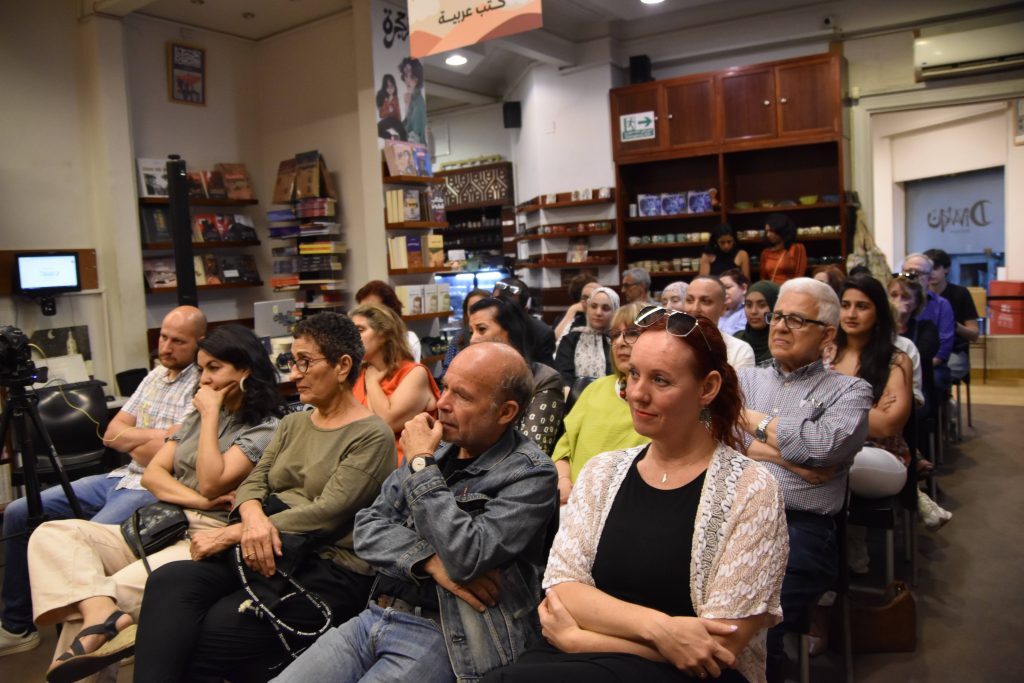
At Diwan Bookstore in Zamalek, in conversation with Nadia Wassef, the collection was first launched in the very place that gave it a home in print. This event brought the literary into the literal: Cairo, captured in pages, returned to Cairo in dialogue. Nadia and Mai discussed what it means to write letters that may never be answered—yet must still be sent. The audience, mostly educated, English-speaking Cairenes, became a kind of third party to the letters. They were not just readers, but receivers. Not just eavesdroppers on private grief and systemic cruelty, but possibly, intruders. They were being asked to confront, maybe even confess, their estrangement.
Nadia reflected on the violence of absence: how being left out of the conversation, how letters that have been left unanswered, constitute a kind of epistemic erasure. She said, “I just can’t move past the idea of silence—because as much as these people are being silenced, there’s also the silence of the editor who never responds. Silence becomes its own kind of violence. And it keeps accumulating weight. What does that evoke for you?”

Mai replied, “The silence is very much part of the concept. These are the people who do not make the cut. But they make a lot of noise in these letters, and they kind of give up and smash mirrors and take off their clothes… It’s despair—a moment of eruption.”
Everyone in these letters confesses to what society forces them to repress: rage, sex, trauma, failed motherhood, unrelenting grief. These letters refuse shame. They refuse silence. Mai gives voice to those who write for catharsis. They write to be heard. Even if and when they’re not.
They write as if no one’s watching—yet they demand to be read.
Diwan was a reflective beginning, but Tamara Haus was a confrontation. They hosted the second event: a larger public launch in collaboration with Diwan and hosted by Amy Mowafi. Here, the poetry was not just read but felt. The discomfort wasn’t avoided—it was center stage. Amy and Mai confronted the porous line between bearing witness and consuming pain. The gap between the audience and the characters on the page unbridged—Cairo’s spectrum of the unseen and unheard: the janitor, the girl sold off too soon, the ghost, the grieving mother—stood exposed. That discomfort, that reality—that’s Cairo: where privilege and poverty, foreign tongues and class injustices, meet without resolution. The evening asked the audience to sit with this discomfort. To not flinch.
Was reading these poems an act of solidarity—or a voyeuristic gaze into others’ pain? These questions a reality many Cairenes feel but do not speak about.
The reader becomes a witness to pain they once ignored. It’s a moment of moral and emotional recalibration, a reckoning with what was once background noise and now becomes central.


The collection captures what’s left when dialogue collapses completely—these poems emerge not as conversation, but as the last resort. When communication fails, when there’s no one left to answer, the poems remain. Not as pleas, but as political and emotional evidence. They are not seeking a reply—they are here to haunt. To pass on discomfort. To make looking away impossible.
The haunting is quite vivid in “Ghost,” a letter that erases itself while demanding to be seen:
Dear Editor,

I went to an enchantress. Didn’t say much to her

except that I felt numb. My moods didn’t swing.

The sun, the moon, the same. How I could not

smell the rose, so I chewed it whole and sobbed.

She hummed in cryptic. Scribbled something down.

Gold bangles on her wrists. Spirits all around

This drug, she said, it’s called Ghost.

She read its properties: Ghost will fade

                                    the parts of you

                                      you cannot face.

                                    Make nothing echo.

                                      Make this town

                                    not your beast

She said, these lines on your face, do you remember?

Your skin. Heavy as a coat in rain. This heart, oh, it needs.

So long in vellum, it needs the loosest gauze. Undress it.

Swallow this and slip. Don’t panic when they don’t see you.

You’re here, only you’re out of place.


                                                             --ghost
This poem captures what Mai Serhan herself described as central to the book: despair erupting into language. The book isn’t just filled with voices on the brink—it is the brink.
“Ghost is someone who feels like he has no agency anymore so he’d rather disappear.” – Mai Serhan

What do these events mean for us, the audience? We enter the room speaking English, holding a book about people who may never read it, whose lives we will never live.
And yet, for a moment, we are in the Mosski. We see the red dress. We hear the bird crash against the sky.
A reader tells Mai, “I will never see Cairo the same again. I always overlooked these people on the street. But now I look at them and I remember your words.”
Do we absorb their stories as aesthetic experience? Are we voyeurs, tourists in trauma? Or are we bearing witness in a meaningful way?
The event didn’t offer answers. It insisted on the question.
In Beirut, at Barzakh, a more intimate, visceral launch where the collection crossed borders. This third event was a convergence of poetic minds—Serhan, Sarah Huneidi, and Angela Brussel—framing the collection within larger diasporic questions of authorship, power, and gender. Barzakh (literally “liminal space”) was the perfect setting. The conversation turned inward again—toward dislocation, grief, and diaspora.
Sarah said, the poems were not written from Cairo alone—they were written from its rupture. From what it means to love a place that harms you. To grieve a place that is still alive. To write to a city that may never write back.
“Are we all just the same city?” – from “Beast of Burden”
The city becomes an audience too—mute and omnipresent, implicated in both the cause of suffering and as the unreachable recipient of these cries. Cairo as both voice and adversary, oppressor and victim—these contradictions are a reality of the city and its citizens.
The poems, like the readers, hover between belonging and exile, between the city and the self. Here, Serhan didn’t just share her work; she surrendered it.
“The whole system is corrupted… I kept asking, why am I writing about Cairo when Gaza is happening?” — Mai Serhan
“Skyscrapers so those without hope can wait in the hallways.” — from “Beast of Burden”
These illustrate the letter-poem’s function as a testament to injustice—not just personal, but systemic. The poet positions herself as both observer and participant in a decaying city/world.
Together, these three events formed a live triptych: a delivery route for letters never meant to arrive. And now that they have, the question becomes: what do we do with them?
Serhan’s epistles are not asking what to do—they are asking why no one did anything. They are part elegy, part indictment. We are complicit.
Nowhere is that sense of complicity more sharply turned on the reader than in the penultimate poem, Dear Cairene. Where Dear Cairo addresses the city as myth, machine, and absent god, Dear Cairene brings the confrontation home—to the people who walk the streets, nod politely, look away. The poem doesn’t target institutions or ideologies. It looks us in the eye. It speaks to the ordinary, the educated, the digitally connected, the spiritually fractured. The ones who’ve adjusted, rationalized, numbed. In this letter, the city is not a monster outside us. It’s the habits we’ve learned to live with. The poem dismantles any fantasy of distance, making clear: Cairo is not something that happens to us. It’s something we all help build, ignore, excuse. And this time, the letter is addressed to you.
Dear Cairene,


Cairene;


you who tell yourself, you are

a beautiful song of faith

when half the fish in the Nile

aren’t fit

for your consumption


Hobnobbing with kings and caliphs

in a hieroglyph no longer

your mother tongue


your mother calls you وحش

grisly

rickety bones a destiny

built-in you like I am,

genetically


over Abbas bridge subterranean girls aghast

give pass to your ass grab

and accept the bribe, reluctantly


Dear Mother,

I’ve been touched by more than hands

but she’s conditioned

to subtract only


your great-grands cried on mosque walls         over a man to bind to a bed

mythically

but the grown men have never combed a girl’s hair

and the girls wears hooves. They give hugs to eerie men,

awkwardly


More Internet cafes than homes

and every minute a smart phone dings

and a TikTok star

is born then nothinged

while the boys Big Bang


The post office in the City of the Dead

is where the garbage collectors go

to mail Friday weekly


at night they play dominoes with crows, and cry

over women they love viciously.


Dust is a bed cover and under is where you tuck

your fetish for obscenity.


And on all the rooftops       incantations

to reincarnate the old

top dogs in lies and ivory


Dear Sheikh

Brother

Pharaoh     Holy Drugger


show me where to kiss and how to persist in matters of my own expiry

how to hide behind

hours like streets, congested,

like buildings, mismatched and stretching,

wall-to-wall

from the Citadel      to the Satellite City.


A thousand minarets            and no sidewalks

         and doves circling atop

drowsed by prayers, doused

in liquid smoke       they nose-dive towards cars

and on windshields

drop

and cease to flap.


al-Qahira is not a name       it’s an energy in a vein,

noisy. mini mulids    river cruising

speakers pulsing sha’abi music

the night, lit, incandescent saffron, mint.


Palms like monuments raised dome-ward

a rugged lifeline etched in mammoth

skyline     strung high

high-strung

and all


yours truly,

al-Qahira.
This poem is not asking for understanding. It is naming what the city does, and what its people allow. It accuses. It mourns. It bares teeth.
The framing poems in the collection—“Dear Cairo” at the start, “Dear Cairene” near the end—act as a narrative bracket. One addresses the city. The other, its people. In “Dear Cairo,” the speaker—the imagined Editor-in-Chief—describes himself as broken, abandoned. He writes:
“All my letters to you have been returned unopened.”
“I have stubbed my last cigarette. Waiting to hear from you.”
These are not just lines of resignation—they’re a dare to be answered. A silence cracked open.
The dare was answered through publication and these three celebratory events. They delivered the undeliverable. However, the paradox that the letters reach the wrong readers remains—and in doing so, changes the readers—forcing them to internalize a new consciousness or one they had ignored.

Adam Makary captured this in his review: “This isn’t a book that asks to be liked. It doesn’t ask to be read, even. It asks you to look inward.” He sees Serhan not as seeking empathy or outrage but recording resistance. Her poetic mode is excavation: she pulls what is buried to the surface and leaves it there.
This is the epistolary effect at its most visceral. The letter-poems force the reader to realize: “This was never written for me—but I see myself in it.”
Fatima El-Kalay echoes this. Her conversation with Serhan reveals how the collection is layered in contradiction: grotesque beauty, mirroring and malfunction, humor and horror. The Editor-in-Chief, ever-absent, looms like a failed god.
As Serhan says: “The editor… is standing in his office at a very high rise, looking out of the window at Cairo. It’s like Zeus on the mountain. It’s here in Egypt and around the world; it’s a system that’s crippled, corrupt, and incapable of saving us. And we’re all kind of falling through the cracks. No one has agency, as we all know—since Gaza, it’s become very clear that no one has agency—he’s this God-like figure. He can be local, he can be global, but he is… he’s paralyzed.” – Mai Serhan
This captures the key paradox mentioned earlier: that although the letters seem intimate, addressable, actionable—the reader has no way to respond.
The characters are unreachable. The authority is absent. The systems are intact.
We are like the letters, ignored, repressed, angry. Our words, our chants, our cries fall on deaf ears…like the letters—never get published in the papers.
And yet, they are here. In our hands. In our heads.
“It’s like, it feels like they are screams that are trapped in envelopes,” Nadia Wassef observed.
Now the envelopes are open.
With this publication, is there vindication for these souls?
And that’s what epistolary poetry, at its most dangerous, most powerful, does. It forces you to listen to what was never meant for you. And then asks, ‘Now that you know, what will you do?’
What began as a set of fictional letters transforms into an anatomy of Cairo and parallel oppressions: the systems, silences, bodies, desires, and failures that make up the lifeblood of the world we inhabit. By publishing CAIRO: the undelivered letters, what was once unspeakable becomes a record. The reader becomes responsible.
To read these letters is to accept responsibility. Not for fixing the city—but for not looking away. That might be a start.
“So basically the letters have been delivered to us.” – Nadia Wassef
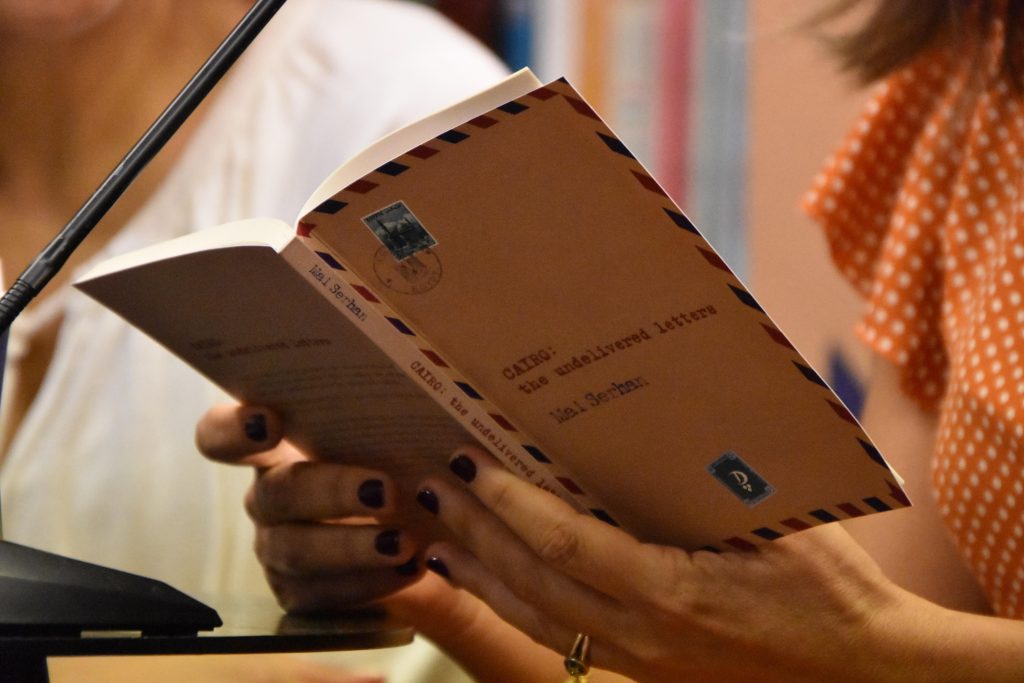
To purchase the Cairo: the undelivered letters from the publisher Diwan or Amazon or Bookshop
Photos and video courtesy of Mai Serhan