



One of the perks of working the day shift – besides not having to get up at four in the morning or work until midnight – is that I have my own cubicle. I even have a key to my desk which means I can lock my headset in the drawer and not worry about some kid coming by and stealing it.
Headset theft is a big problem here. When I worked in the pit, I took my headset home; Missy had always warned me about germs. Otherwise, I would have been forced to use one with lipstick all over the mouthpiece or hair grease on the earphones. Twice, I rubbed someone else’s earwax on the side of my face. After that second time, I went to the snack bar to buy my own pair. Along with nachos, burritos, and Cokes, the company snack bar sold two different types of headsets and extra foam cushions for the ear pieces.
I bought the more expensive one for twenty dollars. That was over two hours’ worth of earnings if I adjusted my wages for income tax and social security. They’re actually no different than the cheap ones, but I spent twenty bucks, so, like every other afternoon, I lock them in the drawer and check the time. The clocks on everyone’s computers are synchronized and clock us out automatically unless we’re on a call, but most people know how to be off the phone when quitting time comes around. The thirty employees who work the day shift all migrate out to the parking lot.
“Take your time, William,” Douglas says. He is sitting in the truck with the windows down.
“Tell Chris to let me clock out early. Tell him we have to pick up Gracie before six-thirty.”
Douglas starts the truck and acts like he’s pondering the question. This was a look he perfected when Missy was alive. She would get mad when she felt like he wasn’t thinking about whatever question she had asked, so he developed this pondering look. I’ve seen his mouth move a few times in the midst of his brooding and I’m pretty sure he’s just singing the chorus of Hall and Oates’ “Private Eyes”.
“Can’t do it,” Douglas says as I buckle my seat belt. “Chris isn’t on my team and I can’t step out of my zone. You know how things work. And don’t call her Gracie. Your sister hates that.”
National Wireless loves structure. The call center has six teams, each with a team leader, two assistants, and ten representatives. Douglas is an assistant. Chris is my team leader. I’m a representative. – Though I usually do whenever anyone will listen. I’m not complaining, though, since I was able to make one of the three-day crews. If I had stayed working four to midnight or six am to two, I’d probably be a crew leader already. But not for me. And I’m okay with that.
We drive back to Gatesville in silence. Douglas says he can’t hear me with the windows down so there is no reason to talk. The air conditioner doesn’t work so he won’t roll the windows up. He says he doesn’t like to drive home in a sauna. Really this is all an excuse since it’s not like we talk once we get home. We eat dinner in front of the television then go to separate corners of the house for the rest of the evening. The only time we speak is when we argue about who was the last to change Gracie’s diaper. Missy would be furious at us if she saw how we were living.
One of the only reasons Douglas helped me get a job at National Wireless was so Gracie would never have to be in daycare. At first, Missy led me to believe that Douglas helped me out of the kindness of his own heart. I was going through a rough patch, still living with our parents, unemployed, and having a hard time getting myself out of bed every morning. Douglas, in a rare moment of altruism, came through and got me a job. Or this is what I was led to believe. Turns out, Missy wanted me to move down to Gatesville and work for National Wireless so I could help with Gracie. It also turns out that getting hired at National Wireless is about as difficult as falling off a bike that isn’t moving. Half the people that work there are related because some cousin or brother or aunt recommended them. Really the only way I wouldn’t have been hired at National is if Douglas actively campaigned against me. So really, the only helpful thing he ever did was keep his mouth shut.
Douglas is right, though. Missy hated when people said Gracie instead of Grace. Missy always said that the first thing she was attracted to was Douglas’s name. Which is totally weird, but that’s just how Missy rolled. She liked that he didn’t go by Doug and soon after they started dating, Missy refused to call me anything but William even though I had gone by Will since the day I was born. This was all because she hated that her own name sounded like an abbreviation. She said she would be forever a child because of her name and blamed several missed job opportunities on that fact. I think it may have been her confrontational interview style. Her strategy was to turn the interview around on the employer. I never saw how that would work.
Douglas pulls up in front of the babysitter’s house. I immediately climb out of the truck but Douglas goes ahead and tells me to get Grace. He ignores my go-to-hell look. The one I give him every day because this is all routine now. Douglas feels that being the brother-in-law means being the authority figure. He’s three years younger than Missy which makes him younger than me by two months. Even so, Douglas acts like the older brother. Actually, he acts like he’s a middle aged man and once tried to call me son but almost got punched in the jaw and never tried that again. Douglas won’t ever admit it, but his incompetence was the reason Missy asked me to move. She admitted this to us once in a rare moment of honesty but Douglas has no recollection of that incident. I feel sorry for the guy and try to be understanding, but it’s moments like this when I’m getting out of the car yet he still tells me I need to get out of the car that I realize: Missy was right.
“Five more minutes and you would be paying an extra ten dollars, William,” Mrs. Potts says, handing Gracie to me like she’s a wet dog. “I don’t like being mean about these things. Especially with you boys’ situation. But I have to have rules, you know.”
“Thanks, Mrs. Pots.”
“Otherwise, no one would pick up their kids till they left the bar.”
“I know, Mrs. Pots. Sorry.”
I take my time walking back to the truck. Mrs. Pots is still talking even though I can’t hear what she’s saying. I’m hoping she’ll get tired of talking to my back and go inside the house. I don’t want her to know there’s no car seat for Gracie. We have one – we’re not that incompetent – it’s just not in the truck. There’s only two seats so I would have to ride in the back if we used the car seat. And I realize how ridiculous it is that Douglas is always driving my truck, the only vehicle we have between the two of us, but he kept stealing my keys and it was always a fight about who drove so I just gave up. Gracie’s safety should be our main concern; instead, we let our pissing contests get in the way. The thing is, the seat really isn’t that much of a problem; besides going to and from the babysitter’s house, we don’t take Gracie out much. We should. I know it’s kind of sad that we make her stay home. We go to the grocery store individually and Douglas doesn’t go to church anymore. Besides those two outings and work, we don’t have much of a reason to leave the house either. And when I think about that too much, I start to wonder why I moved out here to begin with.
We drive in silence. Douglas pulls into the driveway too quickly, we all get jostled in our seats, and I find out Gracie needs a diaper change.
“Dude, I’ve told you to take it easy pulling into the driveway.” “It’s a truck, William. It can handle a few bumps.”
I pull Gracie up out of my lap to show Douglas it’s not the car I am worried about.
Douglas makes a gagging sound as he looks at the wet spot on my jeans. Mrs. Potts has a rule that she does not change diapers ten minutes before parents are supposed to arrive. It seems like a pretty strict rule and feels like maybe it should be illegal, but Mrs. Potts is the only home daycare in town. And by home, I mean unlicensed and by unlicensed, I mean cheap.
Douglas is bent over beside the truck, dry heaving dramatically. “You’re faking that.”
“No, I’m not,” Douglas says, finally standing up. “Seeing someone get peed on is gross.”
“She’s a baby, Doug. And you’ve changed more diapers than you can count. You’re saying you still can’t handle it?”
“But seeing that on clothes. Clothes that aren’t on her,” Douglas says.
He trails off so it sounds like he’s making a point when really he’s being ridiculous and he knows it. He’s making sure I change the first diaper of the evening because whoever goes first usually ends up changing more diapers.
I take Gracie into the house and change her. I tickle her belly as she lies on the table in her room. I wonder how all the fighting affects her. She kind of giggles as I tickle her, but not the way I think a baby should. Not the way she would giggle when Missy tickled her. I didn’t read all the parenting books Missy gave me, so I’m no expert and really couldn’t say one way or another. I am pretty sure we’ve done stuff that has already scarred her for life. But who isn’t scarred by the people who raise them? We go to my room so I can change pants. The house is pretty small, but it does have three bedrooms. Our parents kept telling Missy that she and Douglas didn’t need to buy a house, let alone one with three rooms. I’m now grateful Missy ignored that piece of parental advice. If Missy and Doug had bought a two-bedroom, I would be sleeping on the couch. If they had rented something, well, I would still probably be on the couch. Having a bedroom to myself is the only way I stay sane living with Doug.
Owning a house was part of Missy’s ten-year plan. That was the sole reason she and Douglas bought this one in particular. Not because they had the money. Not because they loved the house. Just because it was on a list she had made when she and Douglas were dating. After being married for three years, Missy and Douglas would buy a house, Missy would be a sales director for Mary Kay, and Douglas would be a team leader at National Wireless. This was all written out, planned even before the two of them were engaged. When the third year of their marriage did come around Missy had to accomplish at least one of her three goals no matter the cost. After five years, Missy and Douglas were supposed to have their first child. Instead, Gracie came at three years and ten months. That’s when I got the call asking me to move down.
“You can’t live with Mom and Dad forever and National Wireless has much more upward mobility within the company than Subway,” Missy said.
“I don’t work at Subway,” I told her.
“Exactly my point. You have no upward mobility there.”
She was a good salesperson. That was probably the reason she did so well selling Mary Kay, even if she wasn’t able to move beyond consultant or get her first suit. I packed my stuff then felt sad that my entire life didn’t fill the bed of my truck. Not even halfway. I drove the five hours to Gatesville and moved into the upstairs apartment Missy had found for me two blocks from her house. After a week, I realized I wasn’t in Gatesville for the opportunity to work at National Wireless. Since I was on the four to midnight crew, Missy had me over at the house everyday painting, baby-proofing, and consulting on colors.
“Isn’t this all stuff Douglas should be doing?” I asked one day.
“Yes, but Douglas needs to put in more hours so he can become a team leader. That was supposed to happen six months ago. But, he’s a bit incompetent.”
Missy smiled and shrugged her shoulders like she hadn’t said something terribly mean about her husband who wasn’t there to defend himself. But that was her way. She could be scathing and cruel but felt as long as she smiled everyone should love her.
I watch Gracie play with her toes before deciding to change clothes completely since I’ll be going to church later. It’s Wednesday which means people will probably get coffee or ice cream afterward and that’s about the only socializing I get to do outside the National Wireless cafeteria. I pick up my niece and walk into the living room. Douglas is standing in front of the TV looking at the floor.
“I think the remote is in the couch somewhere.” “What is this?” Douglas asks, pointing.
I put Gracie in her playpen before walking over to look at the floor. There is a dried, white splatter about an inch in diameter directly under the TV.
“Oh, I was able to get squiggle vision skin-a-max last night.”
I try to say this with a straight face and monotone voice. Douglas’s face gets red immediately and I want to put my hand up to feel the heat coming off his bald head. Douglas is a prude and hates any mention of masturbation. I’m not that guy who makes a lot of dirty jokes and brags about his personal habits. But we’ve both interrupted one another in the bathroom several times so I feel like we should finally admit we both do it. Will put a lock on the bathroom door and I was grateful.
“There is a baby in the house,” Douglas says. This is another one of his arguments that really has no point. It’s a statement he makes fairly often and thinks it should automatically change my behavior. Gracie will be asleep and I’ll be watching some news program about a girl who murdered five boyfriends. Douglas will come in, change the channel to some rodeo, and say there’s a baby in the house.
“Relax, dude. I spilt yoghurt as I was turning off the TV this morning.”
“Why didn’t you clean it up?” Douglas asks, no longer red and angry over masturbation but exasperated that I didn’t clean something right away.
I don’t argue with Doug. There’s no point to it. He was already walking out to the car when I spilled the yogurt and would have been upset if I made him wait. Either way, he gets mad and I get yelled at. I go to the kitchen for the mop. If I make Douglas too mad I won’t be able to leave the house. Douglas will hide the car keys or disappear so I’m left with Gracie or do one of his many other tricks to not take care of his daughter. I really wish I had the determination to just leave, to not care if Doug was in the house or not. Just leave Gracie in her playpen and go to church and make him deal with the consequences. But I could never do that to Gracie. As I get the mop wet in the kitchen sink I hear Douglas moving the TV.
“I figured you could mop behind here while you were at it?” he says as I come into the living room.
This is Douglas’s favorite game. He waits until I have a broom or mop or rag in my hand then starts moving around furniture to give me more work. Afterward, Douglas will refer to the whole ordeal as if the cleaning was a group effort. Beating him at his own game isn’t too difficult though. All I have to do is mop faster than Douglas can move furniture.
I start on the dried yogurt since that was the mess I intended to clean up in the first place. I didn’t think it would have stuck that much in only nine hours, but I really have to put my back into it to get the floor clean. I’m giving Douglas a head start which is not a good way to win this fight. As I mop over the area where the TV stood a few minutes before, the mop starts to pick up dirt and bugs and peppermint wrappers. Missy would have been furious. She always lectured about how the sweeping needed to be done first. After all the dirt was picked up, the mopping could start. Even when I was living in my own apartment, Missy gave me these lectures. She and Gracie stopped by unexpectedly one day. As soon as I opened the door, I could tell how messy my apartment was. I never had visitors so I never paid attention to my own cleanliness. Or lack thereof. So when Missy walked in, I grabbed a rag and started swiping at the counter.
“Child, what do you think you are doing?” Missy asked. “You never wipe down the counter first. You do it after you sweep off all the crumbs. Look, you’re leaving mud streaks.”
Missy handed Gracie to me. She took the rag away and showed me proper cleaning techniques. I thought she was going to stop after wiping off the counters and cleaning my sink, but she methodically went through my little apartment and cleaned the whole place as I followed her around holding Gracie. I didn’t mind how long she took. I loved carrying Gracie. Missy talked about her Mary Kay business and asked me about National Wireless, acting like her working as my maid while I bounced her child on my knee was completely normal.
“Now you know how to clean your house properly,” she said. “This is good. Your wife won’t have to train you once you get married.”
Douglas leaves the living room, but not before moving Gracie’s playpen, the end table, and the rocking chair into the middle of the floor. The couch is the only piece of furniture that hasn’t been displaced. I’m pretty sure I can finish mopping behind the furniture, put up the mop, and do my own disappearing act before Douglas shows back up. He comes back much more quickly than I expect. He’s carrying a bucket of soapy water, sets it on the floor, and moves the TV back into place.
“We’re just making a mess like this.” “Then go get the broom.”
Douglas knows how to clean for the same reason I know. But the most frustrating part about this game is that instead of playing with his daughter or fixing her dinner, Douglas would rather create more work for me to do. Work that Douglas is perfectly capable of doing himself and could be done while I’m at church if he needs an excuse to not hold Gracie. I take a few more swipes at the floor but can’t stand the little stripes of mud the mop is leaving behind. I go to the kitchen and get the broom and dustpan.
I’m losing this game and it’s starting to make me mad. Douglas moves Gracie and the playpen into the hallway to make more space in the living room. Usually, he waits until I have finished behind the rocking chair and the end table before he tries to move the couch, but he knows I’m trying to beat him and he is starting to move more quickly, so I ask him to hold the dustpan.
“You can hold it fine yourself.”
“You know it’s easier to pick up all the dirt if two people do this. That’s what Missy told us.”
This is my trump card. I don’t like playing it and it always hurts a little when I do. But Douglas won’t do anything I suggest, he never lifts a finger to help or listens to my suggestions unless I mention Missy. Douglas drops the chair while it’s still a couple of inches off the ground. The thump scares Gracie.
“You made my daughter cry,” Douglas says under his breath as he holds the dust pan. I hand over the broom once Douglas stands up.
“You’ll have to sweep behind the couch,” he says.
“Set it over in the corner, Doug. And go get Gracie, she’s scared.”
Douglas follows my instructions, still under the spell invoked by Missy’s name. He goes into the hall to pick up Gracie. He doesn’t seem to be moving as quickly as a concerned father should. I go back to mopping. The whole house is covered in linoleum, a terrible decision by one of the previous owners. The little bumps and crevices hold dirt like Gracie holds her pacifier. The back of my arms are burning with the amount of pressure I’m using on the mop. I know pressing down so hard isn’t making the mopping any easier but it is keeping me from yelling at Douglas.
“Don’t call me Doug. My name is Douglas and my daughter is Grace, not Gracie.”
I bite my tongue and mop harder. Douglas is trying to move the furniture while bouncing Gracie in his arms. It’s not working well at all and seems a little dangerous.
“I’m done over here.”
While Douglas is busy with Gracie, I decide to go the extra mile. I won’t stop cleaning and Douglas won’t be able to complain. I’ll go to church, though I’ll be late, and maybe this time I’ll have the courage to sit next to the cute army girl with red hair who lives at Fort Hood. I set down the end table and turn to see Douglas trying to move the couch away from the wall. The thing is a behemoth. It’s a sleeper that our parents bought years ago when I grew out of my crib. The only way they could afford a bed for me was to sell my crib and the living room furniture then buy the couch with a fold out. I slept on it for eight years.
Douglas lays Gracie on the couch, on her back, so he can free his hands. I look at him stunned at first. I’m convinced that I don’t actually understand what I’m looking at. That Douglas has some other intention and is not stupid enough to try to move the couch his baby is laying on. But Douglas pushes the couch away from the wall with a jerk. Gracie first rolls towards the edge then, when Douglas’s burst of strength lets out making the couch stop abruptly, she rolls back, her face smashing into the back cushions. Douglas doesn’t move. I rush over to the couch and pick up Gracie. She sucks in air as I lift her and starts to wail. Her face was stuck between the cushions and, for a moment, she wasn’t able to breathe. Her nose is bleeding. I walk past Douglas and into the kitchen. I rock Gracie and wet a paper towel so I can blot her nose. I realize that I have no idea what I’m doing. This is what I would do if I had a bloody nose but I’m an adult. Am I actually doing the right thing? This is Gracie’s first real accident since I moved in and I’m terrified of doing the wrong thing, making it worse, causing Gracie more pain. Douglas is still moving the couch around in the living room.
Gracie’s nose won’t stop bleeding. She is still crying. I sing. I sway. But I’m not a parent and those are my only two tricks. The only tune I can think of is a silly song about cats hunting a mouse that my grandmother used to sing. Missy made me learn lullabies before Gracie was born but none of them come to my mind. Every once in a while she gasps for air like she still can’t breathe. Babies are fragile. I wonder if there could have been damage to her nose, damage that is making it hard for her to take a deep breath. There’s no longer noise coming from the living room, I turn to find Douglas standing behind me.
“She’s fine. Go finish sweeping,” Douglas says, trying to take Gracie away.
“She’s not fine. I’m going to take her to the emergency room.”
For a moment, I think Douglas will protest. Douglas complains about every medical expense he has ever had to pay for. He still brings up the emergency room trip he made his first week in college more than ten years ago. I sometimes suspect Douglas is secretly thankful that Missy died in the car crash, relieved that she didn’t hang on for a days or even a couple of hours. While most spouses would want to say some final words to their partners, I’m convinced Douglas preferred the fact that he never had to pay a hospital bill.
I carry Gracie into her room to get the car seat.
“What do you need that for?” Douglas asks when I come out with Gracie strapped in her seat. Douglas has moved from the kitchen and is standing by the front door. “I’ll hold her in my lap.”
“You’re not going,” I say.
Douglas doesn’t move away from the door. We stood in a very similar position the night Missy died. Only in reverse. I was working the four to midnight shift. When I got off work I had a text from Douglas telling me to come straight to the house. I knew something was wrong since Missy and Douglas were always in bed long before I clocked out. I figured the water heater had burst or Douglas had knocked the sliding door off its track again and Missy couldn’t sleep until the floor was clean or the door was back on and securely locked. I walked into the house to find all the lights on and Douglas standing in the hallway with Gracie in her car seat.
“Take me to the morgue,” Douglas said. “Missy’s been in a wreck.”
That’s how I found out my sister died. I recommended we go to the hospital instead of the morgue. I was trying to find some amount of hope, some possibility that Douglas was wrong. Douglas explained that he needed to identify the body, not pick her up from anywhere, not see her lying in a hospital bed. He needed to walk in and say, yes, this is my wife and leave. I wouldn’t move away from the front of the door, so Douglas kept talking. He explained that he was supposed to pick up a prescription for Gracie. Missy usually took him to work and picked him up in the afternoons. But he wanted to take off early and go play golf with a buddy from high school. Missy agreed as long as he picked up the prescription. He forgot. She spent an hour calling pharmacies, finally found one in Copperas Cove, over forty miles away, that was still open. A tire blew on her way back. Her car rolled into a ditch. The next of kin needed to go fill out paperwork and look at the body, but I was still standing in front of the door, blocking Douglas’s way. He was yelling by the time he got to the end.
“You go,” I said. “I’ll stay here with Gracie.” “I can’t drive. I can’t go alone.”
I ended up going to the morgue by myself that night. I identified my sister’s body. I called my parents. I called Douglas’s parents. I left a message for the insurance guy. Several hours later, I went back to the house to find Gracie asleep in her car seat and Douglas watching TV. All the lights were on in the house. I put Gracie in her crib and slept in Missy’s Mary Kay room. I never spent the night in my apartment again. I just moved all of my stuff to the house over the next few months.
“You’re not going,” I repeat.
Douglas is still standing in front of the door. He doesn’t seem like he is trying to stop me but I don’t know if he’ll try to push me if I move. Gracie is getting heavy in her car seat. I move her to my left arm. She is crying. Her nose hasn’t stopped bleeding. She still gasps for air, but that might be due to the crying. Douglas looks at the floor for a few moments, shrugs his shoulders several times, acts like he is about to speak, then moves out of the way.
I have a hard time getting the car seat secured. I haven’t put it in the truck for several months, and I’ve forgotten how it works exactly. Between Gracie’s screaming and the sun going down, I fumble with the seat belt. I hear Douglas come running out to the car and think about turning around and punching him in the mouth. I lock Gracie in, wipe her nose, and shut the door. I walk over to the driver’s side without turning around or looking at Douglas. After I start the car, Douglas puts his hands on the door and sticks his head in the open window. He squeezes Gracie’s foot in the only tender moment I’ve seen him have all night. He gently wipes her nose with his hand and wipes the blood on his shirt.
“I’m not incompetent,” Douglas says.
I nod and turn on the headlights. Douglas doesn’t take his head out of the window. I look forward, refusing to look at my brother-in-law or offer any reassuring words.
“You should finish cleaning while we’re gone.”
Douglas nods and steps away from the truck. He stands for a moment then walks back into the house. I sit in the truck and watch my brother-in-law move through rooms. He turns off the lights in the kitchen, the hallway, Gracie’s bedroom. He comes back into view, picks up the broom and moves over to the couch. Before he starts sweeping, Douglas walks over to the front door, looks back at Gracie and me in the truck, then shuts himself inside. The truck’s engine starts to lurch since it’s been running idle for too long. Gracie has fallen asleep in her car seat, her nose is still bleeding. I know our first stop will be the hospital, but I’m not sure where to go after that. Mom and Dad are five hours away. Oklahoma is six. Matamoros is seven. As I start to drive all I know is that I have never seen Grace look so peaceful since the night her mother died.
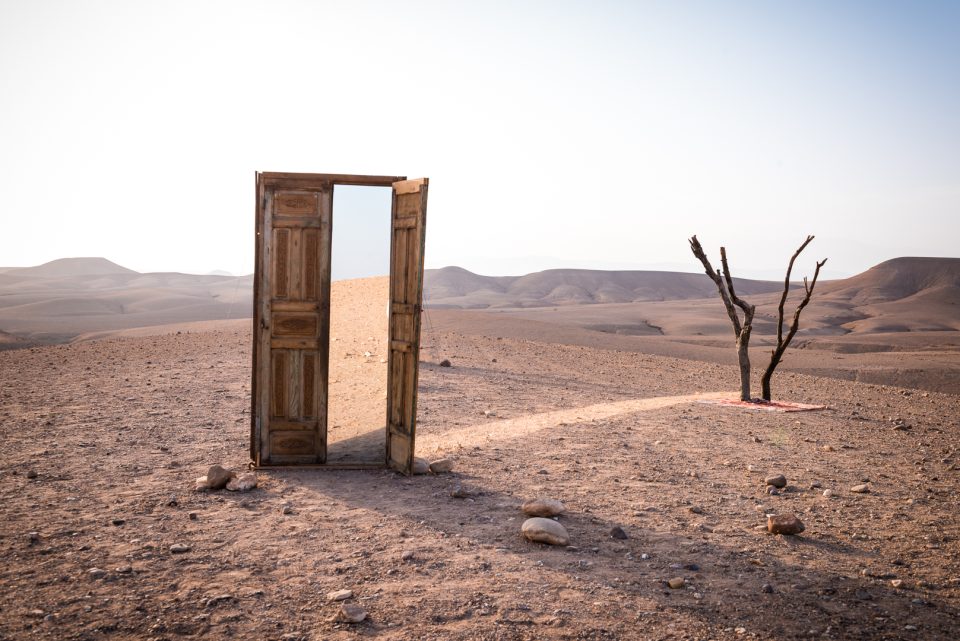
Shirin Abedinirad, House in the Wind, 2017. Land art, Marrakesh, Morocco. Created in collaboration with Nikon and BMW Mini, the work imagines the desert as an open studio where, in the artist’s words, “the ceiling is the sky, the walls are horizons, and the door is open to everyone in the world.” Bringing mirrors, wind, clouds, and sand into conversation, the installation becomes a meditation on nature as collaborator, refuge, and boundless space of belonging. Artwork courtesy of featured artist Shirin Abedinirad.