


The nightingale warbled in the trees. In October, the ancient eucalyptus trees were evergreen and ribbons of bark curled in garden patches. My grandfather was sleeping in the bedroom directly above the garden when he was wakened by a humming. It was the first night in the one-story, five-bedroom house in Manshiyat Al-Bakry that would become our family home. Below the balcony a young soldier crooned. My grandfather opened the window onto the garden where Arabian jasmine would flower, fruit ripen, mango, mulberry, and sycamore trees grow, hoopoes waddle, and pigeons coo. The story swirls from a room, an open window, in a bundle of my father’s interviews.
Faraway, the sea gleams year-long. Lotus-flowers grow in the white-washed dome-shaped house, and fuchsia bougainvillea climbs down windows with ornate bars and spills onto the white tiles. The scent of sea is year-round. Daybreak is a blaze of soft lilac and tangerine above the sea. For two long years, I pine for home in a country I’ve grown to love, besotted by the beauty of blue-painted, arched doors and palm-tree oases.
In our sunlit living room in Tunisia my father felt at ease and was joyful in November, the lotus-flowers steady and upright in the garden.
My father was in Tunisia for a short spell. He strolled into Dar Zarrouk’s courtyard in Sidi Bou Said around white domes and ornate, blue-painted doors with Hand-of-Fatima-shaped knockers. My father didn’t haggle over the tiny bouquets of jasmine, the machmoum, he bought from the flower sellers for my mother, my daughter, and me. Young men wore the machmoum, fastened to an ear, sipped mint tea, and played backgammon in cafés. We ambled through the alleys of Sidi Bou Said in mid-afternoon. In Tunisia I crossed into green country; we luxuriated in nature. There was a purity, a simplicity, an abundance. Rain and the sweetness of the fruit. I was overtaken by beauty: cafés on a promontory over the sea, the seashore in La Marsa, the winding alleys around the mosque in Kairouan, the dome-shaped troglodyte caves like a honeycomb in Matmata and Tataouine. Benedictions peppered Tunisian Arabic: “Yerham waldik” – God bless your father and mother—and “Ya ‘ayshak”—God keep you! Sidi Bou Said was lined with shops and ceramics displayed on tables at the storefronts: hand-painted blue-and-white earthenware, Hands of Fatima, Tunisian tiles, kaftans, kilims, Berber silver anklets. Fish-shaped bowls for fertility and the Hand of Fatima to ward off the evil eye. It was a famous art colony with shops, ateliers, and teahouses. He’d wanted to treat my mother to kaftans from the covered Turkish souk and had sat patiently in a café in Avenue Bourguiba.
Afterward, at Dar Zarrouk, we ate fish and harissa and nibbled on flavorful bulbs of fennel drenched in olive oil.
“What is this?” he had asked about the platter on the table.
“Bisbaas,” the waiter chirped.
“Fennel,” I said.
“What’s the Arabic word?” he asked.
“Shamar,” I said.
“Bisbaas” became a magic word for sweet, fennel-flavored afternoons.
The air was fragrant with jasmine and the sea breeze. I wished I could take him to Sidi Chabaane, a terraced café perched on a cliff over the Gulf of Tunis in Sidi Bou Said, for steaming hot mint tea with “bunduq” or pine nuts in the tiniest hourglass-shaped cups, but the cobbled climb would have been too steep. Or Dar El Jeld, the sumptuous traditional house in the medina with the lovely white and blue tiles, for Tunisian brik à l’œuf and chorba frik.
At home, in the hum of the late afternoon—it was no longer the hour of the séance unique, the siesta, in the humid summer months—he looked out at the garden.
A story steeped in afternoon like tea leaves in a glass cup. Bourguiba was home in his villa by the sea in Monastir. They brought him newspapers and he thought he was president. There had been a coup, but Bourguiba didn’t know.
At a seafood restaurant in La Goulette, my father stood patiently with Ahmed in a long queue, his jacket folded on his arm. He just wanted to have simple, fresh fish. They rolled up their sleeves and dug into platters of sea bream, clams, squid, and red mullet.
By the sea in Gammarth, he sampled sardines, the smallest red mullet, and fresh sole. He chuckled and nimbly peeled the sole meunière.
He sat in courtyard cafés in the sun, sipped sweetened mint tea with pine nuts, bought me miniature jasmine bouquets from the machmoum sellers, and was happy. He was almost the picture of health.
Later on, when he was back home, he called every day. “I know,” he said, “about homesickness.” Anywhere. His words traveled gently along the wires, an incantation, well-wishes swirled in an ornate calligraphy, worn around one’s neck to protect from misfortune. They flew to me like swallows, an allotment of blessings, and became an amulet against the long-distance worry for his health.
In Tamerza waterfalls sprouted from a deep gorge. The jeep had rolled into the mountain oasis in southern Tunisia on the eve of November 7, the anniversary of the 1987 coup. Dusk had fallen and flags flapped red in the desert breeze. The old abandoned village of Tamerza had been shrouded in a blanket of ink-black.
Near the waterfalls were makeshift stalls with colorful ceramics, and kaftans, kilims, and cloth were hung. Waterfalls tumbled from the mountain into natural pools.
In Touzeur, a desert oasis of slender palm trees laden with bunches of ripe dates, horse-drawn carts clopped along. In the autumnal oasis the soft golden Deglet Nour dates were bursting with sweetness.
The jeep crawled along the desert. A woman ran alongside the car, waving a loaf of sand-baked bread. Her skin was sunbaked into the color of dates. The car stopped and we clambered out onto the sand dunes. And there was a young Bedouin girl with two braids and a desert fox curled up in her arms. The fox had pointed bat-like ears and wore a collar with a chain clasped to a rope wound round her slender wrist. It looked drowsy. Its legs and a long bushy tail dangled from her arm. In her other hand was a piece of nibbled sand-baked bread. My daughter stood beside her. Her mother tore a hunk of “ash bread,” the “bread of the embers,” of the desert in Bedouin hospitality. The bread was baked in sand and ash, an ancient custom of the desert tribes. The dough was kneaded and flattened, covered with the sand and embers, the bread baked, and the sand brushed off. We smiled and nibbled at the crust of a half-crescent of the warm, freshly baked bread.
We traveled deeper into the Sahara. In Douz, I leaned against two shy camels, Mabrouk and Mobarak, one mottled white and the other speckled brown—a pair of Eid wishes that made me chuckle.
When I woke, my feet tapped the “Thousand and One Nights” rug spread on the stone floor beside the bed. Women spun yarns in the carpets. The weavers, the women, were the tribal and ancestral storybearers. A rug took years to make, woven from patches of yarn: geometric patterns, Berber symbols, a bird, a tree, a flower. The weavers spun wild threads of a secret story. Flowers and birds, pale-blue and pomegranate-pink, were drawn from memory or woven by happenstance. They wrote with spools and looms, wove row by row, blue, pink, and milk-white threads into a yarn.
Our room opened into the old village, a palm-studded labyrinth of sand-hued houses like boxes. From the little alcove in our room, I peered at the date palms and abandoned village of Tamerza. A bowl of juicy succulent dates, pomegranates, and tangerines on the table. Palm fronds were abundant in the empty rooms and courtyards of the village, the foliage green in the desert. In the late afternoon, the sunbaked ruins of Tamerza’s mountain oasis-village burst into rose-colored stone. The palm grove glowed in the pink rooms. I was used to absence and the vacantness of rooms that had been lived in.
In Tunis I ask my father about my grandfather. I’ve been invited to draw an intimate portrait of my grandfather whom I never knew, who died before I was born, and I enlist his help. But what could I ask that isn’t trite or prying? I tread and ask him simply. He has bundles of interviews I will collect when I am back home in Cairo and comb through in Tunisia. All I need is in the interviews, his warm voice seems so distant on the line.
His story is like darkened rooms I go into blindly. I rummage through them: my grandfather awaken from sleep on the night he moved to our family home Manshiyat Al-Bakry by a soldier’s humming below his balcony; my grandfather opening his window and looking out into the darkened garden; my father’s favorite swing in the garden of guavas; my grandfather plucking purslane around his army camp in Faluja; family meals; my father at his father’s funeral in an island on the Nile, a funeral among the largest in history, where millions of mourners flowed on Qasr El Nil Bridge, so that in photographs, there were two rivers.
In October, the garden of palm fronds and trees trembled green.
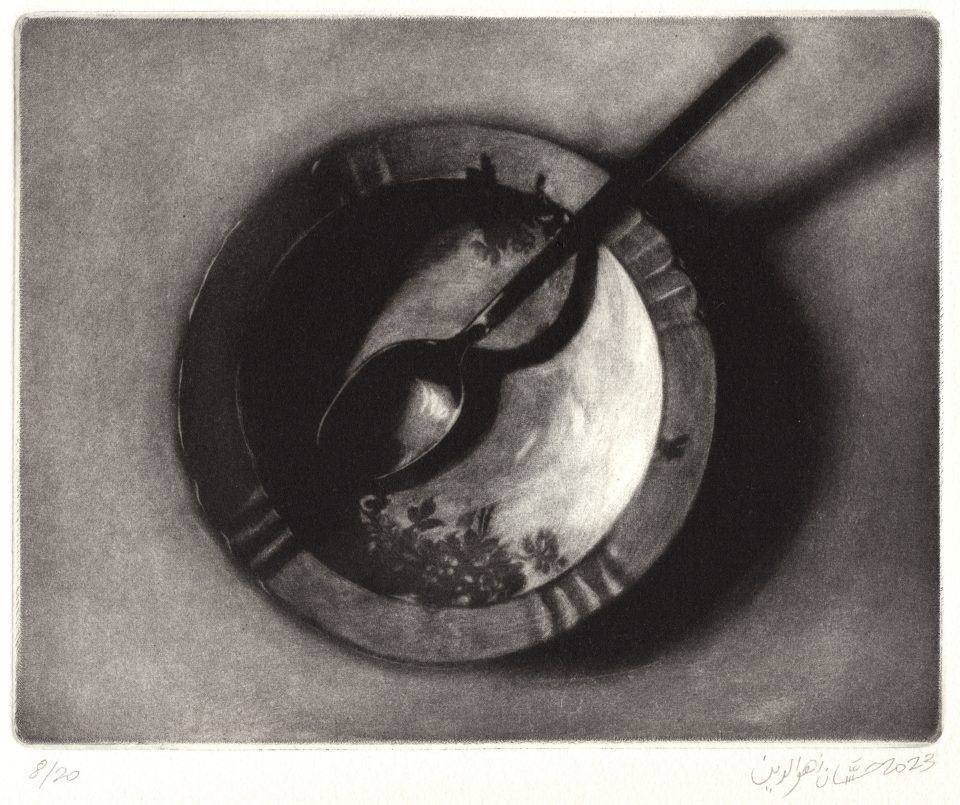
Artwork courtesy of Youssef ElNahas