

Don’t lose the dive line, don’t lose the dive line.
He repeats this incantation in his head at every major freediving championship, and today is no exception. Will he finally beat the Russian this time?
Don’t lose the dive line, don’t lose the dive line, don’t lose the dive line. Of course, he can’t—a lanyard tethers him to the white dive line, though accidents have happened. He repeats other invocations, too, drawn from prayers, affirmations, and holy verses that have resonated with him throughout the years. Like a secret poem or a well-rehearsed song, the words punctuate his descent—a sonic guide.
He inhales and exhales seven times before plunging, before breaking the surface. Seven breaths during which he ritually circles the Kaaba, surveys the heavens, visits the planets. Seven breaths linking him to those who have similarly braved the sea’s turbulence. He tips into his Mediterranean Sea.
He’s determined to meet his fate. This might be the most important competition yet. His guided meditation also helps him keep time, a fundamental metric when the body fights for its own survival, each word pushing him deeper into a measured trance. Winning, returning to the surface alive, escaping the human realm—he chases all these things now. This dive will only last minutes, momentous minutes.
He’s descending. He passes a depth equal to the height of the Great Sphinx of Giza, an island of pharaonic glory amid Cairo’s sprawling urban chaos that broadly resists external assaults. He visualises the limestone statue he’d marvelled at just days before joining the competition off Egypt’s waters—its disfigured nose, its leonine paws—resting firmly in the sands further inland.
His ears pop—a delicious burst. The volume of air in his mask and ears has already reduced by around fifty per cent. With his usual focus, he moves into a world of marine wonders and hazards. He breaks the first threshold; he’s in. Stepping across that doorway starts with the acoustics. Always.
His father, a fisherman in Kiliana, discovered his special abilities when he was eight years old. Aboard the family flouka, dawn’s persimmon light glistened across his father’s wrinkled face. Fishing equipment jingled in the boat. Picking up a spear, he jumped into the sea, into this boundless bath of gems. His small body vanished under water, melting into serenity amid dying coral reefs, groupers, basses, and breams. He examined their colours, their shapes and this—this attentiveness—prevented him from hearing the screams of the one above who called his name. He resurfaced empty-handed, but something else had triggered his father’s wrath.
“I thought you drowned,” his father said, eyes bulging out like a dead fish.
“I was out for a few seconds only,” he replied, ashamed of his empty loot.
“No, son. You went down for several minutes. Mashallah.” His father’s ageing teeth peeked beneath a wide smile. Ever since, diving has occupied a larger place in his life: he has elevated it as a purpose, a path.
News of his spearfishing exploit travelled across Kiliana in hushed tones and exclamations. The village fishermen solicited his spear and developing lungs. They asked if he ever found pearls down there, as they do in the Arabian Sea. But he cared little about Kiliana’s noisy fish market and to blend into its scene, lifting a daily load from the beach, performing the same steps as others. No. He wanted something different from what his father had; he wanted to dissolve in the water’s cradle, like an effervescent Vitamin C tablet in a glass.
“You will become the greatest Arab freediver in history, un phénomène,” prophesized the fifty-something former professional swimmer who worked at a municipal pool in the bigger town; he’d assessed his performance of completing several underwater laps in one go.
From that day on, he traded fishing duties for a regimen of diet and training exercises. At the neighbourhood café, his friend Hedi mocked his dedication. “Are you going to reach Lampedusa Island in one breath ya hout?”
“That would be a long breath,” he replied, eyeing the cigarette butts collecting in Hedi’s ashtrays. “Don’t jinx me with the evil eye.”
Now, almost two decades after that morning with his father, his legs plough through the water, spinning downward like seed pods falling off from their linden mother-tree. His fins draw their own helix. He coils; he drills. His fins propel him lower into the sea as he bends his body to gather more force.
Today’s weather conditions—suboptimal—do not align with his intention of setting a new personal record. His lungs tighten; his limbs lighten. Above, in a sky he can no longer see, faint, moody clouds have formed. An uninitiated eye usually misses such a subtle atmospheric change. Not him. He recognises their discreet patterns, their pace, their ripples, when patches of white shift to a more decisive overcast. What unfolds up in the sky, he senses down here, in the water.
Doubtful parts of him dissipate under a jealous, domineering call: his heart, pumping in his chest. He paddles his fins in a regular motion—intently, routinely. His body grows into a divine mechanical object, an automaton animated by God and succoured by angels. All past championships have led to this moment, this possibility of breaking another number, another barrier. This possibility of becoming someone here, home in his sea.
Thirty meters now and it feels like accessing a holy site’s outer perimeter—a Haram guarding an obscured shrine. He penetrates a different tier, one reserved for those who crave more than leisurely adventures, for divers who want to settle questions that trouble their sleep. For those like him and the Russian. He tests such limits constantly.
He has reached neutral buoyancy, the exhilarating stage in which he neither floats nor sinks. He’s a sea astronaut. He finally stops paddling. He enjoys the pull that assails him now that his lung compression drags him down without assistance. He surrenders to freefall.
Beyond thirty meters, he is in the familiar world of The Big Blue, the 1988 French blockbuster about two freedivers that his coach made him watch after training one evening. In the film, Enzo and Jacques’s friendship etiolates, replaced with rivalry.
“Don’t get too close to other athletes,” his coach insisted, wary of the emerging Russian prodigy. The coach warned against another Enzo-Jacques entanglement. “I will beat him, inshallah,” he said, nodding furiously to settle the matter. That night, he dreamed of riding a dolphin to Lampedusa. But despite this dream, he still hasn’t defeated the Russian after all these years. Instead, he has spent many nights grinding his teeth, tossing and turning. Could this calling of his be reduced to a two-man race like in The Big Blue?
He’s been training in this austere and prestigious sport for years, and yet, the Constant Weight World Record still evades him. The Russian prodigy currently holds the highly coveted title, crowning a dive without weights supporting one’s descent. The diver must use their own body mass, breath-hold, and fins to reach the desired depth, as he is doing now.
He continues to freefall into the deep waters, further into the darkness, where water blends with the infinity of the cosmos. There are no adversaries here with him, only survival and calculated moves to prevent narcosis, lung squeeze, and blackouts. Water is a potential coffin, a heavy sarcophagus lid that threatens to snap shut.
The deep waters allure him like the touch of a fantasised lover. There will be, he knows it, marine stars and zoomorphic constellations that mirror those in the sky. A mental image of twinkling stars populating the dark sky sends a brief jolt of pins and needles through his arms.
Day becomes night. His eyes adapt to the dimness.
The universe of diving is free. On land, he dreads the prospect of prison, where politicians, activists, bloggers, journalists, lawyers, comedians rot until an unlikely presidential grace grants them the freedom unfairly stripped in the first place. He would not survive long away from the sea. Here, no one tracks his moves nor his speech. Here, he is sovereign.
“An athlete, I’m an athlete,” he repeats each day before sunrise.
Fifty meters. He presses on. By now, his heartbeat has slowed dramatically to around 40 beats per minute. A faint but reliable pulse. His blood determines which organs to feed, disregarding those deemed a burden. Seconds ago, he lost track of his song, his poem; seconds ago, unwelcome thoughts have intruded on his mind.
Numbness comes and goes. He can feel his fingertips again now—warm, radiating, throbbing. His hands rest near his hips. The pull of the freefall sends him through a frigid patch of water. His body, his diminishing vitality, braves the cold. Is this what the Russian experiences when he trains at home in icy lakes, he wonders.
He keeps his neck straight, facing the sliding lanyard. The smallest twitch can be fatal. If he strays from the dive line, his eardrums can rupture; his lungs can contract and swell under barotrauma. Heart failure is an unceasing risk.
Down here, no one is ever truly alone; there is a constant presence. Him and the pocket of air in his mouth. His heart and lungs, bound by a tight, twin fate. He surpasses what many would consider the danger zone. He darts through an exclusive space, only accessible to him—and the Russian.
He must be close to the seafloor, he speculates, where an underwater forest of Posidonia oceanica awaits his arrival. Like a sonar, he scans what is below, mapping signs. These sea grasses cover vast swathes of the Mediterranean floor, connecting Tunisia with the Canary Islands and Türkiye via Egypt in a fragile web of nature, a meadow where borders have been abolished. Posidonia oceanica moves like hair, undulating in the water, blonde and silver. He senses otherness; he’s almost there.
When the current parts the grass, he spots creatures scavenging in the sea forest. He nears, curious. The sea grass tickles his chest, but there’s more. Creatures abound. They critter, frolic, labor. He steps into their afterlives: asylum seekers roaming the sea forest after they’ve capsized. Their voices speak to him:
Aslema. Kifak, ça va? Selam, kemey ‘aleka? Chi tor hasti?
A Babel of Arabic dialects—Sfaxian, Jerbian, Shami, Darfuri, Hassaniya—but also Eritrean, Dari, Hausa, and Pulaar coalesce into this polyphonic Mediterranean Sea. African, Arab, Asian.
Then these distinct dialects and tessituras come together in a confused clamor. These friends, these sounds don’t find him when he trains in the Bahamas. They include voices of dead men, women, and children too, resting in this graveyard hidden from the West. He wants to talk to them, of course, but doing so would end him in mere seconds. His mouth would fill with water, then his lungs, and he would become one of them.
His sight blurs and he courses through another series of windswept cold streams. He shivers. His limbs tingle, then tingle no more. His mask gnaws deeper into his skin. His eyeballs beg to jump out of their sockets. His nose clip feels like it’s tearing his nostrils apart. Abrasion besieges him; his exposed skin burns and burns and burns. Water is like a wall sometimes, stubbornly rigid.
In agony, he finds comfort in picturing jellyfish, the way their trailing tentacles elegantly drift when they swim, contract and relax across the sea, these oldest multi-organ animals defeating stasis. This vision motivates his lungs and heart not to give up. Jellyfish are God-sent messengers in the cosmos of the deep seas. Obeying their own sacred geometry, they know how to do one thing: breathe.
Suddenly, the jellyfish show up and wail, warn like the sirens of the olden days. All across the Mediterranean, they bear witness to what can’t be spoken of. The sea forest is an underground vault, an imaginative geography where earthly suffering has ceased, from which liberation fails to flourish.
He remembers other jellyfish from the last time he faced the Russian at the world championships: in Corsica’s waters, he assumed he was on conquered grounds, in this relic of a Carthaginian outpost. He froze when the Russian resurfaced holding the white card for a new world record, after an equalisation issue had disqualified him just before. Elated, the Russian splashed everyone, throwing his nose clip into the water that loved him so much. The Russian doesn’t know that the dead glow like jellyfish, but he does. Now, a shiny glare threatens to distract him from the dive line. He must resume his song, to his poem—his true line of survival.
The capsized below must amount to a populous city of the dead, a crime disguised as individual tragedies. No one records the number of departing boats that never reach their intended northern shores. Activists denounce the systemic violations of the laws of the sea, immemorial codes that have regulated human existence since the time of Yam and Neptune. Dramatic capsizes sometimes break a quiet news day but barely. This open-sea necropolis has been invisibilised. He’s no gravedigger, just him, a visitor to a collective moral wreckage. Why has he become their chosen witness, the only one it seems?
His body stiffens on the verge of splintering, nearing that stage of inner breakage once more. The shapes on the sea floor expand into a moiré-like pattern, veiled, soft-focused, and their companionship feels dreamlike. He can’t despair at such a distance from the surface. A freediver he knew failed to re-emerge several years ago, a few days after a painful breakup with his girlfriend of five years. “Leave your problems on land,” his father had told him from a young age, wizened fishermen advice he piously obeyed.
Speed—juvenile excitement—kills. Yes, he could finish quickly by kicking his fins harder, faster. He could reach 120 meters and back in under three minutes and thirty seconds. But he trained to control his impulses, to tame the murmuring voices. When he silences these seductive whispers, other sounds threaten to possess him—the creatures.
A ground genius like Usain Bolt would have already run several ten-second-long one-hundred-meter sprints. But down here, it’s not about the speed. He used to imitate Bolt’s victorious thunder move. Once his breathing settled into its regular post-ascent rhythm, his ribcage still trembling, he shouted his own name and performed the familiar motion, extending his arms upward to the sky. See God, I am your child, and I’ve returned to worship your greatness! He stopped when the local imam scolded him one day after seeing a clip of his third-place win in the Majorca world championships. “It’s haram to tout God like that, son,” he said. “God is not a fan. Stick to your prayers, follow the Holy Qur’an and the Prophet’s Sunna, don’t insist on this… gesticulation, or whatever that thing you did was.” He forsook Bolt’s thunder signature then. He replaced this life-celebrating exultation with humble duas. Palms facing up, head tilted down, sea drops dangling from his furrowed eyebrows and curled eyelashes, he let the sun rub against his wet cheeks.
His cheeks. Something—someone—grazes the side of his face. It’s her again. He can’t explain the science of it, but her scent reaches him despite the nose clip he’s wearing. He catches her bewitching blend of scents, like a juicy fruit, a slightly bruised apricot, but he also detects woody and sea-salt-like notes. Her mildewed smell mixes with a hint of gasoline from the unsteady boat that took her life. Her iridescent mane strokes his face as she twirls near him. He experiences all this when the worst migraine of his life hits him. His eyelids droop like honey overflowing from a teaspoon. His heart isn’t pumping enough blood. Some of his organs are starting to fail.
Her. Her skin, dark like nigella seeds. She sings to him, timidly at first, then giggles. She picks up folk songs from Khartoum and famous songs from black-and-white Egyptian cinema. She hums Umm Kulthum contralto improvisations and Palestinian revolutionary chants. My sweetheart let us live in the eyes of the night…
He lingers there, with her. He likes her company the most, even as he ignores her name, her provenance—her story. He will never admit openly that he strives to establish new records for this حوريِّة البَحْر, this bride of the sea, in the hope that deeper grounds may unlock more of her secrets. She’s real to him. She’s connected to the afterworld. He knows she converses with God and God converses with her. He wants to prove his worth to her because it would justify her choice to appear before him and no one else.
She animates for him, energetically swaying her hips with a controlled, rhythmic spasm in her shoulders—her smile sincere and luminous. Her chest purrs like the soothing movements of a pulsating jellyfish, with regular oscillations that accentuate her voice’s reverberations. He ignores the plaintive melodies she cherishes. She grabs his left hand with a warm, soft touch. Her invitation stirs him away from the lanyard and dive line to her transitory kingdom.
“Your father killed me,” she says, delivered in a flat, matter-of-fact tone.
He hears her spoken voice for the first time. This takes him by surprise.
“We sought help; we screamed. Our misfortune terrified us. And no one came to our rescue. The fishermen saw us waving, gasping for air; they saw us. They saw how quickly the sea swallowed us. They watched that cruel hunger as entertainment, bored, maybe, of viewing the same program every day: a season of more crammed boats, more of us, and the same predictable ending. Pitiful and uninspired episodes, really, if this were a TV series. Your father was one of them. He saw and stayed back.”
Over the years, his father, like most local fisherfolk, had become more taciturn. The sea’s ancestral bounty had dried. In Kiliana, he heard rumours of a fisherman who caught the bloated, discoloured leg of a “Sub-Saharan,” a term thrown with scorn as if a fortress of sand partitions the continent. Locals alleged the fisherman brought the human limb to the police station in a plastic bag, unsure what to do next.
“I blame your father, who did nothing, like countless others who looked the other way or benefited from our pain,” she said. “Are you your father’s son? Would you have done something for me, for us?”
So, she has thought of him, too. She disappears before he ponders a reply. He feels moisture in the corner of his eye. Is his mask leaking? Is it blood? If only he could apologise for all the times men have failed to protect her. Where was he when she was left to drown? He wants the revenant to breathe into his lungs so he can reach where no living human has before, to abdicate his silver medal and bite into solid gold at last.
But it darkens around him. He knows in his flesh that he must turn back. His song has ended. More than three minutes have passed. It’s an unforgivable oversight. He has dangerously lost track of time. He wants to rotate his head to see her, but if he does, he will be trapped in her chthonic prison.
Breathing will keep his temptations at bay. The breath of life, what God has insufflated into all beings, is stored in his lungs. Breath keeps him conscious; breath guides him across perils through restraint. His chest contains his spiritual centre, a gateway to divine love. From his heart radiates light, where he most vividly experiences the truth of revelation.
He often wonders why he’s doing this, why he’s risking his life exploring the limits of the human body while befriending depths unknown to most. No one pushed him to. He didn’t dream of becoming a phénomène, like his coach had said, waving Tunisia’s red flag as its child and representative. No one owed him medals, and he never assumed that these would come easily to him.
When he’s invited to speak to students in schools, some of them write to him after their first swimming lessons, sharing how his feats have inspired them. He’s proud to show that the sea isn’t just a deadly highway or a playground for white tourists. It’s a life force, part of a long ancestry.
In water, he returns to the recesses of the womb. His body sinks yet his mind floats. He objects to the notion of freediving as a form of addiction, a sport reduced to dopamine, endorphins, and adrenaline. The discipline demands concentration at all levels, at all times. Rigour eliminates foolishness. Mistakes can be fatal.
Sometimes he senses that he belongs to the great lineage of Arab travellers and their tales. He has never considered writing about what he experiences in these depths, fearing it might be a kind of sacrilege. How could he simultaneously explain the ethereal transcendence and the deep physical shame that also grips him from within?
He finds a sliver of power to shift his body upward. That’s the turn. His hands are joined above his head. They hold the tag with a coveted number on it: the record. Breaking through the water like a torpedo, he wrestles with the crushing force of the water.
He hears echoes of her voice, fading in the distance. His body feels depleted. He paddles his fins slowly, resisting the desire to race back to the surface. He recites his poem again: Don’t lose the lanyard. Don’t lose the dive line. It is now a rope of ascent, a thread that leads him out: to light, to air, to life.
His legs long to rest, to return to the magnetic freefall. He crosses jellyfish blooms, the wardens of the sea, on his way up. The water grows hazier, but his mind can’t focus on these minute changes. He desperately aches for air, sympathising with just-caught fish gasping in tight nets.
His urge rapidly turns into a frenzied desire: for the taste of air, its texture in his nostrils and throat, its smell. For seconds, he is consumed by a wild, primal need. Air has never felt more urgent than it does at thirty meters, when its absence is almost palpable. He would do anything for air. He tears off his nose clip; he can make out the outline of the safeties and other swimmers at the surface.
He made it. His fins have carried him back up. Several hands grab him. They palm his arms while the sea lifts him to the surface like a dejected thing. His ecstasy is matched by infinite exhaustion. Release comes like a wave when floaters are safely tucked under his armpits.
He blinks, compulsively, trying to oust the many red dots that appear whenever he closes his eyes. He flashes an “okay” sign with his right hand at his coach and the judge.
“And done in four minutes and three seconds,” the judge calls.
A new personal record. A new national record for Tunisia, and a new continental record for Africa. His coach is elated.
His ribcage heaves and bellows like an accordion held by a drunkard. The pounding in his veins eases. Rapid breaths fill every part of his body—flesh, bone, blood, every pore. Every part of him throbs with life, with a renewed sense of having overcome death. There will be lots to celebrate—local journalists have readied their recording equipment in a nearby boat. But before he does, he performs his dua and sinks his head back under water one last time. Salt stings as if his entire body had become an open wound.
With his eyes open, he scans the depths of whence he came, and he makes out a blurred, bluish image of his father in the water. Is he his father’s son? he repeats the question without mustering the courage to answer.
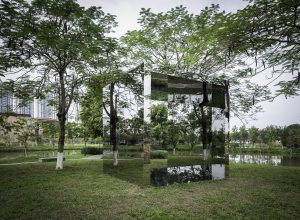
Shirin Abedinirad, House in the Wind, 2017. Land art, Marrakesh, Morocco. Created in collaboration with Nikon and BMW Mini, the work imagines the desert as an open studio where, in the artist’s words, “my studio has no walls, no roof, and no borders.” With the sky as the ceiling, horizons as walls, and wind, mirrors, clouds, and sand as collaborators, the installation becomes a meditation on nature as a partner, sanctuary, and boundless space of belonging. Artwork courtesy of featured artist Shirin Abedinirad.