


I Carried My Father to Uruk
My father taught me how dates,
gathered in enough numbers,
left to age and turn to syrup,
will become wine in time.

He taught me how to enter the temple,
the manner of ablutions at the spring,
what offerings to give Enki,
what words to say at the idol’s feet.

He, who in my memory
(and in my memory alone)
is fully divine,
named every hill and valley for me,
taught me the story behind each waterway
and the histories of the farmers squabbling since their twelfth ancestor.
He planted his own feet in the soil
to hold mine on his shoulders
and raise me to the height of the trees.

My father, who is my inner voice,
never wandered farther than our shore,
yet my feet, uncertain in the orchard, were fins in the sea,
my oar-bearing arms the sinews of a dream
for which his earthy contentment became a map's edge.

In my heart I carry him into the life I built in Uruk.
Father, what would you know of this land,
where the wine we pressed is the drink of the divine?
Would you find words fit for a river-king’s gods,
where the sea is a clay-baked fable?

You left me without a pen
to complete my maps.

Plant a kiss on the tip of my chin
where sorrow wobbles,
Lend me your sweaty scent
mixed with honeyed date wine
and the comforts of Dilmun’s autumn.
The Egyptian and Me
The Egyptian tells me how small Uruk is compared to Memphis.
He is a king of making others feel small,
laughing at our king—two-thirds a god? His Pharaoh is all divine.
How tiny our temples—theirs are colossal;
how polluted our river—unlike the pure Nile.

I tell him that these are not my temples, my river, my king.

He cuts in with a laugh, says the seas that straddle Egypt
are so much greater than my sea.
I long for a friend from the Indus Valley
to school him for his narrow views,
but the traveller from Indus is just as proud,
while the Ionian guest sits in a daze.

Uruk…
I feel in my bones this city was not made
for us of small lands with unmapped horizons.

Give me earth, wet and wriggling,
mud to define the creases of my feet,
give me the brief blooms that mark winter’s end,
the mayfly’s brevity.

I choose bones that ache before the weather turns
to bones that only rattle their secrets to a seer.
Ur-shanabi Returns to the Sea
Unseen rocks slice his heels
in the murk reclaimed by reeds—
not far from here, the river meets the sea.

He scans with eyes that once knew the contours of this land:
      there — he muddies his hand,
a disturbed mayfly drowsily swears,
      there — he can feel it, slick,
      he grasps it, pulls and heaves
chiseled stone loose from the mass,
the earth shifts and rises in his cupped hands,
the face of a god: one Stone Man,
just the one, disembodied, moss clouding its eyes.
The ferryman kisses it like a parent reunited with a child.

The beat of waves drums as they always drummed,
the bass for the song of the rain
and Ur-shanabi feels this in his bones,
a warning chiming underneath his skin.

It occurs to him that he does not know life
like Ziusudra shall forever know.
Nor does he know death
like the graying king claims
to escape in sculpted declaration.

It occurs to him that his feet no longer know the land,
but his bones still know the sea,
and the sea, eternal, beckons.

Ten years he watched the walls of Uruk grow
like his belly in the beer house by the temple
as winter smoke rose from the hearth of every palace
that crushed the ancient groves and palm-thatched huts
where oxen kept warm alongside their keepers
who farmed the groves and fired-up the kilns
that baked the bricks to build more walls,
and all the while his sailor’s beard shot white,
his coughs splat black,
his bones grew weary holding up his sag,

and all the while the sea swept through his sleep.

His god in hand, he presses forth to it,
the river sends his blood-streaks on ahead,
and at its maw he kneels down and submits—
the approaching tide a thunderous embrace.
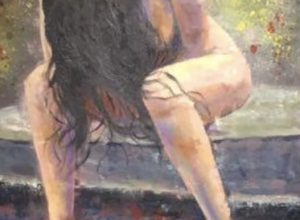
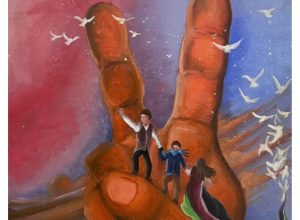
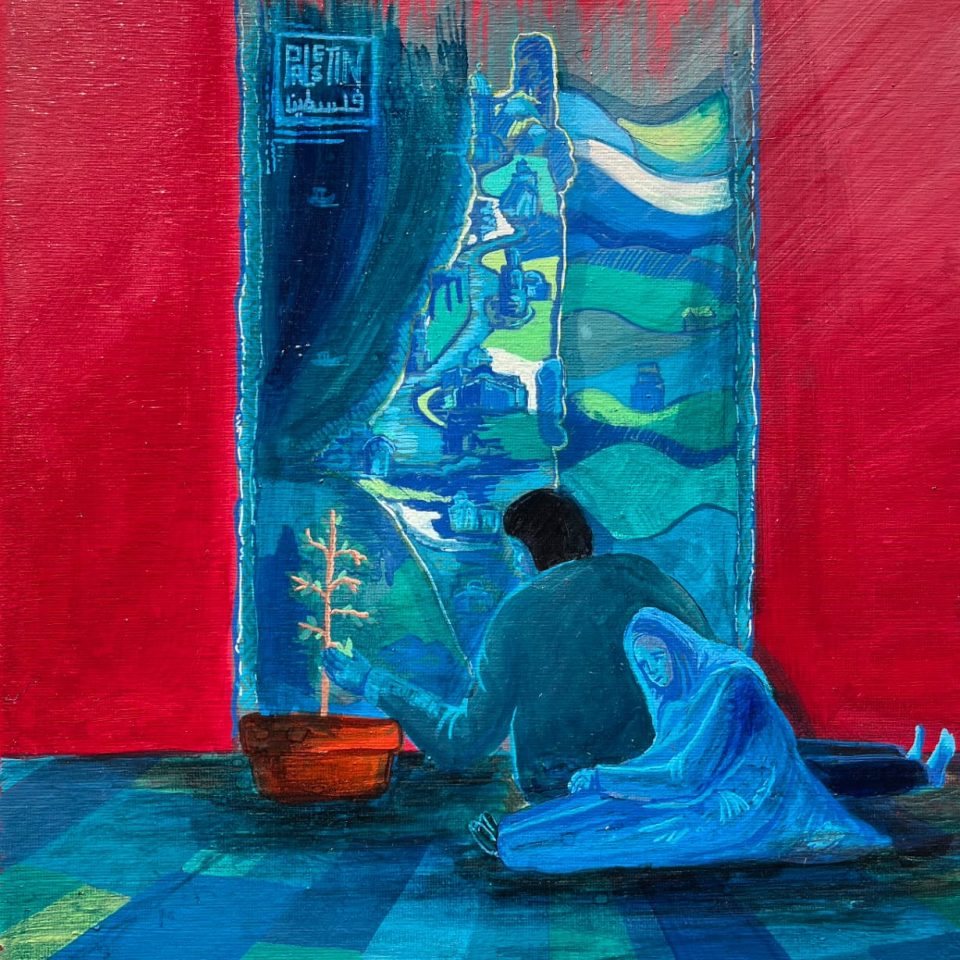
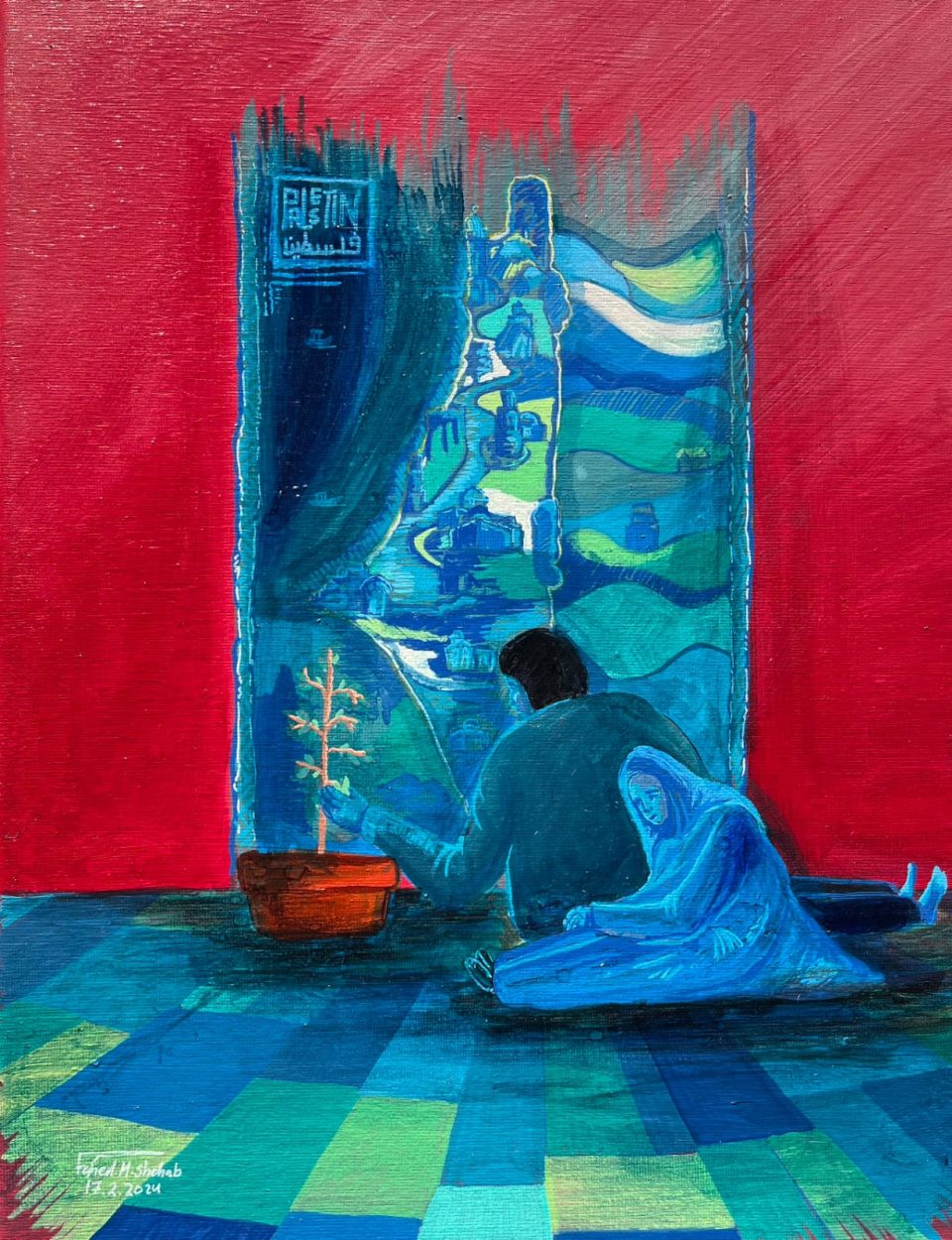
Painting Courtesy of Our Featured Artist Fahed Mohammed Shehab