
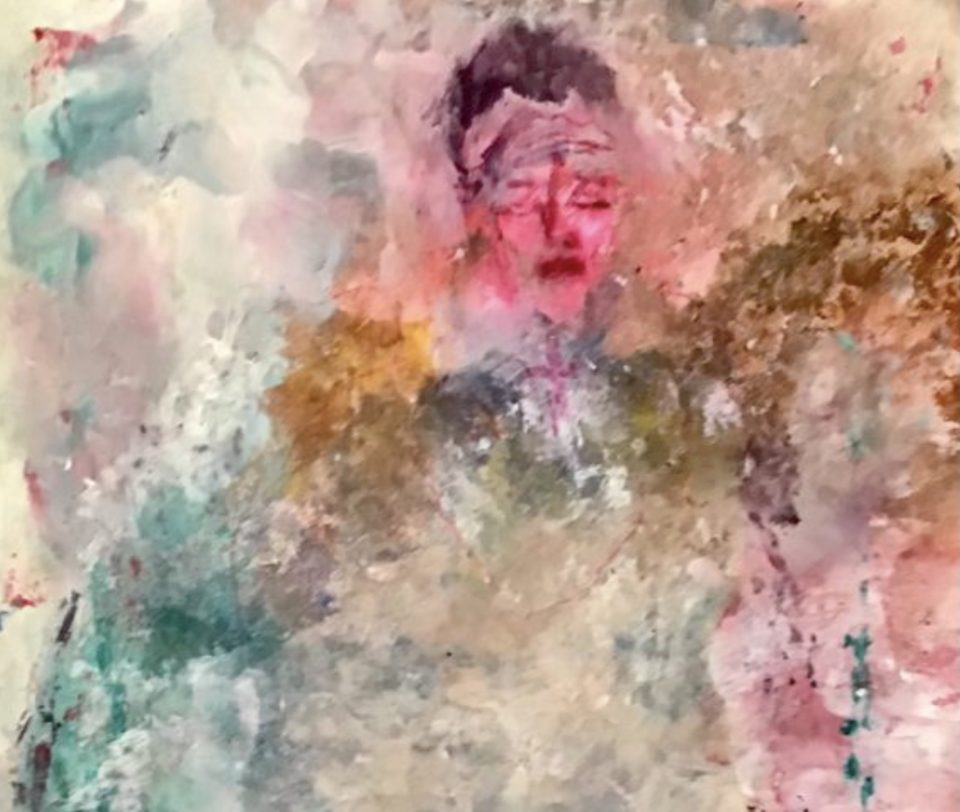



“And don’t do anything crazy!” My parents called from the other side of the phone. On my screen I could see my smiling mom waving at me while I heard my dad’s television show in the background. As I pressed the red phone button, my heart ached for our movie nights at home and laying my head down on my mother’s lap while I took up most of our comfy old couch. I felt a pang of loneliness sitting in my small Parisian apartment room, my one-meter Ikea bed shoved forcibly behind my roommate’s. But I remembered that at least here I was freer, and I had a mission. My parents knew me enough to tell me not to do anything crazy. But if they knew me that well, they already knew I was going to. Well, crazy by their standards, anyway. I was already dressed: black sweatpants and a black top, and my loyal blue fanny pack. On my way out I picked up my puffer jacket and most importantly: my black and white keffiyeh. It peeked out from under my jacket, matching my gold Palestine map necklace.
***
When I arrived, many students had already gathered, and so had the police. Stationed at the corners of our campus street were two police cars, and the CRS men scattered every few meters. The CRS were not regular police officers. You couldn’t joke with the riot police, nor reason with them. I guessed it would be the day I found out how true that was. It was a critical day. Two of our friends were in garde-à-vue for protesting the university’s complicity in genocide. As we gathered, our friends were waiting in police stations for their lawyers. Furious, we called for a protest right in front of the university doors. I remember thinking how remarkably peaceful it was, at first. Just dozens of us students sitting on the street in front of the campus, chanting and singing and holding banners. The street was closed for the day, with the CRS watching us quietly, patiently. While we sat and stood and sang and danced. While leftist parliamentarians came and spoke and shook our hands. While we waved flags and screamed in their faces and reeled with our collective power.
Until soon enough, it was decided that it was the end. Not by us – but for us. The university and the police thought our little performance was enough for the day. But we had no plans to move until they released our friends. So we sat, huddled next to each other, promising to stay. We knew our power rested in our number, that if one person turned their back and left, the rest would follow. The CRS called in the megaphone: move or be moved. When we stayed seated, holding their gaze, they marched towards us. Like angry, blinded horses that stomped on whatever was in their path. One step, two steps, and they were almost on top of us. To not be trampled, we had to stand up. And yet, we would not move. I linked my arm through Luisa’s, who stood by my side, shoulder to shoulder. Each one linked their arms with whoever was next to them, and we stood in lines and rows. For the first – and only – time in my life, I would feel like a soldier. Standing tall, leveled gaze, feet glued to the ground.
I don’t remember being in the front line, at first. But somehow, quickly, the people who were once in front of us were no longer there, and Luisa and I came face-to-face with the officers. Us in our keffiyehs and masks drawn on our faces, them in their protective gear and helmets. They came closer and closer, until they were towering over our 1m60 heights. I didn’t need to look at Luisa to know we were not going anywhere. It was enough that she kept holding my arm tightly between hers. So I kept my eyes on the man in front of me; challenging, provoking. But the CRS didn’t need provoking. Us standing there, in lines till the end of the street, was enough.
So they came at us. Walking, at first. Then shoving. It felt okay in the beginning – it was not that bad. Until we were stuck between the strength of the CRS and the determination of the line behind us. It was like being pushed into a wall, if that wall was also unstable and could break down at any moment. I urged my feet to be firm enough to stay in place, my lungs sturdy enough to not be crushed. But around us ankles buckled, and arms let go. The only arm I could still feel was Luisa’s. She was decidedly strong despite her small figure. I remember looking up to the sky, trying to get air, thinking to myself: you’re okay. You can breathe. Then I lowered my gaze again, until I looked – really looked – at the men in front of me. I’m not sure how I managed to realize, amid that chaos and pain, how descriptive their actions were of their personalities.
There are only two men that I remember, that I could recognize anywhere. First, the one facing Luisa. Tall, blonde, and unsure. A weak link, I would say. Some would call him kind. Kinder, maybe. His eyes didn’t have the fervor of the others. He didn’t push as ardently. He caught the arms of students who tripped. Warned us of the bicycle rack on my left that I kept hitting. In his eyes I saw a sliver of something hesitant – guilt, maybe? Remorse? But in that moment, it didn’t matter. I almost liked the other one better, the one right in my face. Yes, that one I wanted to provoke. The sliver in his eyes: undeniable pleasure. And his anger, it reeked of insecurity. We were pissing him off, and I liked it. He wasn’t careful, didn’t wait for someone to come close to him. No, he was a man of initiative who stepped forward intentionally to push someone far from him. He was aggressive, sloppy. So I kept my gaze on him in this disbalanced game of chicken. He could only see my eyes, anyway. So I hoped he saw himself in them, and the daggers they threw.
I must have been too caught up in that game in my head, because I wasn’t aware of Luisa until I felt her arm suddenly heavier on mine as she dropped halfway to the ground. NO, I remember thinking. No, no, no, no. You can’t fall, Luisa. The worst option for you there was to fall. The officers’ pace had started and had no intention to stop. Behind us were students still trying to stay in place. And behind them other CRS: we were completely surrounded, illegally. So if someone fell, they were walked on. Or worse, they would suffocate. In that moment I forgot the CRS, the people, the sirens, the megaphone, the university, the bicycle rack. All there was, was my arm and Luisa’s arm, and I had to pull her up. When I finally did, I noticed that Weak Link was holding her up. But I didn’t need his pity, his half-assed conscience. In that street there was us and there was them, and he had chosen his side. And the Snarky One, whom I had found for a second amusing, was now the object of my vengeance.
For lack of a better outlet of my anger, I pushed towards him with all the strength left in me. Clad in muscles and his police gear, he barely moved. Instead, he laughed. That bastard, he laughed. And then, like the flicker of a candlewick, he stepped forward and shoved me. The first thing I felt was his helmet, hanging in front of his chest, scratch the flesh off my arm. But then I lost my footing, and suddenly I was falling to the left, on the bicycle rack, where my head met the metal.
A clang, I think, was the sound it made. Deeper than the sound of a gun, sharper than that of a punch. Then a brouhaha of sounds, and colors. I slid down the rack, feeling the cold of the metal and the rubber of bicycle wheels. I can’t remember seeing much after that, except Luisa’s alarmed face, muffled words, and the blue eyes of that man. I remember Luisa’s arm still tucked into mine.
At that moment, I remembered when I met Luisa at a Moroccan restaurant, next to the Grand Mosque of Paris. We were gathered around a long table, most of us North African. She was German, but she had the heart of an Arab. She had been so excited to find out I was Egyptian.
‘My boyfriend is Egyptian!’ she had said. ‘I went before and picked up some words. I can say ismi Luisa, aywa, shokran, and yalla habibi!’
When I had hugged her goodbye before I went back to Egypt, I’d thought I wouldn’t see her again. But a year later, I was tearing up at the sight of her in a white dress, getting married to her Egyptian fiancé in Heliopolis, Cairo. My German friend who had shown me more solidarity than some of my Egyptian peers. As I sat light-headed at the bottom of the rack, she wiped my face with my keffiyeh. It had seen blood, sweat, and tears. How my memory worked so well while my senses abandoned me, I would never know. My brain was not processing the people around me or what I was hearing. Instead it replayed the time I pulled that keffiyeh out of a small gift box when I was back in Cairo.
My best friend Yasseen had sat and listened to me talk my anger out so many times. He had also heard me say I wanted a keffiyeh and didn’t know where they sold it. Before I went to Paris, he sent me a gift with a friend. Sitting under the trees in a small Maadi café, I hadn’t known what to expect when I first got the gift bag. But when I peeked into it and saw the bold straight lines, the fishnets and the grape leaves, I knew immediately what it was. I squealed in excitement as I pulled it over my shoulders. Unlike the typical keffiyehs that were white with black lines, this one was fully black with the designs stitched in white thread. Like him, it was different. He had refused to tell me where he got it from, so I knew it hadn’t been easy. For that reason, I promised to honor it, to fight with it. I wasn’t sure I had succeeded. I remember having to sneak it into the bottom of my luggage at dawn before my flight, so my mom wouldn’t notice. My mom, who always worried too much about me. My mom who advised me to stay away from protests, from trouble, from danger. The last thing I remember thinking on that bloody street as I lifted my head to the sky was:
I’m sorry, Mom.
***
When I reopened my eyes there was no noise anymore. It was cold, and the air was gushing in my lungs in rapid strides. It took my eyes a few seconds to readjust – it was darker now. There were no police officers in sight, no students either. There was only Luisa. With her short brown hair, her round white face, and her brown eyes. She could easily pass for an Egyptian, I thought. She was crouching down by my side, holding me up as I came back to my senses. I expected her to look troubled, worried about me after I’d been knocked out. But there was a tug of her lips that I couldn’t miss.
“What?” I asked.
She smiled wide now. “It’s over. They released them.”
I didn’t register what Luisa said right away. Shifting uncomfortably on the cold pavement, I couldn’t feel my body yet. Where is my keffiyeh? I remember thinking suddenly. With one hand on the ground propping me up, my other hand grabbed at my neck, pulling at the loose ends of the light black and white fabric. It was disheveled, soaked in sweat and the smell of rain and dust. And then it registered. I smiled despite the pain in the back of my head, despite everything. And then I let myself lean back on Luisa, let my body rest and my head fall back and my eyes close as I looked up to the sky, still holding my keffiyeh close.