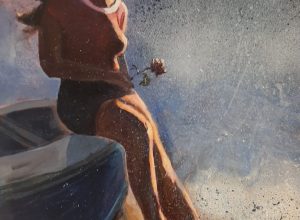


Shirin Abedinirad on Mirrors, Landscape, and the Art of Presence
For Rowayat’s fourteenth issue, we could imagine no better guide to its theme than Shirin Abedinirad. The Iranian artist has spent more than a decade placing mirrors in deserts, on mountainsides, and at the edge of the sea — installations in which the sky becomes ground, beauty meets beauty, and the viewer is sharply called into the present. Trained as a painter in Tabriz and shaped by three years alongside Abbas Kiarostami, Abedinirad traces her visual language to the mirror-work of Persian shrines and the poetry of Rumi, Attar and Bidel Dehlavi, mystics she considers land artists before their time. In this conversation, she speaks about humility before nature, the miracle of reflection, and the art of truly seeing.
Your journey began with painting. What led you from the canvas to working with landscape as a medium?
I was trained as a painter, but I quickly felt constrained by the gallery system. As a young woman in Iran, gaining access to galleries often meant navigating connections to people tied to the government—and that felt impossible. I wanted more freedom to express myself. So I began exploring other mediums: fashion design, performance and video. I started using my own body as a canvas.
But the real shift came when I realized I didn’t need walls at all. I began performing in the streets—Tehran, Mumbai, Istanbul—and my interaction with people in those unscripted, public moments became the art itself. The street was my gallery.
At the same time, I spent three years working with Abbas Kiarostami, the celebrated Iranian filmmaker and photographer. He was first my teacher in a video art workshop, and later I worked in his studio on his photographs. But I wasn’t there to learn filmmaking. I was observing how he looked at people, at nature—what mattered to him, what he chose to see. More than any technique, I learned a way of seeing.
Then came a pivotal moment. In 2013, I travelled to the desert of Isfahan. I had grown up passing through those barren, dry landscapes on family trips and never appreciated them. But that day, standing alone in the desert, I discovered a beauty I hadn’t been able to see before. Nature became my partner, and I’ve been working in dialogue with landscapes ever since. My installations—mirrors, stairs, doors placed directly in deserts, mountains, and shorelines—are physical, site-specific works created in real environments. The landscape is not a backdrop; it is a collaborator.
The landscape is not a backdrop; it is a collaborator.
How have Persian visual traditions and mystical thought shaped your approach to reflection, space, and perception in your work? What other creative work inspires you?
It’s only recently that I’ve come to fully understand how deeply Persian architecture has influenced me. The mirror-work of shrine interiors, the arched doorways, the geometric patterns—these elements appear throughout my installations, in my use of stairs, arcs, doors, and portals. I wasn’t trained as an architect, and I never had architect friends, yet architecture has been quietly shaping my visual language all along. When I visited the Imam Reza Shrine in Mashhad at sixteen, I stepped inside and was moved to tears by its beauty. That experience left a mark I’m still tracing.
But the deepest influence comes from Persian mystical poetry. I am profoundly inspired by Rumi and Bidel Dehlavi. I think of these poets as mentors I never met—their words are how I connect with them across centuries. When I read their poems, I see what they see. Honestly, I sometimes think they could have been installation artists or land artists if those mediums had existed in their time. What they describe—the way light transforms space, the way the self dissolves into the world—is so visual, so spatial, that it could become a physical artwork. Perhaps, because they did not have these mediums, words became their material, and they gave their visions life through language.
In my own research, I’ve found that Bidel Dehlavi, who was also a Sufi, used the mirror as a metaphor in dozens of different ways to convey different ideas. That is exactly what I do: I use mirrors in my land art, and each time, the mirror means something different. The poets and I are working with the same material, only in different forms.
In your work with mirrors, viewers often encounter both themselves and the landscape at once. What interests you about that moment of doubled seeing?
When you stand before a landscape without a mirror, you see only nature. You might admire the sunrise, but your mind drifts—to the past, the future, a conversation. It’s difficult to sustain presence for long. But the moment you encounter a mirror in that landscape, something shifts. You see yourself within the scene, and that recognition brings you sharply into the present. You observe yourself observing. The mirror is a gentle interruption that says, “You are here, now, in this.”
What fascinates me is how differently the mirror behaves outdoors. At home, you approach a mirror to check your appearance—the background is a white wall, a bathroom. But in my installations, the mirror is in a desert, on a mountain, by the sea. What you see behind your reflection is not a wall but the sky, the earth, the horizon. Beauty is meeting beauty, and you begin to see yourself differently.
Beauty is meeting beauty, and you begin to see yourself differently.
And it’s not always about the viewer’s reflection. Sometimes my mirrors face the sky and are placed on the ground, so when you walk toward them, you feel as though you could step onto the clouds. The ground becomes sky beneath your feet. It creates a moment of wonder, a gentle illusion—merging different angles of nature, different planes of reality. There is always more to discover depending on where you stand and how you move.
What happens to our sense of reality when reflection enters a landscape?
Reflection has always been part of nature. I’m not introducing something foreign when I place mirrors in a landscape—I’m echoing what is already there. Think of the story of Narcissus: the first time a human being saw their own face was in the surface of water. The sky reflected on a lake, the shadow of branches shifting on the ground as the light changes, a puddle after rain doubling the world above—these are all reflections that already exist.
But we stop seeing them. They become ordinary. We look at a lake and no longer marvel at the sky living on its surface. We have grown accustomed to the miracle.
What my mirrors do is make us notice reflection again. By placing a mirror deliberately in an unexpected location—in a desert, on a mountainside, at the edge of the sea—I’m not creating the miraculous. I’m making the miraculous visible again. The mirror asks you to pause and truly see what has always been there: that the world is constantly reflecting itself, and that you are part of that reflection.
I’m not creating the miraculous. I’m making the miraculous visible again.
Light and weather play an active part in your installations. Have there been moments when they unexpectedly changed the direction of a work?
Not once, but many times. I have no control over nature—the weather is unpredictable, and my work is an ongoing interaction with forces far larger than myself.
One moment stays with me. In 2018, I created a piece called “The Revision”—a pyramid of old television sets whose screens I had covered with reflective surfaces, placed in a landscape. When I arrived to document the work, I had about thirty minutes before the light changed. The moment I stepped into the scene, a double rainbow appeared. I began photographing immediately, and within minutes, it vanished. The colours, the position of the arc—it felt like a gift from nature, offered precisely in that window of time.
But I also carry another story that taught me something harder. My very first land art photograph, taken in the desert in 2013, was made when I was completely alone—a student with mirrors and a simple camera. I spoke to the desert. I said, “I’m a student; please help me take the best photo.” And the sky cooperated: soft clouds, beautiful light. That image remains, to this day, my most successful photograph.
Two years later, I returned to the same location, this time with a professional team, better equipment, more resources. I couldn’t take a single good shot. The magic was gone. I believe it was because it was the first time I approached the desert with humility—with an open question. The second time, I arrived with confidence, perhaps even pride, and nature answered clearly: if you are not humble, I will not work with you.
Being humble before nature is the most important thing I have learned.
Being humble before nature is the most important thing I have learned.
What do you hope stays with someone after they leave one of your installations?
I hope they begin to see things from different angles. When you stand before one of my mirrors, what you see depends entirely on where you position yourself. Look from below, and you see only sky. Step to the side, and you see not yourself but the landscape, or another person. Move again, and the whole scene transforms.
The mirror asks you to keep moving—to shift your perspective, to look again, to come closer or step back. And I think that is a practice that extends beyond the installation. Life asks the same of us: to change our point of view, to pay attention to our surroundings, to be aware of the present moment.
In recent years, I’ve learned this in my own life—that the greatest gift you can give yourself is being present. I hope that is what lingers: not a specific image, but a way of seeing. A renewed attention to the world as it is, right now.
Photo Courtesy of Artist Shirin Abedinirad