


— “Where should the trees sleep after the last breath of air?” — Mahmoud Darwish
I
By your bed I stood, facing lilies,
admiring the grooves in a mason’s
face – self educated and self made –
observing my fate and fortune;
you came round but strained to turn
the wheel of memory, tried
to recycle a story we share
but could not restore with words,
and in your eyes I discerned,
for the duration of a glance,
a glimpse of the man I knew,
and felt the blind kind of trust
that only a child knows – like when
your parent holds your hand
to cross a street, or when they keep you
afloat among the mighty waves.
I remembered how you once hoisted me
over the settler’s fence and landed me
on the other side. By your side I stood –
feeling anxious and curious but safe.
Together we went – sneaking through
stubble fields, the rampant remains
of a church, a mosque, houses and graves;
you’d set out to find my grandfather’s grave
between settler’s manure and tractor tracks;
we had no time for grief; in stealth, in haste
you fell to pulling out weeds, and I
lined up stone by stone to mark the grave
where we tore down the fences
between presence and absence.
II
Your eyes remain closed while my hand
refuses to let go; without you
I fear I might falter over walls
you taught me to conquer.
You never cared for words, preferred
to peel oranges for sunset,
apples for evening leisure –
served us love on a platter.
I stand now like a priest, peeling proverbs,
quartering verse and rhyme, trying
to help you rise over this final fence,
with the solemn words of a promise:
father, before you shut out the light,
see the torches on the hills flaring
like bonfires, see the exiled souls
march back like phantom dreams, and soon
they will arrive at burial grounds
circumscribed by solemn palms, silenced
by cooing doves, covered by the clear
Galilee skies, and then, only then
shall I lay you to rest and weep
like liberated people weep,
carve the banished names in bloodstone,
erect them again as tombstones.
All the while, my daughter held
my other hand and seemed to learn
these perpetual final words
as I had learned from you before.
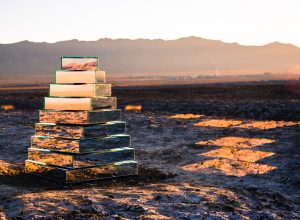
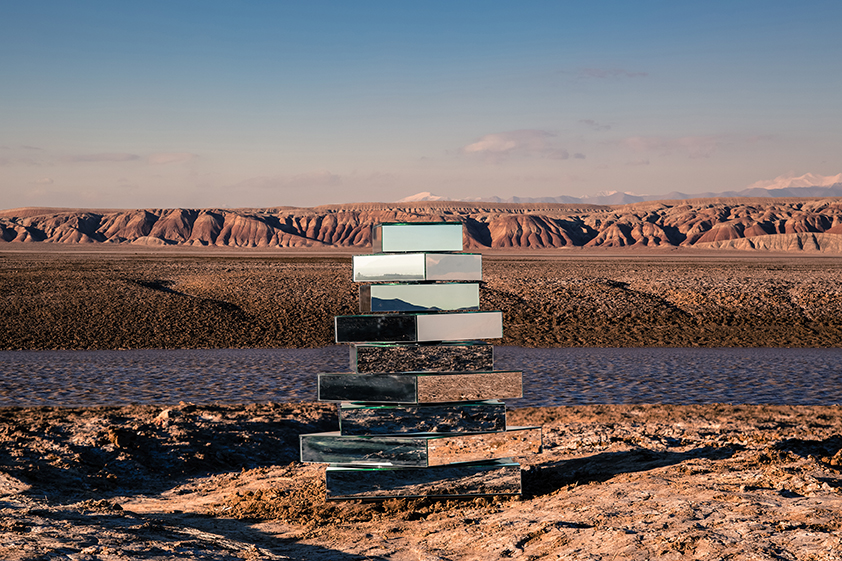
Shirin Abedinirad, Babel Tower, 2015. Interactive installation, Tehran, Iran. Created with interaction designer Guglielmo Torelli, the work reimagines the spiritual architecture of Babel through mirrors, light, and movement, recalling a time when humanity shared “one language” and lived “freely without boundaries.” Responding to audience interaction and shifting weather conditions, the installation gathers fragments of city, nature, and sky into a changing image of the world, transforming division into dialogue and longing into a vision of unity. Artwork courtesy of featured artist Shirin Abedinirad.