



The “eco”-blockade and military assault ethnically cleansed Karabakh
Have you ever dreamt of becoming a refugee or a displaced person? I became one without even noticing—together with 130 000 of my countrymen. Since then, I have avoided having the word “refugee” attached to my name, because it seems to overwrite the part of my identity that I valued the most and that I no longer possess—not a lecturer, not a professor—just a refugee.
The word also reminds me of my hometown, which I can now only see—whimsically in social media posts and snapshots. “Refugee” somehow implies that you no longer have dreams. It also crushes the feeble hope that I still harbour.
It’s hard to explain, but my hope was stronger back in my blockaded homeland, when we were trying to live a normal life, half-starved and under duress. Looking back, it was clear that our hope was fragile—perhaps delusional—the military assault always looming—an anticipated outcome. But when we were finally cleansed from our land, some felt a sense of relief. The long, festering conflict had been “settled,” they said. A price paid to open borders, to revitalize the Caucasus. Others flared and were outraged by the exodus. But outrage fades. Emotions quiet down, they grow feeble. Then, we were left with the stark reality—to fend for ourselves, scattered in exile.
Still, these relentless upheavals have taught us essential lessons. They have made those of us who stayed sane, who didn’t block out the world—invincible and perhaps wiser even. After being exposed to air-raids, skirmishes and starvation, and stripped of all material possessions—losing everything, land, home, belongings—what remains is an invincibility born of survival. And you grow wiser because you grasp that real belonging is the things you have shared—love, expertise, support, money, these will stay with you forever. You also learn to empathize more. You definitely understand Gazans and Ukrainians on a much deeper level.
Stories of migration may seem familiar, yet each one is anything but ordinary. Each is a singular heartbreak, a singular survival.
***
Artsakh or Nagorno-Karabakh was a small breakaway state in the Caucasus, wedged between Armenia and Azerbaijan. It was a place where Armenians and Azeris lived together side by side, each asserting their exquisite claim on the landlocked land. The parties clashed fiercely in the 90s, fracturing the Soviet empire, each side utterly convinced of the righteousness of its cause. Hostilities were waged on all the territory of Karabakh with varying outcomes. In the end, the Armenian Republic of Nagorno-Karabakh declared itself an independent state. It remained so for thirty years until Azeris regained control over most of the republic in 2020. Then in 2023, they blocked and cleansed the land.
***
Blockade of Artsakh of 2023
The blockade was carried out in December 2022 by protesters belonging to an Azerbaijani ecological volunteer-organization—men, women and students. They closed off the only road to Artsakh, which had been delivering food and medicine. Time revealed that they would use starvation tactics on the civilian populations—a deliberate tool of warfare—despite its explicit prohibition under Rule 53 of the Customary International Humanitarian Law.
The blockade brought with it freezing rolling blackouts and gas cuts. For more than a semester, school students shivered in cold classrooms. Without gasoline, many couldn’t reach the capital from other regions. In the final months of the blockade, shop-shelves were nearly bare. Though food coupons for eggs and grains were still issued. Even Red Cross transport for the severely sick was banned.
Then, one day, the region’s main state university announced that eggs would be distributed to the faculty. When the professors arrived, their hopes were met with a different promise—each would receive litres of milk instead. On the appointed day, the faculty arrived with large containers, only to find that they would each be given a mere half a litre.
People queued for cabbages and beans but walked away with pumpkins. Others, after spending hours in the bread lines, boasted a few tomatoes like trophies. Families scavenged, foraging for food, hazelnuts from the roadside, mulberries and blackberries from yards–anything that would satiate them for a while.
The blockade forced people to share. A retired physics professor offered a huge pumpkin from his garden to a woman, who helped him carry it home. She confessed later that, in her imagination, it didn’t transform into a carriage, but a big loaf of bread. Imagine her excitement when, on that day, her colleague gave her a handful of cookies from ingredients scavenged in the village.
Six months into the blockade, when spring turned to sweltering summer, everyone had become thinner. Volunteers distributed porridge with shreds of meat to the elderly and the neediest families.
Some of the other volunteers engaged kids in therapeutic activities with paint, brushes and a bowl of grapes:
“After you draw the grapes, we will eat them.” One volunteer told a boy.
The boy, who was mostly running around, half-starved, whispered: “Can I eat them first…? Then draw them?”
With no fuel for buses or cars, many of the city dwellers walked out to the villages in search of food to buy. One man was searching for something—anything to feed his pregnant wife.
The Karabakh blockade continued into 2023, gradually tightening the noose for nine long months. Yet every morning, people still woke up with renewed anticipation that the blockade would be lifted. Food became a weapon—not just to starve the body, but to kill the future, to break resistance and to develop the psychology of a victim. These tactics would ease the upcoming assault, planned by the Azeris, that would enable them to seize control over the land. It was, in fact, nine months into the blockade, when the first Armenian died of hunger, that Azerbaijan’s military pounced, knocking the bottom out.
***
Long Expected, Still Unexpected Assault
Teachers tried to make lessons playful and gamified, because undernourished students could barely focus.
There was still hope, although the continued silence from the international media was getting unnerving and bizarre. Until that silence was broken—not by the wished-for advocacy—but by bombs.
Everyone froze for a minute. Weak from months of malnutrition, they hoped it was some kind of military routine, or perhaps an accident or a controlled disposal of a leftover shell. Such sounds had happened many times before, like when an occasional mortar salvo fired on the suburbs. But this was war, a military assault. Everyone rushed out into the bunkers. Electricity and mobile coverage vanished. Those trying to call loved ones—sons, fathers and brothers—collapsing when no one answered. Some had strokes.
Schools without bunkers sent children to nearby shelters. Parents roamed the dim bunkers with flickering phones, searching for their kids, then, not finding them, they crawled out to the other basements to inquire further. Some parents were reunited, while others searched in vain for days, slowly unravelling—while many never found their children at all.
Oksanna was from Sarnaghbyur village. She lost her child, who was killed on the way to shelter, together with her mother and father-in-law. It was because a drone dropped a bomb directly on a crowd of civilians who were trying to reach safety. Two more children—Nver and Mikael Poghosyans—were also killed. The body of one of them could only be collected after the ceasefire, because the village was so close to the border.
Apartment dwellers dragged camp beds, mattresses, blankets into the basements, huddling together as women, infants and toddlers, screaming from the rhythmic blasts of cluster munitions. The bread was half-made of fodder and instantly gobbled up by the children.
One child, tasting local grapes and watermelon for the first time in nine months, called out to his younger brother:
“Come quickly! We have GRAPES and WATERMELON!”
Their poor mum crouched nearby, explaining that she could hardly afford to buy them in the face of skyrocketing prices and all-out unemployment induced by the blockade. She recalled sobbing in the kitchen, because her husband lost his job during the blockade. They had survived only on their cultivated patch of land. Her eldest would gather berries from it to sell at the market, hoping to bring home a few coins.
A lady serving in the headquarters shook and squawked hackneyed slogans: “Glory to the Army! Our soldiers are holding strong.”
A young mother rocked a toddler: “Don’t cry. Daddy will come back from the battlefield–he will definitely come back.”
Her words were actually directed to her older daughter, who was old enough to understand that war could take her father away at any minute.
When the father appeared briefly in tactical gear for a few minutes, his daughter clung to him so tightly that they could barely manage to separate her from him.
The country-wide power outage meant that only diesel-fuelled generators kept the surgical rooms lit. But for how many days would they last? Hospitals, operation theatres and morgues were crammed full. Bulldozers dug graves, the burials were postponed, because no one could attend – mourners and relatives of the deceased were ambushed in towns and trapped in the regions.
The news of fallen villages arrived. Villagers flocked to the capital, walking through forests and fields, some drove their cars with headlights off wanting to pass-by unnoticed, some walked and never reached their destination alive. Other villagers were brought in crammed open-topped cargo trucks, their floral dresses and dishevelled hair wafting in the wind, their hands clutching the side panels. They fled wearing what they had on, leaving even their most cherished family photographs behind.
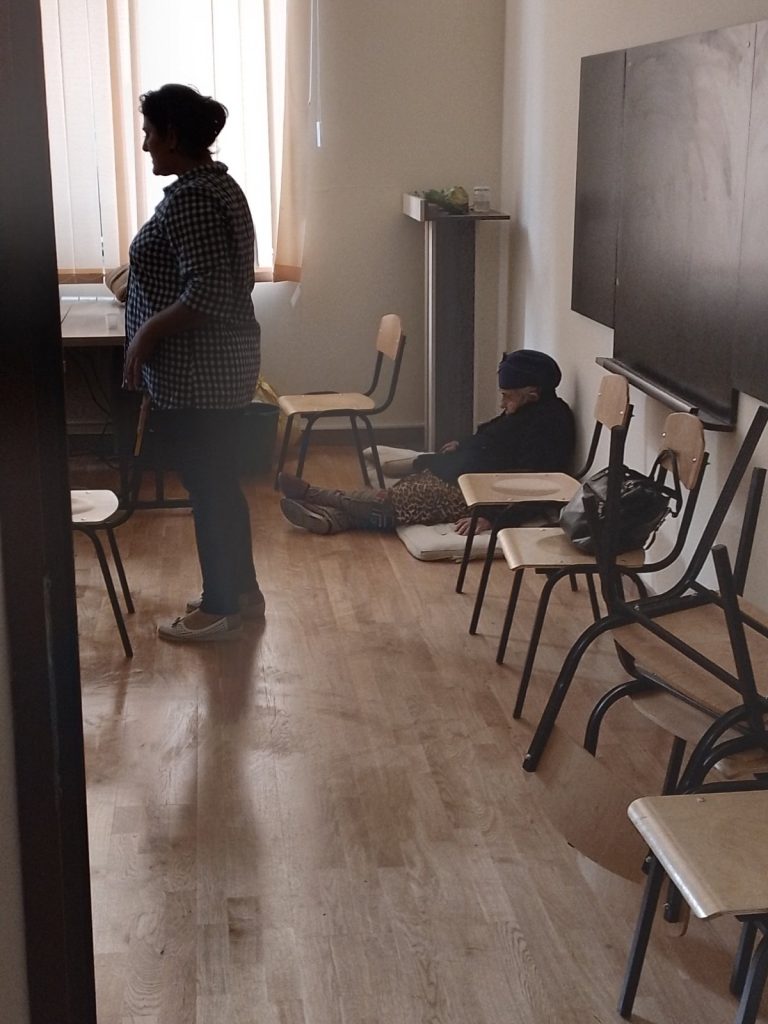
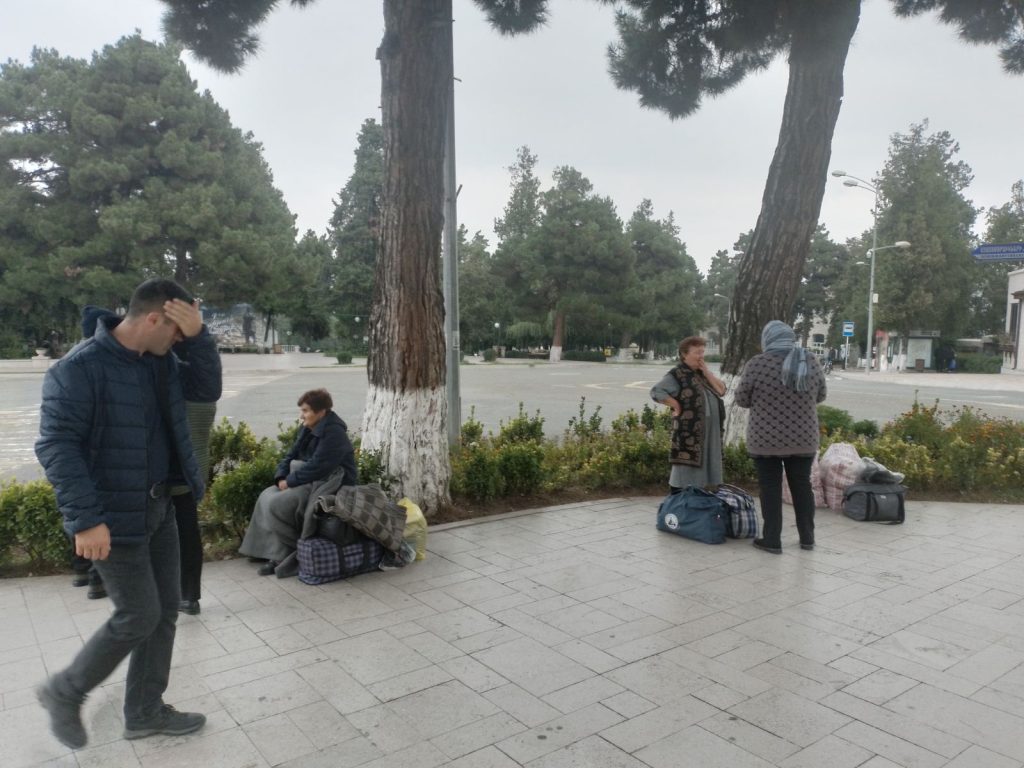
Refugees with duffel bags flooded into the shelters, museums, art galleries, cathedrals, schools and universities. They ran into the streets in search of relatives. Some dashed to the Russian military base, assuming it was “safer” there. But the Russians, stationed to ensure the security of the civilian population until 2025, did nothing. They were supposedly keeping the “perfect balance” by not interfering in the assault. It dumfounded people. But for many, it had reduced their alertness. Their presence had lulled people into a false comfort.
When the shelling paused and the agreement was signed, villagers in the capital began cooking over self-made sheet-iron stoves, cooking grains and pumpkin. The last scraps. One boy was eating grape leaves. The chatter over the fire revealed that most people had nowhere to go. Artsakh was their only home, and they intended to stay. They wondered how they would be integrated or absorbed into Azerbaijan.

People could not grasp what was happening, rejecting the news or blaming the easy-to-surrender government. Some heard that since the army was demobilized and disarmed, the power would soon be reconnected, and the gas would be supplied from Azerbaijan. Others went so far as to claim that Azeris would go back to the border line of 2020 and that former Artsakh guerrillas would be arrested. The latter stirred people up, scared them, since most men had served in the army. Some worried they’d be targeted like the patients, escorted by the Red Cross to Yerevan.
When the corridor opened, people rushed to the fuel reserve of the demobilized army. Those without cars and without relatives who had cars waited with bated breath in the main square, scared and hungry, with a handful of their baggage for public buses to take them.
***
The Exodus
When the order came to leave, people had a feeling this wasn’t temporary.
People queued at gas stations where they were only given five litres per head. They bid farewell to their homes—streets, churches, graves, acquaintances on the street.
A woman thanked her fig tree, planted by her grandfather, for being so generous and saving them from hunger. A shepherd dog desperately sought his master; perhaps he silently envied the pets whose masters had more car space to take them in. Another family didn’t have the heart to bid farewell to their kitten. While others grabbed some books, a woollen plaid, some winter clothes, and played a waltz on their piano before walking out forever.
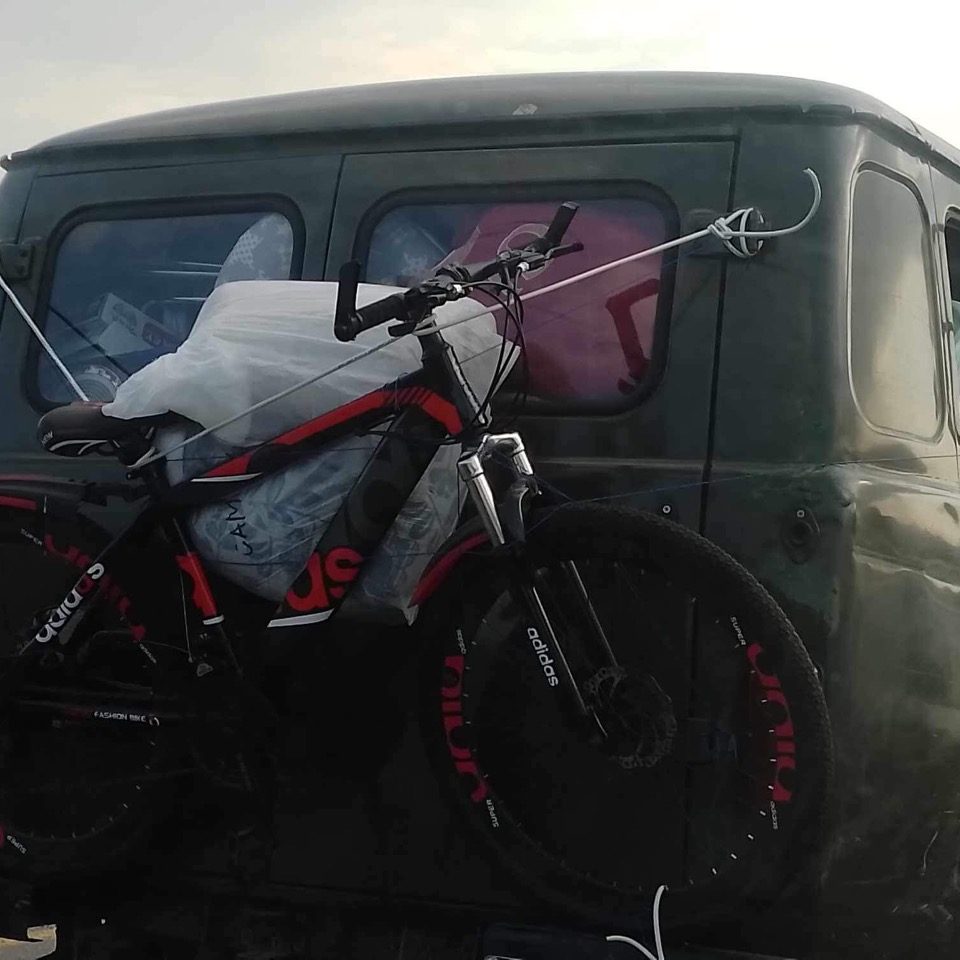
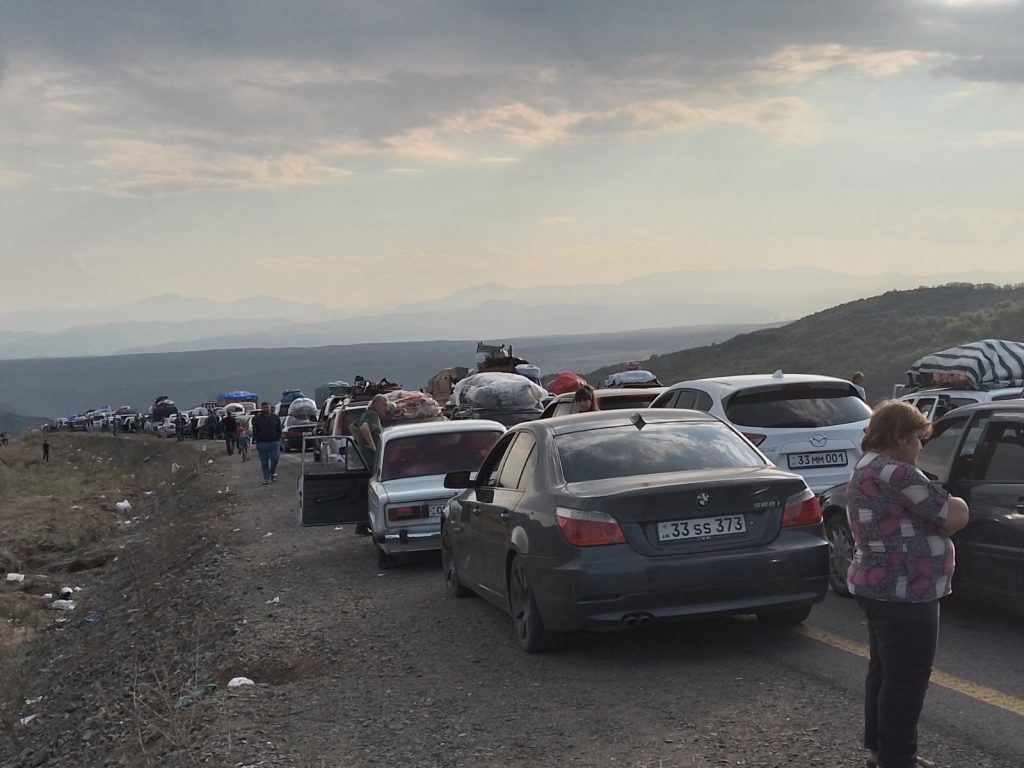
The cars moved slowly—hours blocked in the traffic jam— stopping every now and then, as they progressed through the serpentine road. The jam stretched for kilometres, wiping out the already limited petrol. This was the first and most likely the last time the mountains witnessed such a traffic congestion. The exodus caravan–a line of cars to the horizon–blinking lights reflected in the dusk-red rocks of the mountains and ravines, resembling a lake of fire, with tortured sinners inside. It seemed that the fire would never be put out, and the terror, fear, and hunger would forever gnaw at them.
As people drew closer to the checkpoint, their heart rate beat faster, panic swelled. Fear made some women deliver early, right on the road. Fear of detention made the State television driver throw the television’s archived footage into a ravine. People were getting rid of hard drives with military images, military accessories and decorations—anything that might be used against them. However, none of the foreboding came to pass: the documents weren’t taken away from the soon-to-be refugees. But many old Soviet cars, unused for months, sputtered and died—trunks still open—loaded with what little their owners could carry.
***
Petrol Depot Explosion
Getting enough fuel to flee to take the humanitarian corridor wasn’t as easy as it seemed. Petrol was scarce, and desperation made the situation perilous. People frantically searched for fuel to escape, casting predatory and suspicious glances at anyone carrying a jerrycan. Those who had stored-up petrol were able to join a thousand-kilometre exodus line.
For the rest of the people, petrol was a delusion. Exacerbated by rumours which spread that Azeris were patrolling the town, and that the roads would close for former combatants. So, when everyone learned that there were two fuel reserves left from the already disbanded army—a tank of petrol and a tank of fuel, people flocked outside to the site where it was located, outside the city.
At dawn on September 25, 2023, the petrol tank exploded.
The blast shook the region. Bodies flew. Limbs torn. Flesh burned. Some were unconscious, others screamed for help—burnt but alive, passing the petrol-fed flames to those who came to their rescue.
A wedding ring was all that remained of some. Half-naked people, with brownish swollen faces, puffed up limbs and scorched hair, stumbled through the streets of Stepanakert. Their swollen faces and blistered limbs were indistinguishable from one another. They stopped to gulp air and shed the remnants of their clothing for relief. Hospitals could offer little relief, as they had been evacuated with few personnel left on site. Many burnt bodies remained uncollected till the following morning.
Most of the people who had gone to where the petrol tank was located—went to get fuel for their large families, who were waiting for them to return. The families waited with packed things at the doorstep—ready to leave the country for good—as soon as their father, brother and brother-in-law returned with the petrol. Instead, the blast occurred, their wives and mothers called their unresponsive phones. Bloodcurdling screams all over town filled the air as the families learned what actually happened.
The ambulances took those alive to hospitals, some wards were filled with the wounded and burned—the other wards—were giving birth to the last Artsakhis. Some of the burnt patients were lying on the hospital floor, some were unconscious, others opened their eyes. Some were transported by helicopters of the Russian contingent. Even those only slightly burned, still died from the intoxication of burned petrol, which penetrated deep into their bodies. The registered casualties of the blast were around 219, most of them identified by DNA after a month. Twenty-two were never identified, and another twenty-two were never picked up.
Around 290-300 survivors underwent surgery after surgery, patching pig-skin onto their burned skin or skin taken from other parts of their bodies. They could easily be recognized because of their deformed, often scarf-hidden faces, evading acquaintances with inquiring glances, and fingers that had melted from holding petrol canisters that had blown up first.
One year later, Anahit was still posting photos with her fiancé:
“It’s better with you in the stormy waters, than on a calm sea with someone else.”
She posted videos in which they whirled in a harmonious tango, a happy couple, clearly in love. A smart, slender, long-haired and big-eyed beauty with a handsome young man. His resolute and compassionate almond-eyes looked tenderly at her. Both brightened as their glances met. Facebook would remain the only place where they and many other couples, severed by the blast, could dance together.
So many women and children also fell victim to the depot explosion: a pregnant woman was seen lying motionless at the depot site. Her auburn wavy hair singed, her hand rested serenely on her chest, as if protecting her child from the accident.
Another woman—red-cheeked Armine, was killed with her son. She used to sell greens and vegetables around the corner from the university building. Her merry smile always resonated with the mountain-smelling watercress, lettuce, peppermint, scallions, tarragon, dill, parsley, coriander and basil that she sold. I remember how she always haggled over the prices, only to eventually succumb and offer a discount, like a bunch of extra parsley or two scallions for the price of one. Even the yellow Brandywines, which she produced from large, checkered shopping bags and showcased on oilcloth on the edge of the pavement lawn, were a perk. To sell the fresh veggies from her all-season greenhouse, Armine would stand on the street even in piercing cold. Now, her stall was empty.
We lost so many children. A thirteen-year-old boy had walked to the depot with his father, brother and uncle to help. He was survived by his sister and mother.
Another boy, only ten years old, was saved by his father, who persuaded him to leave the fuel depot area “because of the nasty smell.” After the explosion, the child asked a bystander to take him home to his mother and three brothers. His father was never found.
Two other boys survived somehow miraculously. When the younger brother was desperately searching for his older brother among the people ablaze, he turned to God and prayed. His family had grown more observant and religious since their displacement during the 2020 war. In this instance, the young boy asked God to show him his brother, whom he considered like a father. A downpour of rain suddenly snuffed out the fire on the person right, at his feet, to reveal his brother, scorched, but alive.
***
Karabakhis in Armenia
When people arrived in Armenia, volunteers offered sandwiches and delicious peaches from the Ararat valley. Some hadn’t tasted sweetness in months. This was the beginning of a new status: refugee. All the refugees looked like they had come from another planet – one without food, without power, without safety. From this point onwards, the forcefully displaced were getting used to their new status, lots of advice on how to live on, how to heal.
This reality forced Karabakhis to commune more with one another—first at the funeral services of the fallen and killed by the depot blast.
Then, at beauty parlours of Artsakh hairdressers, on the streets with dialect speakers. People were careful inquiring about family members, cautious, because they may not have survived.
Many Karabakhis intended to stay in Armenia and build their homes here. A paramedic from Martakert was building his house for the fourth time: he had built one after the first war, then after the 2020 war, and then after a fire, and was now building one here for the fourth time.
But finding a place to live was challenging for Karabakhis, the rental prices had soared, since there were also Russian migrants who had come to Armenia with a much higher financial ability.
In a way, the blockade was continuing for Artsakhis in Armenia: the amount of rent compensation was sufficient to pay rent but left little money for food. Even more worrisome was that the compensation would terminate in June 2025. The news came of landlords evicting insolvent tenants–usually families of women, the disabled and the elderly. They had become destitute at the end of their life with little hope for a decent job and house, deprived of their community—relatives and friends, suddenly scattered around the world.
They had to adapt and accommodate to a different culture, like the orderly festive laundry lines, one of the familiar emblems of Artsakh’s capital, were frowned upon and unwelcome in a Yerevan elite neighbourhood and were said “to spoil the view from their window”.
The refugees seemed caught between two states—either lost in the dark with no hope, or defiantly optimistic, preparing for a journey back to Artsakh.
Artsakhis and Indian Gastarbeiters wore the same uneasy facial expression—an uncertainty, insecurity and sense of not quite belonging in this context. It was like leaping from one inferno to another.
Still, they could never have survived without heartfelt aid and professional medical help. Armenia backed Artsakh emotionally, professionally and financially. While the blockade, in its cruelty, taught Artsakhis to be happy for things they had taken for granted. Simple things became small wonders like the ability to switch the light on and off at will, or how precious uninterrupted work on the laptop was—without the anxiety of power cuts—or the joy of being able to warm meals anytime, without relying on the unpredictable hiss and occasional bursting spiral flare of a homemade stove.
These memories have empowered many to tackle the challenges and disorientation of displacement—to push back and fight the procrastination and paralysis it often brings— a spin-off of the displacement itself. Displaced teachers and journalists struggled to think, many of them repeated: “It hurts to think.” Their manuscripts were left unfinished, books lay unread. They were either house-hunting or job-hunting—just trying to stay afloat.
By the time they were scribbling notes, jotting down stories and slowly starting to heal—facing their pain on the page. It was already time to brace for more upheavals-to-come.
Photos and video Courtesy of Lusine Vanyan