



You brush against your holster in the sinewy fog draped over the town. It’s afternoon, but it still hasn’t burned away, reducing the world to shadow-less daubs and lingering on the rusted lampposts and red-brick facades of historic downtown Bakerton. A call brought you here, shrouded in static, from a woman hysterical over a break-in at the old theater.
The tacked cardboard scrawl announcing the theater’s closure has hung in this town far longer than you, despite your being born here, and the boarded up ticket booth and gunked marble trim lurk all too familiar.
You can see the boot-hole in the door, glass shards a glinting frame around the darkness inside. There’s a shotgun in your patrol car, but you shouldn’t need it. It’s no doubt some kids, or a bum passing through from one of the larger towns, on his way to another liberal haven for those people. Best not stay in Bakerton. Get along, now.
The Mag-Lite heavy in your hand, you nudge open the door. A greasy gold coats the dim interior. Tacky and ancient, that fake regality with faux velvet trim and peeling wood-paneled wallpaper. No one’s working the snack stand. Must be in the stadium proper. Your hand wanders toward your radio, and you try to decide if you need backup.
No, no need to bother Simmons. He’s probably in the middle of his nap right now, keeping an eye on traffic on Interstate 84. Don’t want to wake him up.
The unforgiving beam of your light roots him out, waking him with a yell. A grubby man, tanned and wide-eyed.
“Hey, you. You can’t stay here. This is private property, and you’ve been asked to leave.”
It occurs to you that you have no idea who owns the rundown hulk, but you’re going to have to find out.
“I have to stay here, man.”
Fucking beatniks. Hear a phrase three decades ago and they’re still repeating it… ‘man’.
“That’s not my problem,” you say, contempt welling in your voice. You palm your handcuffs, showing them to him, bathing his pupils with glaring light. “Bus depot’s on the far side of town. You might get there walking, and then Detroit’s not too much further.”
“No, man, no…. You don’t get it. You just don’t get it.”
Great, another whack job. “Alright, fine. You’re going in the tank,” you say, advancing.
He doesn’t resist, but instead offers his hands. You pull him up, none too gently, and after a quick ride back in the squad car through the empty streets of Bakerton, you’re camped out back by the phone again.
Behind you, the bum stands at the bars, like an illustration of an old-west bandido. Wanted, dead or alive. But the Bakerton sheriff always gets his man. You sip your bitter coffee, and consider if switching on the TV sitting at your desk looks bad in front of the prisoner.
“Hey,” he says, waving a little to get your attention. “Hey.”
“Hay is for horses, son.” you say, automatic.
“I want to talk.”
You give up what might be on TV and turn around, your beaten office chair squealing in protest. “Cool it, buddy. I’m on the clock.”
He appears to choose his words. “I’m not trying to just gab, there’s some stuff I wanna get off my chest.”
A confession? Now that you don’t mind listening to. Plus the only thing on right now are the soaps, and Joanna’s new husband turned out to be her brother and it’s a rerun, so you don’t mind missing an episode.
“Alright, pal. Yak it up.”
“Name’s Claude.”
“Great,” you say. “Belt your little heart out, Claude”
“So I’m not from around here. Bakerton, hell, any of Michigan.”
“I figured as much. Drifters usually ain’t.”
“I’m no drifter, sir.” It occurs to you how young he is, barely a week over twenty-five, with a dust of stubble. “But I came here on purpose. See, a friend of a friend lives way out here in the sticks, had some work for me.”
“Who?” you ask, thumbing through who might have yanked this kid into town. “Work’s not easy to come by, not since the foundry shut down. I’m not buying it. They’d’ve had an easier time of it buying local, if you know what I mean.”
He nods, face blank and caught in a lie. “Yeah, sure. But I got a call, man.”
“Mhmm. Who from?”
“Like I said, a friend of a friend. I was told to come to town, that he’d meet me in front of the theater. He didn’t ever show, and I needed a place to sleep, so I found one.”
“Ah, your little felony there.”
“I’m sorry about the glass. I can pay for it.” His hands go to his pockets, but his belongings reside in a drawer of your desk.
Your grin backfills with teeth. “No, you can’t. That’s why you’re in there, bum. Best keep away from those bars, unless you want me to hit you with a fine, too. Cherry on top o’this shit sundae you’ve found yourself in, eh?”
“I told you, I’m not a bum.”
“Right. Well then, explain it to me. Explain real good, kid. How is it that you can just up and pay for a busted window? But you ain’t got a place to sleep, you’re here for work, by your own admission.” The surge of authority nestles right and heavy on your tongue.
He sits for a moment. Coming up with a convincing story, you figure, but the wait’s a dead giveaway. You stand, approaching the cell.
“You must be so cold, way out here, so far from everybody else,” he says, his tone shifting to pity. The coffee curdles in your gut, and the itching burn of anger flares. Playing stupid, then.
“Don’t fuck with me, now. You’re not going to like it when I’m mad.”
“Do you see everybody as a criminal?” he asks, scraping his face in false innocence.
“Nah, just you. You’re holding back on me. Your story doesn’t check out and you can’t name who called you in. It’s all good color for the report, kid, but you’re not helping your case.”
“I suppose every profession defines themselves by the worst things they see, huh. Like plumbers only see the clogs, cleaners the dirt, y’know. I’m sorry it worked out this way.”
You put your hand on your face, drawing it down across your stubble. Whatever he’s taken has kicked in, you decide, and he’s all hopped up on something.
“Look, we’ll go easy on you, just give me a name. Who got you high, kid?” he turns into the light and you see he’s older, older than you maybe. “Claude. Talk to me.”
“We’ll take another tack. If you’re real, would you even know for sure?” he says, without a shred of the dazed, dissociative random rambling you’d expect from a druggie.
His tone is stone sober.
The acidic twist rears again in your chest. “I know I’m real because I fucking say so, kid. I talk, I do things, they matter. Fuck you. Fucking junkie.”
You slump back down on the chair, turning it around. Pen in hand, you write out the report, words splattering. Fuck this kid. Just focus on the report, in the file, then the television. It flares to life, the calming prattle of this week’s escapades.
“I’m not done talking with you. Officer Carter.”
You never gave your name, but you don’t let it rattle you. He saw it on your desk or your badge. You ignore him.
The television flickers off.
You startle, flipping it back on. This fucking guy. Did he smuggle a remote in? Weirder things have happened.
“I’m not done talking. Just give me a moment.” he says again, from behind you. The TV winks off, and this time, no fiddling with the buttons brings it back to life.
“What the fuck do you want,” you growl, turning to face him.
“I gave you the name,” he says, eerily lucid. “You said I could leave if I gave you the name.”
“Not my name, dumbass. Who called you here, who got you loaded.”
He tilts his head, not quite comprehending. You stalk towards him, hands on the bars, and rattle them, cold metal against blood-warm palm. “Quit fucking around, or you’ll be in here till kingdom come, I’ll tell you that, you sonofabitch.”
His eyes meet yours, clear and shimmering. The hair on the nape of your neck lifts, and the scent of summer drear is replaced with that of a rain-dank city.
His edges fray, the light of the cell rolling around him with shimmering barbs, his back-lit face a void that hides multitudes, his mouth a gash in the sanctity and peace of the present.
You hope against hope that it stays shut. You tremble as it does, finding his words, and you quiver from what it might say, thrushes of ice swimming in your veins.
It opens, speaking slow, a whisper usually reserved for lovers.
“I can’t help you, Carter. I’m sorry.” he says, turning and walking past your desk. He pauses. “I’ll leave you to your prison.” and he’s gone out the front door, disappearing into the light.
Your hands leave the bars, still jittery, but they don’t leave your vision. The lines, black and white, imprint on your retinas, a jagged residue you can’t clean off.
Tears threaten the corners of your eyes, but you press them back down with a practiced hand. You shake your head, trying to clear them. The screaming contained within your skull, memories vomiting themselves up unbidden – the twitching metal of a trigger pull, bones giving way under your blows, late-night bleeding knuckles and neon-ripped scars and tatters of a family that no longer calls, the world spinning faster and faster, over and over and…
You find the solid wood of your chair.
It’s easy now. Just the pressures of the job, an inevitable outcome of men like you doing what needs to be done. Don’t let them in, Simmons always says. Those thoughts is dangerous thoughts.
Best put them down.
You wander back to your desk, flipping on your TV. It still works, and the comforting banter fills the room, bleating canned laughter and the melodramatic reactions. Another familiar rerun. You take a sip of your coffee, and you glance out the window.
It’s still foggy in Bakerton.
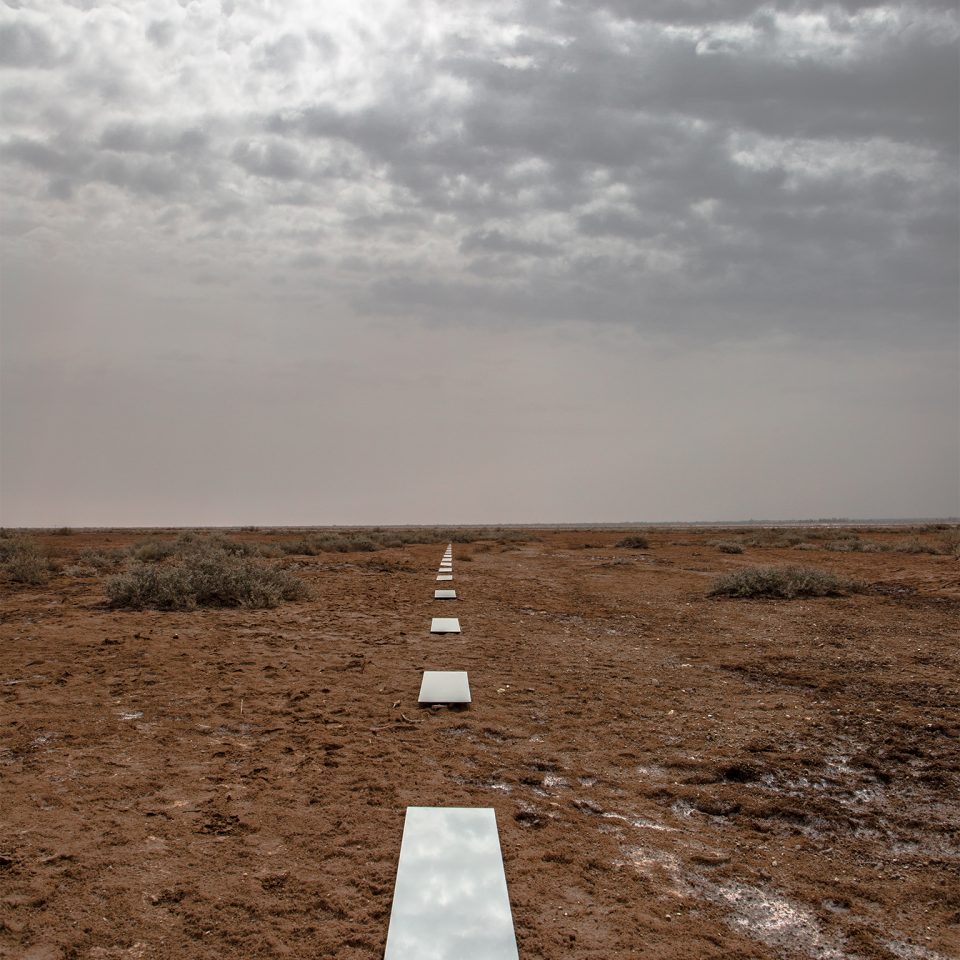
Shirin Abedinirad, The Sky Is Mine, 2016. Land art, Semnan, Iran. Presented as part of The Absence of Paths, curated by Lina Lazaar for the Tunisian Pavilion at La Biennale di Venezia, the work draws on Sohrab Sepehri’s line — “Where I am, let it be so — the sky is mine” — to transform the landscape into a meditation on hope, liberation, and belonging. Emerging from what the artist describes as a search “for a place that opens like a window to life, full of joy and possibility,” the installation brings the sky down to earth, rooting dream and reflection in the very ground beneath our feet. Artwork courtesy of featured artist Shirin Abedinirad.