


I remember a woman hovering over her olive-wood-fashioned board, buried under fresh pomegranates and eggplants for the preparation of Rummaniyeh, a traditional coastal dish that once graced the tables of historic Jaffa, Ramle, and Lydda. Her face is no longer branded into the grey matter of my brain, but as I focus, recalling her hazel eyes and long straight nose, the memory—once compressed and brittle— evolves from what felt like a crumpled piece of paper into a whole archive, layered and breathing.
The woman is my Teta Georgette, my baba’s mother, originally from Jaffa, daughter of a tobacco tycoon. The locals of Jaffa nicknamed him Nafal, a surname associated with individuals deemed prosperous in agriculture and trade. His patronage, however, was not Nafal but Audeh, meaning “the returning,” and the masculine analogue of my name, Ayda.
His agricultural land was laden with tobacco fields painted with yellow blooms from early spring to the end of summer—a precious cash crop supplying the cigarette industry of Jaffa, their sweetness sharp in the air, clinging to clothes and skin.
Rummaniyeh found its place in Gaza, like Teta, her parents, and siblings, following the Nakba and their forced displacement from their homes in Jaffa. The dish became a vessel of Jaffan identity — a custodian of its memories, of its trellises of jasmine and expansive orchards furnished with citrus, its ancient port, the city known as the bride of the sea.
Sometimes I imagine a life in which I grew up as the great-granddaughter of a tobacco tycoon. But my reality is that I’m from another generation, dispossessed, forced to leave Gaza with my parents and brother amidst the First Intifada.
I grew up in a country built on the blood and bones of its original inhabitants. This country, named Australia by colonizers, has a harrowing history not unlike that of Palestine. This meant having to navigate the vast web of existential contradictions associated with being Palestinian— a dispossessed person participating in a state architecture built on the dispossession of Indigenous people.
My first language, Arabic, was replaced with a drawling English dialect with its longer diphthongs and high nasal resonance. I miss the Palestinian accent—more guttural than English, with its strong pharyngeal consonants like Ayn, the epitome of Arabness, yet still elegant and melodic, with the glottal articulation of the Hamza in place of the Qaf. The dialect, like a blueprint still lodged in tissue, like muscle memory, has lingered beneath the tongue and, thankfully, has not become a complete stranger to it.
I only spent my early years in Palestine—it’s where I learned to walk and to use a slingshot. Baba helped me fashion my first slingshot from a stick already comprising the classic Y-shaped frame and whatever elastic textiles he had on hand. Stone throwing, once intermittent, broke out on a large grassroots scale during the First Intifada as a form of civil disobedience. When we protested, we came with stones, slings, catapults, and slingshots. We became the generation known as the “children of the stones.” David defeated Goliath with a slingshot. Israel’s occupation is Goliath; I am David, my paternal line Abu Daoud —“Father of David.” However, my slingshot could not put an end to the occupation, but the act of slinging stones was a rejection of the circumstances of the present — the reality we had no say in.
Baba never wanted me to grow up thinking the occupation was ordinary, but the reality was that living under endless curfews, blockades, and checkpoints had become ordinary—it was the first thing I knew. Whenever we had to leave Gaza, I would go through checkpoints with my parents and Teta, who required specialized medical treatment in Tel Aviv—once Jaffa. Even before the introduction of blue and green IDs, we had to have military-authorized permits to leave Gaza to enter Tel Aviv.
It was cancer that allowed my grandmother to visit the place she used to call home. It was cancer that allowed her to once again feel the soil of Jaffa beneath her feet. After her treatments, we would sometimes visit the house of my great-grandparents. If Jaffa was the bride of the sea, my great-grandparents’ house was her wuqayat al-darahim — her “money hat.” Their house was lavish, built with sandstone, every brick once a witness to the mischief of children from the Audeh family. Two large lion statues guarded the base of the stairs that led to the front door. We would curiously tiptoe around its perimeter, trying to sneak a peek at its uninvited inhabitants.
My mother is not Palestinian but Scottish, and despite the fact that Israelis treated her like the rest of us, she was never fully accepted into Palestinian society. Baba used to regularly donate blood to medical centres in Gaza, but my Mayme was often refused when she offered her own. The occupation made us outsiders in our own land, but my Mayme—she was a true outsider.
Traditionally, in the Arab world, membership in an ethnic group was based on paternal descent — your paternal line determined your affiliation. Kinship was agnatic. I was Palestinian; I was registered to Gaza’s Civil Registry at birth—my hybrid identity acceptable because of my paternal line. I felt for my Mayme; she could not belong to my tribe but was also rejected by her own. Her family found the concept of a white woman marrying an Arab outrageous; the fact that she married a Palestinian was a transgression considered far worse.
Baba had spent time in administrative detention, charged with “breaking an imposed curfew.” When he was eventually released, he was expected to stand trial in military court at a later date. We never knew of his detainment—one day, he just vanished. Later, we found out soldiers had abducted him on his way home from the market. His absence mentally broke my Mayme; she slowly began to lose touch with reality. When my Baba was released, he took my Mayme to see a psychiatrist, who recognized her condition as psychosis straight away. It was a common phenomenon in Palestine, resulting from chronic exposure to political violence. In fear that her mental health would decline further, Baba packed up our lives, and we left Gaza before his trial date.
Not as a choice but as triage.
In exile, I was more than an outsider—I was an outsider with no origin. By Australian state standards, I am not Palestinian. The Western notion of “country” is akin to nation-states— contemporary political entities that enjoy the unique legal status of state sovereignty. Their conception emerged alongside European colonialism. In settler-colonial contexts like Australia and Israel, state sovereignty was achieved through eliminating Indigenous bodies from the land. Palestinians were not granted the right to state sovereignty like their neighbours in the broader region of Bilad Al-Sham following British and French colonialism.
Nation-states utilize bureaucracy—a system built on the rigid rules stipulated by their central governments rather than ties of kinship. Bureaucracy provides continuity in governance and, in settler-colonial contexts, serves as an apparatus to legitimize colonial objectives. There was not a single bureaucratic institution in Australia that accepted “Palestine” or “Palestinian Territories” as an answer on forms asking,
“What is your country of origin?”
When my wisdom teeth finally came through, they became impacted and urgently needed to be removed. I had completed my hospital pre-admission forms, stating my country of origin as “Palestine,” only to find out later that my medical records had been updated to say “Israel.” I could never express how it made me feel—the pain of the words refused to meet my mouth. Instead, they knotted in my stomach, becoming a tangled weight I learned to carry. When I left Palestine, Palestine came with me—but I never expected that the occupation’s erasure of the Palestinian identity would also follow me.
My Teta knew no other land but Palestine. Cancer had taken her before we left Gaza. My mind returns to the memory of her aged body hovering over her olive-wood-fashioned board, preparing pomegranates for Rummaniyeh. She takes a sharp knife to the crown of a pomegranate, which was once a blooming red blossom. In summer, the fruity, slightly citrusy red petals would be placed in the glass base of the shisha. Red petals would dance amidst the bubbling water, the scent of blossoms infiltrating the earthy smokiness of tobacco.
Memory, like smoke, drifts—never fully grasped, never fully gone.
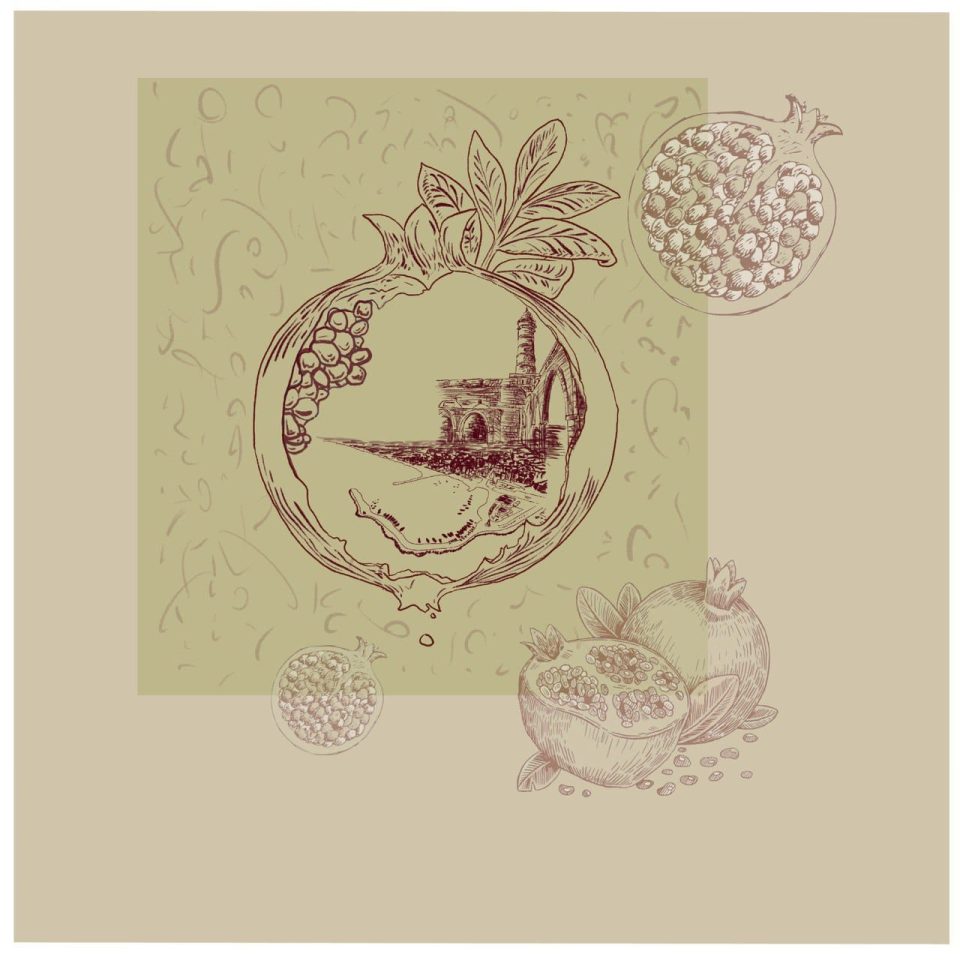
Methodically, she produces a single shallow cut at a time, creating the shape of a pentagon. The pomegranate decrowned, the calyx broken gently along the scored lines, betraying clandestine red jewels — the richness of their colour evoking memories of bloodlines, an ancestry dating back to Bronze Age Canaan.
She proceeds to score great circles through the poles along the ridges and ribs of this wonderfully imperfect spherical fruit. She places the pads of her thumbs at the cut end, once adorned with regalia, pressing against opposing segments, cracking the pomegranate open. The pomegranate breaks along the scored lines, revealing jewelled segments broken across their natural boundaries — fragmented like what became of Palestine following partition, scored by the weapons of colonizers. A single red jewel discloses a single story; a collection of jewels chronicles a collective history, for only through the whole fruit do we appreciate the story in its entirety.
Fragmentation, I learned, does not negate wholeness—it demands a different way of seeing it.
Rummaniyeh — in Arabic, its name conveys “pomegranateness”—is primarily composed of pomegranates and their molasses, eggplants, lentils, citrus, and spice.
When it came to eggplants, nothing compared to Bitinjan Battiri, with their distinctive slim elongated bodies and soft white flesh encased in a royal hue like Tyrian purple — the noble pigment once worth three times its weight in gold. Their flesh, delightfully saccharine, could be eaten like cucumbers. Battir, home to the Bitinjan, was a village in Bethlehem and was once linked to both Jaffa and Jerusalem by railway. It had its own station located among a bustling vegetable market that once boasted exceptional harvests born from its ancient irrigated terraces. The market now exists as a past whisper — a quiet memory of a time before a fragmented Palestine.
The occupation continues to conceive new territories, boundaries, and lines—destructively carving them into the land. Yet, despite this, one can still find small alcoves of land resisting destruction— little treasure troves of wealth. The wild ancestors of the humble lentil, domesticated millennia ago by our forebears, persist and prevail within tiny remnants of natural vegetation. Non-local varieties of lentils now dominate the market, but if you were to visit a village called Zababdeh, you would find the domesticated lentil of Palestine with a single farmer — an heirloom, the fate of its seeds now bound to the hands of successors.
Survival, like seed-saving, is an act of faith.
There is no Rummaniyeh without lemons; the juice enhances the tartness of pomegranates. Jaffa was the city once prized for its citrus, but few people know that Gaza was once lush with citrus orchards — expansive groves embellished with lemons, oranges, grapefruits, and pomelos. Gaza port was once a free-trade zone under Egyptian authorities, and citrus was its main export up until the occupation seized control in 1967, destroying the port and blocking trade through Egypt. Today, the ocean breeze no longer carries the scent of citrus blossom, as Gaza is reduced to dust — their sticky white petals arranged in corymbs, now as scarce as hens’ teeth.
So much has been erased from the landscape, but the plants and their fruit — they cannot be erased from memory, and in that way, what has been lost almost still exists. We never move on from what was, remaining suspended in a past breath, daring not to put fragile memories at risk— for we couldn’t bear to lose more than we already have.
Memory becomes the last ecology left standing.
Growing up, Baba would make sure I ate an orange every day; our fruit basket was never shy of oranges. Citrus was his favourite fruit. He’d managed to establish olive trees throughout our backyard, but the orange trees did not thrive, as they lacked the subtropical climate. He would purchase Valencia oranges from the local store because they were akin to Jaffan oranges in sweetness and acidity. However, they differed in their skin. Baba would tell me that Jaffan oranges were thicker-skinned — their skin resistant and stubborn, just like Palestinians. When he peeled an orange, he would often rub the pith and zest onto his hand, carrying the perfume on his skin, clasping at the memory of orchards, the scent a ghost of lost blossoms.
Scent, like history, refuses containment.
Food remains a link to Palestine. Growing up, our family table was often dressed with traditional dishes. Sunday mornings were reserved for big breakfasts. Baba would prepare falafel, ful medames, and hummus, served with flatbread, torshi, fresh tomatoes, cucumber, and shatta. The various smells awakened olfactory memory. Being Gazan includes a love for spicy food. Shatta, with its fiery heat and perfectly balanced acidity enhanced by fermentation, is the quintessential ingredient in Gazan cuisine. It is prepared with either red or green chillies, whose natural pigments beautifully contrast with any dish. Baba would present food garnished with colour and insisted that people always ate with their eyes first.
Traditionally, Palestinian women are the stewards of culinary knowledge, but Baba loved to cook. He never wrote a single one of Teta’s recipes down — and he didn’t need to. He knows every dish by heart and hand; his eyes know quantities, and his taste never fails him. He taught me the way he learned. When I cook Rummaniyeh, I consider how many other Palestinian dishes, steeped in intergenerational memories, have trespassed borders. Despite exile, food is a constant — a link to identity that cannot be erased by colonial concepts of nation-states and bureaucracy, the instruments of colonial domination.
When I cook now, the kitchen becomes a map without borders.
In the quiet simmer of pomegranates and lentils, I hear what history tried to silence—and I keep listening.