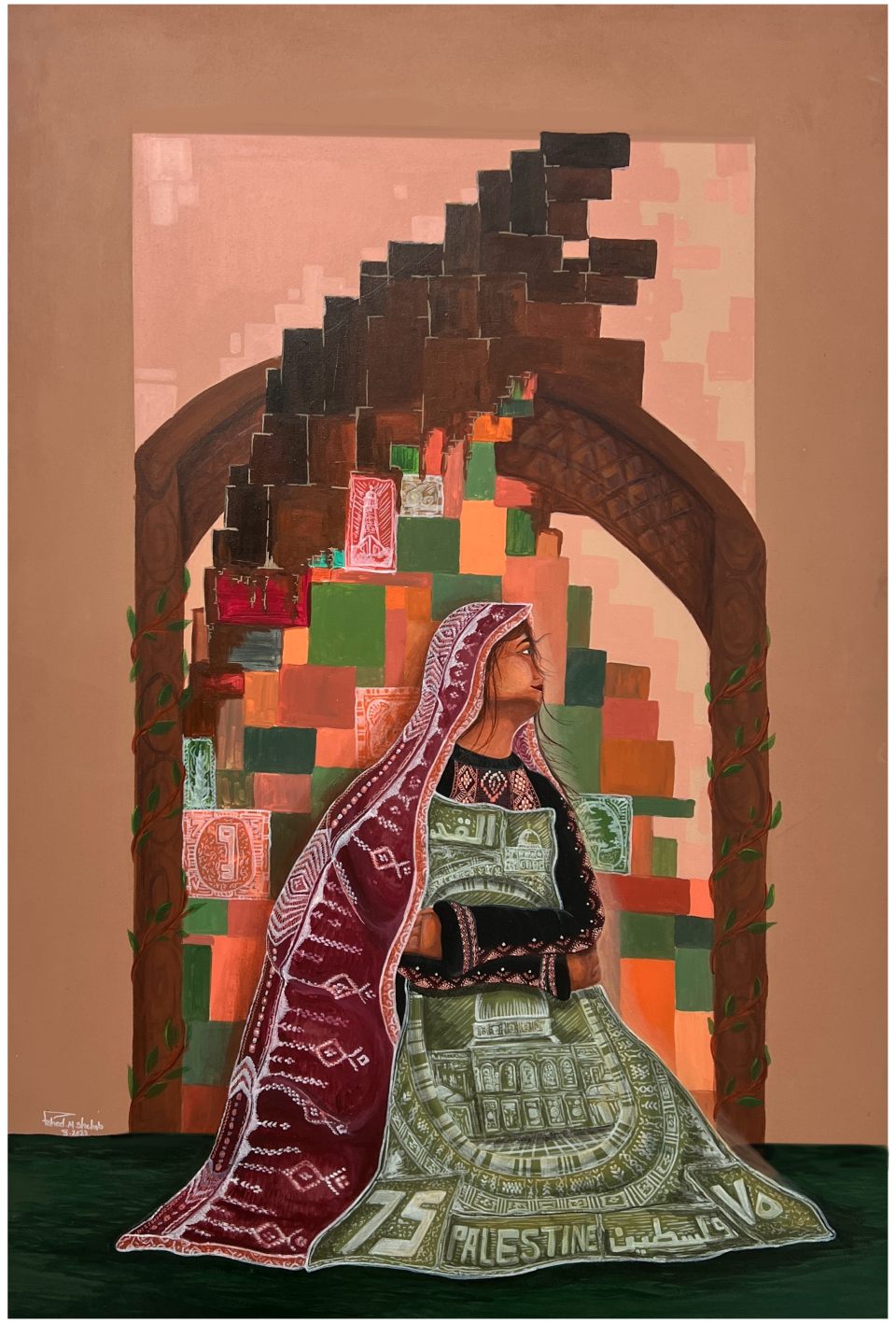



Baghdad, 840 A.D.
I must inform whoever will stumble upon this manuscript that I have written it with the sword of death over my head. Few people in my surroundings know about the existence of such writing, and those that do have all joined hands in cautioning me against completing it. My name, I am afraid to say, must remain in the shadows from which these pages have emerged into the light. It is neither I nor my thoughts and beliefs that the reader ought to be concerned with, for I am of no consequence next to the graver matters that I seek to bring forth. I pray that this will be found by enlightened minds who bend to no fear or mental coercion. If I take such great risks in writing this concealed part of history, it is due to my inherent belief that the search for truth, and not its concealment, is what give us humans our unique distinction.
A city draped in myths, rumors link Baghdad to buried histories beneath its sands - a silent testament to an ancient realm. It is also said that our city’s name was chosen by the Almighty Himself, and that the name itself means ‘God’s gift.’ As the city’s inhabitant, I stand proudly by these claims, and trust that the test of time will succeed in convincing the most doubtful disbelievers.
Dar El Salam, the name decreed to our illustrious city, is unlike any other known to man. It is surrounded in the south by Babylon and Uruk, providing us with the singular sense that our lives and future are guarded by the forbears of civilization. Architectural marvels unfold in a series of concentric circles, abandoning the rigid geometry of the Romans. At its heart, a grand palace, where our Commander of the Faithful resides, is surrounded by the most dazzling avenues. Outwardly, the city is protected by two thick walls built one inside the other, and further fortified by outward ditches filled with water to increase the protection of our precious city from the foolish delusions of potential conquerors and unruly heathens.
In search of eternal knowledge, Baghdad has become the light of the world. I pray you believe me, valued reader of mine, that it is the place where you must be if you seek to be enlightened on matters of this world and well beyond. This city of poetic and metaphysical flights is adorned by countless libraries, and its streets scented by ancient yet still living manuscripts of wisdom. Scholars of various denominations proliferate within our walls, in hopes of reaching a deeper understanding of the world that surrounds them.
It is now the moment to speak of that which I have taken my cautious time to mention: Bayt al Hikma. Home to endless books, manuscripts, and scrolls of wisdom, this library is, as far as I know, the greatest one of its kind. It is said that it was first commissioned by Harun al Rasheed as his own private library, but then was transformed into the great center of learning we know today. I shall say little for now, but suffice it to say that this narrative arc has been greatly misconstrued. Bayt al Hikma is, nonetheless, the world’s most eminent center for research. Various scholars come together to share their findings in matters of astronomy, mathematics, chemistry, medicine, religion, philosophy, and translation. The library also hosts a number of lectures in these same fields, delivered by various Oulama to the city’s most promising students of knowledge. I am, I must now confess, among these disciples of truth. We are provided with six rooms, all located on the first floor of the library. Students have taken to naming it ‘The Floor of Knowledge,’ and it is left to us to decide which lectures we wish to attend. To keep my identity concealed, I will simply state that I have been attending all of them.
There was one fellow learner of truth, Hunayn, with whom I attended three lectures on alchemy, history, and philosophy. He was young and tall in appearance. He always wore a dark blue linen qamīs, and a grey colored turban over his head. I also noted that he was always wearing a black mitraf, a cloak worn over his qamīs, whenever I met him in outdoor settings. He was avidly curious, and never missed an opportunity to enter into a debate with his fellow learners or even the Alim we had a lecture with.
‘Are you not afraid, Hunayn, that so many questions springing from your curiosity might lead you to unwanted consequences one day?’ I asked him once.
‘Has our Prophet not raised questions that people of his time deemed most blasphemous? We must not fear, dear friend, leaping into the unknown,’ he replied.
‘There are limits, dear Hunayn. One must know the boundaries not to cross.’
‘Perhaps you are right or perhaps you will never truly know yourself until you have walked on thin ice.’
It is a commonly accepted opinion that Hunayn was a truly remarkable man, but any man’s brilliance could turn abstruse sometimes. He ventured into ideas and premises that, I must humbly admit, were far beyond my reach; and I cannot help but wonder, in fact, if they were even within his. There was something deeply mysterious about him, he who seemed always enamored and seduced by the ideas he encountered. He was enmeshed in an exploratory quest deep within him that rendered his mind intellectually porous, always ready to host the most subversive thoughts.
He had the quality, some might say curse, of being impenetrable. It was clear that Hunayn was a man with a purpose which eluded everyone but himself.
It was during our common lecture on alchemy with Alim Ibn Razi that I had truly taken measure of Hunyan’s riddled character and the limitlessness of his search. We were six learners that morning, sitting one next to another on the brown Persian carpet which was brought from Khorassan. Our Alim sat, as all Oulama do, on the same rug, but facing us directly. The Alim was in his old age but always wore his light green qamīs and white turban with grace. His voice was deep, and he spoke with the utmost precision, believing that every utterance greatly mattered. It was told in the streets of Baghdad that he had not once accepted payment for his medical services to the common people. In that day’s lecture, he had explained to us the differences between metals that produced vapor when heated such as mercury and ammonium, and base metals such as gold, copper, iron, and lead. We were meant to learn some of his formulations to produce more efficient medicine. It was when he had notified us that it would be all for that day that Hunayn asked him:
‘If I may, most eminent Alim … I was wondering if we would not be better off learning about the Philosopher’s Stone in our future lectures?’
Alim Ibn Razi’s face had turned stern, the likes of which I had not once observed on him. It was as if he had been told a piece of grave, discomforting news.
‘I will tell you this once only, Hunayn’- he spoke with his usual self-control – ‘Let us seek solely that which would serve the greater good.’
But Alim, there was also Jab–’
‘Enough.’
‘My apologies, Alim.’
‘Hunayn, you would do well to remember that not all quests are worthwhile.’
We were all amazed by what had just happened, even though most of my fellow learners went on to ignore it as one of Hunayn’s usual intellectual whims. I confess, alas, that my own curiosity won over my otherwise restrained temperament, and thus could not resist discussing with Hunayn the inquiry he had presented to our Alim. We had just exited Bayt al Hikma, then decided to head towards the city’s main palace, and discuss the matter in its lavish garden. Surrounded by its splendid greenery and basins, the garden nourished our discussion.
‘What is it that you mentioned to the Alim that made him so upset?’ I asked.
‘Is it not you who has told me that some things are better left in the dark?’ he asked back.
‘Yet here I am asking you, Hunayn.’
‘It is precisely why I must confess that I am surprised; if I would have guessed someone else among us who knew of the Philosopher’s Stone, I would have chosen you.’
‘I am afraid it sounds very vague to me.’
‘Perhaps you have heard of Jabir ibn Hayyan?’ he asked.
‘Yes, I have read and studied his Book of Venus’ I said, and then added, ‘He is one of the great alchemists of our generation. He has spoken at length about the importance of separating and mixing complex compounds to create others.’
‘Such as?’ he asked, as if he did not know the answer to his own question.
‘So we could turn lead into gold.’ I replied.
‘And do you recall whom he served?’
‘Yes, Harun al Rasheed.’
‘And do you believe that our previous Commander of the Faithful, may he rest in peace, needed Jabir’s services for mere gold considering all the wealth that he already had?’ he asked with a sly smile forming on his face.
‘What then?’ I asked him.
‘That which had been denied to Adam and Eve in the Garden of Eden.’ ‘That cannot be, that is foolish!’ I exclaimed.
I understood then what the Philosopher’s Stone was about: immortality. He went on to explain to me that Jabir’s real intent went beyond the mere metal transformation that most alchemists aimed for. He shared with me that he had left behind a manuscript entitled The Book of Time in which he had left his magnum opus - his formulation for the Philosopher’s Stone: al-iksir. In theory, the alchemical principle remained the same: a transmutation of one thing to another - but this elixir bestowed eternal life and omnipotence instead of precious gold.
‘It is not foolish, dear friend’ he said. ‘The manuscript is said to be somewhere within the walls of Harun al Rasheed’s secret library.’
‘Is that what you have been reduced to, a victim of unfounded and delusional rumors running through the streets of Baghdad? Such a library does not exist,’ I affirmed.
‘What you name delusion I choose to name hidden knowledge.’
‘That is not hidden knowledge — it is mere blasphemy.’
‘May I ask why you refuse to entertain the idea of immortality?’
‘Because it neither seen nor observed. It simply does not exist!’ I exclaimed.
‘I find it deeply ironic that most men will refute that which they cannot see, but place their entire faith on a divine being that is equally not visible.’ he replied.
‘It is not comparable. We see our Creator in all the things he has created.’
‘Here lies the difference between you and I,’ he said. ‘I choose to believe equally in our Creator as well as his unstated, unspoken creations for us.’
‘You are projecting too far, Hunayn.’ I warned him.
‘Have you ever wondered what we might discover about ourselves if everything was permitted?’ he asked.
Shortly after, he informed me that he had to leave and that someone important was waiting for him. I reflected on his question when he left, and I finally knew who Hunayn was. He was a lost soul headed towards perdition, and seemed to have cut any umbilical cord he might have had with reason. I could not decide, and still cannot do so now as I am writing whether he had turned into a host for someone he had become, or whether this was what he had always been. In the power of his urgency for things larger than himself, he had slipped into an ungrounded and unanchored darkness.
As days went by, I could scarcely remove the conversation I had with him from my mind. I drifted into thoughts I did not wish to dwell on, but could not restrain myself from exploring further. Could he have been telling the truth, that there was a hidden library somewhere in Baghdad which preserved Jabir’s manuscript? This is when I succumbed to the unpredictability of the human mind. Until that moment, I had always believed I knew my path in life, but there I was, possessed by something I could neither name nor grasp. I realised that my understanding of my own self, of the sense of self-control that I thought I had, was but a feeble belief. Bewildered, I opened my eyes to the fact that I was penetrable by forces of gossip that I could not restrain. Hunayn’s quest, which only days ago had struck my senses as the work of madness, now started creeping into the most curious recesses of my mind. I had turned so impressionable that I felt as if initiated into new rules of mankind. Hunayn never brought up our previous conversation again, which misled me into believing that he had, in alignment with his impulsive interests, moved on to a new pursuit. It was only when he began missing some of the lectures a week later that I sensed something strange taking place.
God works in mysterious ways and brings revelations to us in equally enigmatic places. The sun dipped below the horizon, casting long shadows across the bustling and intriguing marketplace. Located to the south of the main city’s palace, the suq’s constant stream of visitors, coming in and out, makes it almost vertiginous. You will find there people from various walks of life, drawn there for the sole purpose of exchange and purchase. Persian and Arabic rugs were on constant display, as well as warmly baked bread, fresh yields of vegetables, fruits, and utensils such as dishes, jars, cups, and beautifully inscribed vases. It was next to one of these vase sellers that I had witnessed him only a corner away from where I was. Hunayn was in the company of another man who was wearing a black mitraf as well as a black turban, but whose face I could not distinguish. I was also unable to decipher their conversation, yet it seemed clear to me that they were having a vehement argument with one another. Hunayn, in particular, was furiously gesturing with his hands. The suq echoed with the lively sounds of haggling, merchants shouting prices, and the rhythmic clinking of metalwork. In that moment, they slipped away, as people often do in the marketplace, disappearing into the secrets of hidden corners.
Hunayn’s presence grew less and less noticeable as the following days went by, so much so that he no longer deemed it fit to come study at Bayt al Hakma. Elusive as always, no one understood his motives nor could we ever get hold of him to discuss the matter. It was by mere chance that I caught sight of him when I decided to remain studying late at night in our library. I was on the second floor inside the room dedicated to the translated works of Greek thinkers. It was Al Kindi’s recent translations on the works of Plato and Aristotle that caught my interest. Since it was dark, I had lit three candles. One I had placed by the window which I left half open, one on the main reading table of the room, and the third suspended on the wall by one of the bookshelves. A gust of wind had extinguished the candles by the window and reading table, making it impossible for me to read. I had just lit them again, when glancing from the window, I saw a man walking in the inky darkness of the night carrying a candle protected by a glass dome. He wore a black cloak, a faintly discernable blue qamīs, and a grey turban. I could not have mistaken him – it was Hunayn.
I rushed out of the room and headed towards the stairway to exit the building. Once outside, I stood in the darkness looking for him. Feeling slightly anxious to have lost trace of him, I spotted his faint candlelight from far away. It headed towards the northern side of the palace, Naubakht’s Entrance. I ran towards it, but he was still a considerable distance away. He seemed to unlock the door of a smaller adjacent building, one that I had seldom noticed until that night. I made sure he entered it first before I followed in his tracks. I reached the thick wooden door, which he had not locked, and stepped inside with blood rushing to my head.
I lost sight of Hunayn, but I heard his steps above me. I located the stairs and decided to go up. Once I had reached the first floor, I could see a faint light in the corridor coming from the room which he had entered. As quietly as possible, I moved closer to the barely opened door much as a thief would. Reaching it, I peeked into the room. There he was: I could see his figure from the back. The room was extremely small, but was filled with books and bookshelves. The scent of ancient manuscripts permeated the library, a heady mix of leather, parchment, and ink.
He stood in the middle of the room with his head slightly bent, reading from a book that his body shielded from my sight. It was then that I heard him say excitedly, ‘My God, my dear God, so it is true.’ What took place afterwards gave me the fright of my life: I heard the door below squeak and saw Hunayn’s silhouette swiftly turn towards me. I immediately ran towards the stairway and escaped into the enveloping darkness of Baghdad. I moved as quickly as possible and did not once look back until I reached my quarters four streets away from the palace. Trembling, I hurriedly unlocked the door of my house and locked it again as quickly as possible.
I took a deep breath and then headed to my room. I lit a candle and sat on my bed, and then frantically began to relive what had taken place. Despite the fear I had felt, I found great solace when I realized that it was nearly impossible for Hunayn to have recognized me. The door was barely open, the room poorly lit, and my cloaked head was only peeping in. It could have been any other man in Baghdad, but my mind was then invaded by questions I had no immediate answers to: what was that room and what was it that was true? Could it have been what he made mention of when we spoke of the Philosopher’s Stone? No, surely that was not possible. Feeling extremely anxious, I found it hard to get to sleep. It was only when my body had exhausted itself that I slept for a few, fitful hours.
I woke up next morning still feeling a great deal of anxiety, but resolved to attend my lecture on philosophy to avoid any suspicion that might arise. I could not manage to eat anything except two small dates. I prayed, got ready, then left for Bayt al Hikma. There was an unusual number of people surrounding the main palace. Making my way as best as I could to the entrance, I noticed that the crowd seemed greatly troubled by some event I had no knowledge of yet. Having now reached the place, I saw Raheem and Seif Edeen — fellow disciples of mine — rushing towards me.
‘Alim Ibn Razi is dead! He’s dead!’
My mind refused to grasp the words.
‘He was found lifeless in his quarters this morning, a dagger in his heart,’ Raheem revealed. ‘MURDER!’ an electrified voice erupted from the restless crowd, held at bay by vigilant royal guards.
‘And Hunayn? Has anyone seen him?’ I pressed Raheem and Seif Edeen.
‘Not a trace. He’s vanished,’ Raheem replied, his eyes reflecting the chaos swirling beyond the palace gates.
We did not know it then, but we would not see Hunayn ever again. This is where, valuable reader of mine, the mystery of it all deepens to unfamothable degrees. Not too long afterwards, I gathered whatever courage I had left and went to the secret room I had followed Hunayn to on the previous night. I could not believe my eyes: the room had disappeared. What I mean is that it did not disappear physically, as its walls, ceiling and floor were still there, but the shelves, books and small table I had seen, had all vanished into thin air. It was now mere walls and dust, devoid of the slightest traces that there had ever been manuscripts once occupying that room.
Was I hallucinating or did I dream the secrets of that night? No, I am convinced that my eyes did not betray the reality I had seen. Baghdad shortly turned into an arena of speculation where factual evidence merged with mythmaking. Rumors began spreading like wildfire, with no limits or end in sight. I realize now that I am at the same crossroads with those of you who have found my manuscript. The same questions that I assume are lingering in your minds, I assure you all, are lingering in mine.
In the wake of these dark twists, the city’s dwellers have become avid speculators, weaving intricate tales of intrigue. Whispers in the shadows connect Hunayn’s vanishing act to the demise of Alim Ibn Razi, some confidently casting him as the orchestrator of the murder. Some have rejected this premise saying that for all the flaws and shortcomings that he had, Hunayn remained a most respectable and God-fearing believer. Others have suggested that it was a fellow alchemist who had done the deed, motivated by the prospect of wealth. Alim Ibn Razi did offer, after all, free services to the common people — something that must have infuriated other competitors. I am also fully aware that some of you will be enticed into considering my own complicity in this account, but rest assured that the shadows cast upon my involvement in the tragedy remain a subtle whisper lingering between the lines.