

In the Spring of 1988, Saddam Hussein’s planes dropped poison gas on the Kurdish city of Halabja in northern Iraq. The image of the war still haunts me.
At the time of the Gulf War, I was newly married. I had just finished my training as a teacher. My husband was an intern at the hospital. We were living not far from Halabja, in the small Kurdish city of Darbandikhan. The two cities are separated by the Sirwan River. They are so close that people sometimes swim from one city to the other.
I was decorating my new house when the bombs began to fall. The bombs fell all day long. At noon on that day of the bombing, I saw a lovely tree in front of my house cut in two. Suddenly, the doors and the windows of my home were blown out. I knew I had to run. There was no time to think about what belongings I should take with me. I grabbed my small handbag, with nothing more than some important documents and two family photographs. I ran out the door, not sure where to go, what to do, or how to save my life.
The moment I left, I heard an explosion in the front yard. Dozens of people were leaving their homes. I ran with them to the hospital basement. I saw an eleven-year-old boy, my neighbour, who had lost his legs in the bombing. His parents were taking him to the hospital. After a few minutes, I heard the mother wailing over the death of her son. Her cries sharpened my fear. I rushed through the door of the basement. I couldn’t speak with my husband inside his office, which was now filled with injured people. Still more people were being brought by ambulance.
Not long after, a wind drifted over the town. It carried a scent that was unfamiliar to everyone. I had never smelled anything like it. It was like a perfume. It smelled like an apple or an orange. Or was it gas? The basement of the hospital was so crowded I could barely find a place to stand. It was a horrific and long afternoon. People waited to hear any news. We were surrounded by fear and suspicion. We anticipated death at any moment.
The bombing continued until the next day. In the morning, I went to the terminal to return to my birthplace of Sulaimani, where all my family lived. The terminal was closed, and there was only one taxi. Fortunately, the driver lived in Sulaimani and was willing to give me a ride there, though at a higher fare than usual. We travelled from Darbandikhan to Sulaimani. The driver attached a white flag to the car antenna to show that we were civilians. Both of us were extremely anxious until we reached our destination.
It was only later that I learned that everyone had died in Halabja. The list of the dead was 5,000 from that area alone, and every day more names were added to the list. Days later, I listened to the news to know what had happened. In just one day, the whole city had been poisoned. Women, children, animals, trees — everything was dead.
I had to accept that I would never see my house again. I do not have any pictures of my childhood or of my wedding. I might have a home in the future, but I will never have those pictures of my childhood back. My parents helped me overcome the grief.
After a month, my husband joined me at my parents’ home in Sulaimani. But after what had happened, our relationship changed, and we never regained our wholeness again. He was from the southern part of the country, home of the aggressors, the Arab Ba’ath Party, which wanted to rule northern Iraq, which is primarily Kurdish.
This deadly day haunts me still.
Three years later, in 1991, there was an uprising by the Kurdish people. Five million Kurds — the entire Kurdish nation — fled to the borders of Iraq, Iran and Turkey in search of safety. The Kurds had no friends except the mountains. They sheltered us until we could return to our homeland, after the no-fly zone was imposed.
Three months later, I returned to the almost-empty city of Sulaimani. There were no government services and next to no movement. Cars and buses were hardly seen on the roads. Gas stations were closed. Basic needs such as home phones, electricity and water were not available. The city was uninhabitable.
I thought about the home I had shared with my husband in Darbandikhan and about finding a way to go there. One morning my sister Pesho and her husband came to my parents’ home. He had bought gas from smugglers on the street and offered to give me a ride to Darbandikhan. With his help, I would finally see my home after three months away.
But what we found upon our arrival was a shock. My home had been broken into and looted. The doors and the windows were gone. The living room was a mess. A dirty tray had been left in the middle of the rug, and the rug was partly burnt. Sausages and juice had been thrown on the loveseat and the sofa. The boots and hats of soldiers were on the floor. My bedroom had been vandalized and emptied. It was the same in my son’s room. The closets had been emptied of clothes and shoes. My traditional Kurdish clothes had been burned, the few pieces remaining left on the floor. The bag I had prepared for my baby, filled with items that I had sewn, was gone. The baby’s bassinet was broken.
I went back to the living room, where our pictures had been thrown on the floor. The vandalism was painful. No albums were left. Hardly anything to hold as a memory remained. The kitchen was almost empty, except for garbage on the floor and leftover animal food. I went out to see the yard. Because of the chemical weapons, the trees had died. Not a single plant had survived. My trip home had been a nightmare. I collected the few pictures scattered on the floor and left them in my brother-in-law’s car, then returned to my parents’ house.
My heart was broken. There was nothing to take with me except the memory of a looted house. I left in sorrow, with tears in my eyes. Only with my parents’ support was I able to overcome the pain of the tragic loss. I never saw my first home again, even though I have returned to my homeland many times. That is why the image of the war haunts me still.
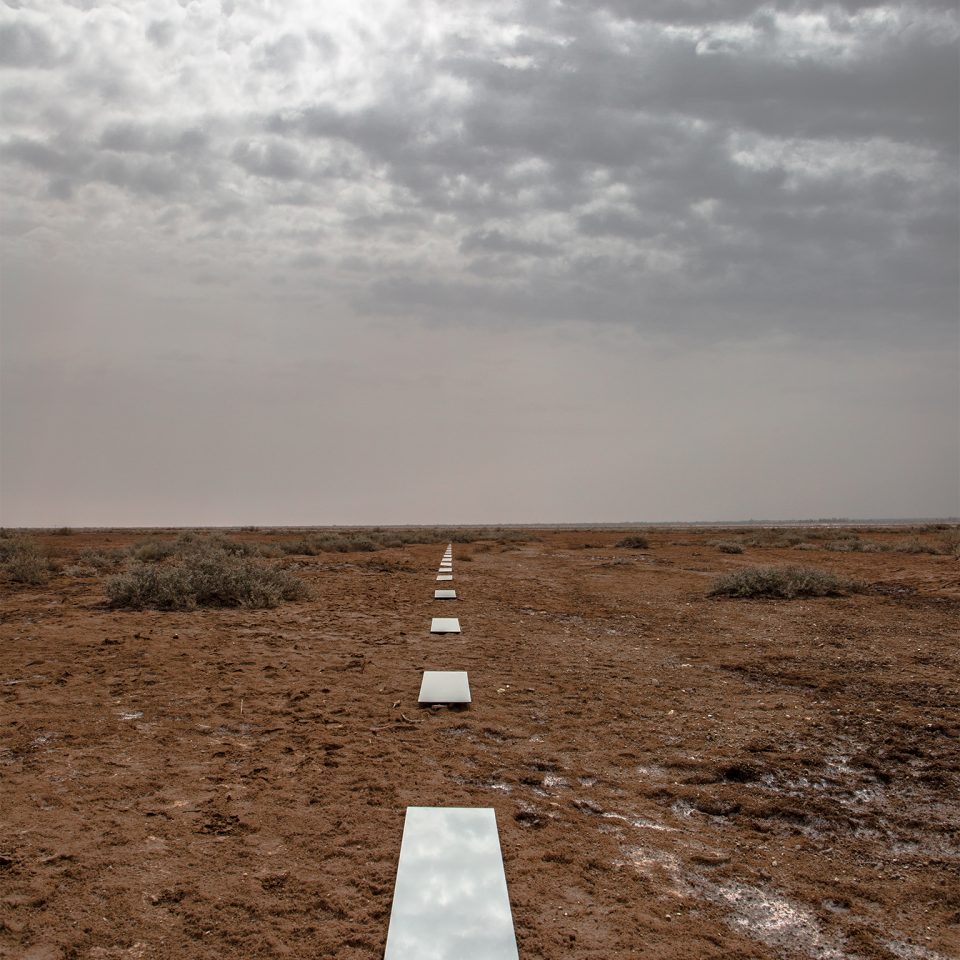
Shirin Abedinirad, The Sky Is Mine, 2016. Land art, Semnan, Iran. Presented as part of The Absence of Paths, curated by Lina Lazaar for the Tunisian Pavilion at La Biennale di Venezia, the work draws on Sohrab Sepehri’s line — “Where I am, let it be so — the sky is mine” — to bring the sky down to earth as a gesture of hope, liberation, and belonging. Artwork courtesy of featured artist Shirin Abedinirad.


