


Road N13 is closed because of snow. It’s been coming down all night, so thick that cars were going over cliffs until the checkpoints closed. The snowplow went through thirty minutes ago, but the white is still accumulating, concealing the raveling, filling the potholes, doing the work the parties will be doing once the next election gets a little closer. For now, these mountains are forgotten. Only emergency vehicles are being allowed through. That’s all right for me and Houri, him in his ambulance, the red one, for the living, because for him there is still hope, and me in the old Fiat Siena, the words Gendarmerie Royale inscribed along the sides, white lettering against a bar of black against more white, like camouflage against these rocks, this snow.
They say we’re heartless, me and Houri. Born out of wedlock. Raised in Zniber. Only fit for this. When news of the murders reached the station, I was the first, the only one, to grab my gear and hurry out into the snow. I’m not even on duty. I just have nowhere else to go at this hour, no one else to wait out the storm with, drinking tea, playing cards. It’s the same for Houri at the public health center. He was the first to the ambulance. Maybe it’s a death wish, common to our kind, the secret reason we’re fit for this. Or maybe it’s just bastards have a lot of free time on their hands. Some of us find productive uses for it. Others turn out like Jawad.
Houri and I both knew at once, and knew the other knew, and had no need for words, that Jawad was responsible for the massacre at Jbel Hebri. A whole family slaughtered. Their animals stolen. The grizzly scene discovered in the early hours of the morning by a child sent to borrow sugar. The latest, most audacious in a string of killings to hit the region, which is Jawad’s neck of the woods, after all, the place he thinks he’s from. And this time, there’s no way he’s working alone. Not with all that livestock missing.
The cleverest detective in the capital will get this story wrong: will say he’s been killing for the cattle, the contraband. But it’s never been about the contraband. There’s always at least one female body on the scene, always over thirty. To the spinsters, he usually grants the minor mercy of efficient dispatch, but per the autopsies, each mother and prostitute was honored with hours of torture. Just in case she happened to be the one who gave him life, then gave him up to Zniber.
The same detectives would’ve peered into the rain barrel at Zniber on that frosty morning five years ago, seen the nameless infant’s body there, beneath the ice, and concluded that they had a heartless killer on their hands. I saw something else. I never told anyone but Houri, and even he took some convincing, long nights of heated whispers, but eventually he came around.
The question was never whether Jawad had left the baby in the barrel. It could only have been him. He was always pulling vicious pranks on teachers, fighting boys, seducing girls, sometimes not even bothering to seduce them, always getting his way. Everyone knew, including the grownups, and no one stopped him. The more those things were done to girls, the more of us bastards there would be, meaning more grants, more donations, more reasons for Zniber to go on existing. The real question, the one keeping me and Houri up at night, was why. Why was Jawad turning out the way he was supposed to, whereas others—us—were growing differently? Jawad’s story wasn’t any worse than mine or Houri’s; but, as I pointed out, Houri had medical school to look forward to. I had the gendarmerie. We were good because we still saw goodness as an option. Jawad was the way he was because he saw no other way to be.
The rain barrel convinced me, and I convinced Houri, to take matters into our own hands. We agreed that what was needed was an intervention. At first, we tried reasoning with Jawad, using words, even though we’d never trusted words. If they were loyal to anyone, it was to Jawad, who knew how to twist them, to insinuate and coax and persuade, to turn on the charm when he had to—though that wasn’t one of those days. To all our arguments, finely crafted and carefully rehearsed though they were, he didn’t bother mustering a verbal response: just dropped his pants, squatted right there in the hall, and started shitting, smirking, his eyes locked on mine.
Next, we tried using his language. We jumped him while he was alone, pinned him, beat him until he wept and bled and begged for mercy, then gave him threats instead. This was my idea. My hope was to win his respect in a brutal way, break him down, show him that someone was stronger than he was, then slowly, painstakingly build him back up again. It didn’t work. A few nights later, he left through a window. Zniber lets you go at eighteen. We were fifteen then.
Not quite a year later, the Jbel Hebri murders began.
If Houri and I had trusted words from the beginning, maybe we’d have mastered them by eighteen, when we sat for the baccalaureate exam. As it was, we both scraped by with passing grades: good enough for the gendarmerie, as it turned out, but not for medical school. I applied for the gendarmerie in Azrou, whose administrative orbit happens to encompass Jbel Hebri, ever mindful of where I was needed. Houri also ended up in Azrou, though by chance. Having wasted no time grieving his exam results, he set out from Zniber and went straight to the public medical schools in Fes and Casa and Rabat and Marrakech, where he begged for admission, for an exception to be made. One and all refused. Next, he tried the hospitals, offering to work for free in exchange for on-the-job training. Again, he was turned away. Only the Berbers at the public health center in Azrou were willing to make him an ambulance driver—and even they did it with contempt, as if throwing a feral dog a bit of rancid bone.
“I’ll save lives someday,” Houri used to tell me back at Zniber. “Wait and see.”
I had no reason to believe him, but I did believe him. I even said, “Me, too.”
“I’m in the red ambulance,” he said twenty minutes ago, on the phone, just before white static washed the line. “I’ll meet you there.”
“I’ll meet you,” I agreed.
* * *
It’s mid-morning by the time I arrive in the town where it happened, one of the hundreds of anonymous settlements scattered along N13, known collectively by the same name as the mountain itself: Jbel Hebri. This one looks to be no more than ten or twelve families, all of them already gathered beside the road. The man at the head of the small throng, gaunt and old, with fat lips and white hair coming out of his ears, sizes up the Fiat with beady, crawling eyes. He can’t read the lettering on the sides, I can tell from his scrunched-up expression, but he delivers his verdict with confidence anyway:
“You’re not the ambulance.”
“No,” I agree, one foot out the door, testing the slickness of the gravel-studded ice beside the road. All night, my ears have been full of the roar of the heater, the whine of gusts through clouded crags. Now, with the engine dead and the storm in regress, silence sweeps in. Something tells me it was a mistake to cut the engine, that it will not be revived, but it’s too late. The tires are already half-deflated from the cold. The Fiat will be leaving this place behind a tow truck, or not at all.
“Where is she?” asks the old man, coming forward to stand between me and the sun.
“She?”
“The ambulance.” He inserts a finger into his ear and rotates it thoughtfully. “I talked to her myself, you know, and she was a lady ambulance.”
“The dispatcher, you mean?”
With his free hand, he waves this distinction away.
“It’s the red one,” I say. “The red ambulance. He was ahead of me. You must’ve seen him.”
“There’s no red ambulance here.”
These words settle on my surface, as delicate as frost, as cold, and take their sweet time sinking in. And as they do, whatever was warm in me grows cold.
“I tried calling her back,” says the man. “I kept calling and calling, but that phone of mine isn’t doing anything useful. It just makes that irritating noise!”
“Cell service is down.”
“Cell service is down,” he agrees. “And there’s something wrong with my television.” He offers me his hand, one finger waxy and glistening. “Ben Nasser.”
For some time, I stare stupidly at the hand.
“That’s all right,” he says after a while, putting it back in his pocket. “I already know who you are.”
I wait for him to tell me who I am. I really want to know.
“Mr. Police.”
“Gendarme.”
“Why don’t you tell me something,” he goes on. “If that ambulance of yours is so damn good at saving people, why doesn’t it start with itself?”
“He doesn’t know this road.” At least I tell myself he doesn’t. I tell myself he’s never had to take the national highway, the main route through these mountains, either while traveling from city to city by bus in search of opportunities, or as an ambulance driver. All I really know is that Jawad’s handiwork has never called for red ambulances. “And it was dark,” I add. “Snowing. He must’ve passed you and kept going.” It occurs to me to wonder when exactly the cell tower went down—the moment our call dropped? Or sometime later?—but I quash this question, tamp it into a crevice of my being from which it cannot be retrieved.
“Not that it matters,” Ben Nasser goes on. “There isn’t anyone left to save. My daughter, she found them last night, all cut up and mixed together. It made her forget how to talk, it was so bad! She wouldn’t even tell me where the sugar was, why she didn’t have it with her. Of course, I had to beat her until she started talking. What was I supposed to do? I needed that sugar. How else was I going to sweeten my tea?” A splotch of green mucus leaks out of his nose.
“I’ll need to see them.”
“Who?” He sucks the mucus back in turbulently.
“The deceased.” Which does not include Houri, I tell myself. Cannot include Houri. If he went off the road, I’d have passed him. I’d have seen the wreckage. He must’ve kept going, stopped somewhere farther along, in the wrong town, and not been able to turn around. Maybe a tire burst. Maybe the engine stalled.
Maybe black ice.
“Deceased?” Ben Nasser wrinkles his nose. “I don’t know them. They must live somewhere else. Not here.”
“The dead.”
“Oh!” He recoils a little so that the sun shines past him for a fraction of a second, hits my eyes. Then he regains his composure. “What do you want to see the dead for? Why don’t you come in, get warm, have a cup of tea?”
“No, thank you.”
“Don’t worry. I ended up borrowing Abdullah’s sugar.”
“It’s not that,” I say. “It’s just that I need to examine the crime scene.”
“You’ve got your heart set on it, eh?”
“It’s my job.”
“It’s a good thing it’s cold. If it were summer, they’d smell pretty bad.”
“Please, just take me to them.”
“Why not?” He turns with a shrug and trudges back the way he came, slotting his boots into the boot prints in the snow. The blood drains from my head as I stand. The mountain looms unsteadily above, and the sun is momentarily blown apart into a giant dandelion, a cosmic scattering of spores, but my legs take my weight and bear it, and the world comes back together, and I am myself once more.
The villagers are dispersing, shuffling off to hide themselves in the brick and concrete hovels scattered about the mountainside. An elderly woman, two adults, and a gaggle of children fall into step along with me behind Ben Nasser. Why this little procession is going with us to the crime scene, I cannot at first make out, but I don’t get much time to ponder the question. The house to which Ben Nasser leads us is the closest, not ten meters from the road. He lets himself in, and one by one, the others follow, pausing at the threshold to slough their shoes and knock the snow off—and I realize that, in fact, I am not being taken to the crime scene. I’m being taken to Ben Nasser’s, for tea.
Inside, the stoop-shouldered woman—Ben Nasser’s wife? His grandmother-in-law?—hangs a kettle on a hook above the fire, which crackles and flares voraciously when fed another log. The adults and children take their places around the room on cushions and divans. No one shows me where to sit, so I remain standing.
“The ambulance said we shouldn’t touch the bodies,” Ben Nasser says, speaking to me across the room, the circle of his kin. “How about you? Are you going to touch them?”
“No.”
“What are you going to do with them?”
“Just take some pictures.”
“Pictures?” He pantomimes raising a camera, clicks his tongue for the shutter. “You came all this way for pictures?”
“We need records,” I mumble. “Documentation. This is the twenty-first century.” But his question has found its mark. What the hell am I doing here?
“You don’t think you’ll get scared and forget how to talk? Like my daughter?”
“No.”
“You must inspect a lot of crime scenes.”
“I’ve seen a few.” It’s true, I have, but never one of Jawad’s. This is his first time killing since I finished my training and joined the force. Or at least the first that’s been reported. The last few months have been mostly domestic disturbances: wives beaten to death by their husbands, children electrocuted climbing utility poles. Gruesome stuff, but short of the evil that Jawad is capable of. Aloud, but to myself, I say, “But none like this.”
“You look young for a policeman,” says Ben Nasser. “Do they really let you roam around these mountains on your own, inspecting crime scenes?”
“I’m twenty.”
“Married?”
“No.”
“Why not?”
Caught off guard by the question, all I can think to say, again, is, “It’s the twenty-first century.”
“My eldest granddaughter’s thirteen, and she’s not married.”
“I’m sure she’ll make a husband very happy someday.”
“Maybe you,” says Ben Nasser. “You’re here anyway. Why don’t you have a look at her? She’s awfully pretty—but don’t take my word for it. See for yourself! Anyone in town can vouch for her. I’ve taught her everything, you know, how to cook and clean—everything! Halima!” Raising his voice, he summons the girl. “Come out here and meet this nice man—your suitor!”
The first thing I see is her black eye. She must be the one he sent for sugar—but no: that one, he called his daughter. Apart from the bruising, she’s pretty enough: long, dark hair around a mien as pale and blank as snow—though, as with the snow, if one were to dig a little deeper, there would no doubt be something else. Under different circumstances, I might take an interest, but right now, I’m too disoriented. Too confused. Too little in me has thawed.
“This is my lucky day,” Ben Nasser says to himself. “My daughter is going to marry a policeman!”
“Please, Uncle.” I look away from the girl, determined to ignore everything that’s happening, but shouldn’t be. “I’m not here to talk about marriage.”
“Why not?”
“I’ve got other matters to tend to.”
“What a silly thing to say!” Ben Nasser snorts. “Haven’t you got anything between your legs? Does it fall off when you put on that uniform?”
“Nothing’s fallen off. I just—”
“Well, then, what’s the matter?”
“There’s a time and a place.”
“So, what? You’re gay?”
“Zniber,” I snap. “I’m from Zniber.”
Seconds pass before I realize that I’ve said the word aloud. When I do, I sense my body tensing, prickling, shriveling inside my winter clothes. My attention darts around the room, seeking signs of my own mortification mirrored by the others, but they don’t seem to have heard. Maybe it’s the shock of the murders, maybe just the grind of living with Ben Nasser—something has inured them to faux pas. Only Ben Nasser’s face is muddy with the requisite confusion, chin drawn in, eyes agog, unable to respond.
“That’s why I can’t marry,” I say quietly. “You never know who’s who.”
“Well.” He draws himself up a little straighter. “Whatever. You’ll need a place to sleep, I guess. And I’m already hosting the asha’ dinner.” It’s supposed to take place in the home of the deceased, but that’s assuming someone’s left alive to do the hosting. “I might as well look after Mr. Police, too.”
The old woman moves forward, unhooks the kettle from its place above the fire, and begins to pour the tea. Her frame is shaky, but she has a steady hand.
“As much as I appreciate your hospitality,” I say to Ben Nasser, “it’s time I got to work.”
“Do you know where their house is?”
“How would I?” It’s the first useful question he’s asked, but my temper’s wearing thin.
“The one with the blue door.”
Ah, yes. The one with the blue door.
“And where is the one with the blue door?”
“Where it’s always been.” The quality of his belligerence has changed, become somehow more calculated, but the gravity of the occasion is such that even he does not indulge himself for long. He cranks his long neck like a vulture, calling, “Hafida! Come here and show Mr. Police to Auntie Khadija’s.”
The child who materializes can’t be more than eight years old, a skinny eight at that, but I know at once that she’s his daughter, the youngest one, the one he sent for sugar. She moves like a much older woman, haunted by something that hides in the joints, a kind of pain she can’t pretend she isn’t feeling, versed in numbness though she is: not one, but two black eyes.
Without a word, she leads me out into the snow, crosshatched by overlapping tracks, a big web radiating outward, linking my car to all the little homes in which the villagers are hidden. From all the stovepipes, smoke is curling, testifying to the labors of the woman preparing the asha’ dinner. All but one. Nothing curls from the stovepipe of the big house with the blue door at the far end of the village, half-hidden by a copse of trees.
“It’s all right,” I tell Hafida, high-stepping after her. “I see it. I’ll take it from here. Go back.”
But she doesn’t seem to hear. Like a wind-up toy set running by father, she plows through the snow, following the nearly indiscernible hint of a furrow, all that’s left of the path she cut hours before. Her body is too small for high-stepping. Next to hers, my locomotion is ridiculous, mincing. From behind dark windows, I sense women’s eyes tracking me, stashing the memory of my gait away in some deep mental recess, from whence it can be gotten out and snickered over for years to come.
Ten meters out, Hafida stops and stands rigidly facing the blue door, clenched fists hovering centimeters above the drifts, emitting puffs of gray.
“Thank you,” I murmur, easing past her, shrinking from a whisper in my ear—this is the worst thing you will ever see—and from the image drifting in my mind of that gray baby, locked beneath the ice.
But the whisper is right: this is worse.
There are thirteen bodies in the main room, sprawled, tangled, interwoven. Jawad and his crew must’ve struck in the early hours of the night, just as their victims were entering the first stage of sleep, the hardest to be roused from. Otherwise, somebody would’ve fought back. There’s no sign that that happened.
They’ve been stripped naked. All of them. The men have been castrated, the girls’ breasts cut away, the hands relieved of fingers, the feet of toes. The faces hardly count as faces anymore, minus eyes, ears, noses, lips, and tongues—but not all the way minus. Here, protruding like a chubby cigarette from a mouth, a finger. There, pressed into the hole left by an ear, an eyeball.
Facing me from against the far wall are the matriarchs, the mother and grandmother, their eyes still in their skulls, blankly surveying the indelible scene. Gags are knotted in their mouths, and black blood encrusts their throats, but otherwise, they are unblemished, except by the worst of all the punishments: to watch.
Outside, I hunch and wretch. My bile burns scattershot holes in the snow. Time passes. Somewhere far away, a branch buckles beneath the weight of whiteness. Lets it go. Dark clots haunt the edges of my vision. I shake my head to clear them, raise my eyes, and scan the snowscape, hands unsteady on my knees.
No Hafida.
Mr. Police will have to find his own way back to Ben Nasser’s.
The crime scene is no longer undisturbed. On the steps leading up to the blue door, my bile is crystalizing. I drag a sleeve across my crusted lips, clean my mouth with a handful of snow, steel myself as best I can, and once again brave the threshold.
With so little light, a lot depends on the camera’s flash. With each click, two pictures are taken: one on the memory card, the other in my mind. I document the rooms meticulously, probably more meticulously than is necessary: main room, kitchen, storeroom, hall. My last stop is the room where the livestock were kept during storms, empty now. I almost don’t bother—it’s never been about the livestock—but my only other option is to slink back to Ben Nasser’s and wait, a severed appendage of the central authorities, until the snowplow comes.
Soon enough, that’s exactly what I’m doing. The women pass me tall glasses of mint tea, trays of cookies, bowls of nuts, and steaming loaves, and because of my emptiness, I eat, but I taste nothing. The prevailing atmosphere is one of shock, not mourning. The script has been shredded. No one knows what to do, or who should do it, or where it should be done. There are too many bodies, too much death all at once, and no red ambulance on the horizon.
No red ambulance.
The thought that breaches me, slips past my resistance, insists on being thought by me, is this: What fool could know Jawad and still imagine he would leave a soul alive?
“He’s a monster,” Houri said decisively the morning I told him about the rain barrel. “A monster.”
And I said, “Are you sure?”
When I looked through those layers of ice, through which Houri never dared peer, I saw something I never thought I’d see at Zniber: evidence that even Jawad had a heart that, like the Prophet’s, might yet be washed clean. Maybe it was wishful thinking, maybe a delusion, maybe sheer naivete, but in that barrel, that eternal womb, in the natural peace of the baby’s repose, I saw not a murder, but a mercy. A gift to that child: the very gift that Jawad surely wished, deep down, as so many of us did, someone had given him.
Why not the other ambulance, Houri? The one for the deceased?
Didn’t that one have chains on the tires?
Did the red one?
“Can you believe it?” he asked the day we celebrated my joining the force: my first time ever at a café, spending money of my own. He’d been working for some time already. He wanted to pay, as he’d been paying for everything while I was in training at the Royal School, but now that I could, I insisted. Our apprenticeships were over. We were men.
“Sometimes,” I agreed.
“Sometimes it feels like a dream.”
“It does.”
“But we made it. We made it out of Zniber.” Just knowing wasn’t enough for us anymore. We needed words and words and more words, all the words we could amass against the possibility that this reality we’d worked so hard to carve out might yet be woken up from.
“Yes.”
“And we’re not monsters.”
“It depends.”
“On what?”
“The world.” I shrugged. “Society. God. Not everything is up to us.”
“This is.” His eyes flashed, his face thrusting forward, his coffee forgotten. “We’re changing the narrative. Showing the world what we’re made of. It’s not just guys like Jawad coming out of Zniber.”
“But he is from Zniber.”
“For every hundred women he kills,” Houri declared, “I’ll save a thousand.”
“With one ambulance?”
“You and me, working together. Five hundred each. Don’t you think that’s possible?”
“What he does is easier.”
I was just pushing back so that he would push harder. It wasn’t an argument I wanted to win.
“True,” he said. “What he does is in his nature. What you and I are doing runs against the grain.”
Tears welled up in me then, not in my eyes, but all around my tonsils, too thick to be swallowed: salty, stubborn, suffocating.
But Houri wasn’t done. He raised his cup, a cockeyed toast, his face a stab at jaunty: “That’s why what you and I do matters more.”
* * *
It’s night before the snowplow comes. The asha’ dinner is still going on at Ben Nasser’s, but I’ve stepped out to relieve myself, and so I’m the first to catch sight of the lights on the road. Anxious that my lolling shrunkenness shouldn’t be the driver’s first impression of this stricken village, I button my pants and crunch back down the slope to meet them.
Behind the snowplow comes the ambulance, not the red one, marked by the Quranic text, There is no god but God; and third in line, a tow truck; and bringing up the rear, another Royal Gendarmerie car.
“You know how to handle yourself on these roads,” says the Chief of the Gendarmerie himself, disgorged by the vehicle, haloed by its glow. “I’ll give you that. But it’s a damn fool thing you did, coming all the way out here in this storm.”
The first wave of a fever has begun to roll in, eroding my faith in my senses. It’s all I can do not to giggle in the face of this broad-shouldered, ruddy-faced apparition, my superior, who stands before me in this place where no such man should be. Luckily, there’s still enough protocol in me to squeeze out a flaccid, “Yes, Sir.”
“That car of yours is government property,” he adds. “Or have you forgotten? And all the money spent on training you—all so you can go and drive it off a cliff? For what? What the hell do you think you were going to accomplish here?”
“Just doing my part.”
“What?”
“My part,” I echo myself. “My five hundred. Same as Houri.”
“Houri who?”
This is too much for me. The headlights scatter into rainbows, refracted by my tears, and my throat locks around the words, which somehow still squeeze through: “If Jawad could do it, we can.”
Breaths cloud between us, snowflakes burning in the lights from the vehicles, no longer falling, but still airborne, dancing on the wind. A strange look passes over the Chief’s face, a question: “How do you know the name Jawad?”
“Oh-ho!” Ben Nasser’s voice cuts through the rumble of engines. “What’s all this now? Mr. Police, Mr. Ambulance, Mr. Tow Truck, and Mr. Snowplow, all having a party on my little piece of road?”
And just like that, I’m fading, demoted to specter by the radiant glare given off by these men, both more solid than I can ever hope to be. They stand in the tracks we made hours ago, speaking to each other, equals, as I drift at the edge of things, to-and-fro’ed by the new information: the Chief knows Jawad’s name. Which means they’ve got him. Without ever having heard of Houri, with no help from me, they’ve caught him. Somehow, this fact, more real than flesh, more spilled than blood, is enough to prove to me that I am not hallucinating. It is the truth toward which the universe has always angled, the truth of our uselessness, at once confirmed by and confirming that the rest is real, the Chief is really here—and Houri’s not.
Soon enough, I’m in the backseat of the car. As if I have surrendered. I breathe cold across my fists and listen to the distant pounding from my skull as we creep back the way we came, toward Azrou. Ahead, the snowplow grinds along. Behind us crawls the tow truck, dragging the car that I pushed beyond its limits. Still farther back, the ambulance waits while the villagers help the driver carry the frozen bodies from the house and load them like logs.
“What a job.” Casual is how the Chief’s voice sounds, but really what it is, is impersonal. “You lock up one criminal, and a hundred more are waiting to replace him. It never stops. God help us.”
The driver sniffs a little, rubs his nose.
The Chief adds, “There’s something wrong with the world.” Then, still facing forward, speaking to the road, “How do you know the leader’s name?”
Zniber isn’t something I want brought up here, in front of the driver. The Chief already knows. To jog memory, I mumble to my frozen hands, “A hunch.”
He grunts—a skeptical noise?
“We grew up together.”
“Did you, now?”
We ride in silence for a while, snowcapped escarpments and abysses gliding darkly by.
“They made it all the way to Itzer,” he says eventually. “They had a big truck, also stolen, and they drove it all night. The police found them there, in the souk, selling the animals.”
“How many?”
“Thirteen men.”
One for each member of the family they slaughtered.
Down from a higher shelf of darkness comes a shuffling of snow and stones, not enough to thrust us into space, but enough to make the driver clench and slow. His anxiousness seems frivolous to me. My floating forehead finds its mooring against the Chief’s upholstered seatback. My gaze bores down into the gently rocking darkness where my boots must be, the rubber mat, the floorboards. Jawad. My lips wrap around the absence of the name. And then Houri. And then my own.
Three bastards.
“And Jawad?” I ask at last.
“In custody.”
Custody. My lips form that word, too: a known condition. Recognizable. Defined. Even death is recognizable, made so by a word, a name, a definition. Only my state remains unfixed, unfixable.
How many men stayed home last night? How many men would never have been roused to brave these roads by anything, least of all by thirteen corpses, which the cold had already preserved? How many men are there, how many in the world, who are more than the uniforms they wear, who are also fathers, husbands, sons?
Tomorrow, it’ll be Jawad’s name in the all papers. Villains are remembered. Some heroes, too. The Chief will be hailed as a man of the people just for showing his face in Jbel Hebri, never mind that Ben Nasser and his people don’t know his uniform from mine. But no daily has ink to commemorate fools. Maybe, if I’m lucky, the photos I took will appear alongside a description of his grizzly deeds—but now it occurs to me to wonder where the camera is.
Back at Ben Nasser’s.
My body sinks into the engine’s shuddering, my throbbing head sinks into waiting hands, thumbs press into eyes, and I imagine knives. I imagine waking from a happy dream, tongueless and blood-throated. No pain. Just a long, slow ebbing. So far from anyone, and getting farther. So alone. And then I’m experiencing the weightlessness that Houri must’ve felt, perhaps the only weightlessness he ever felt in all his life, as the red ambulance tumbled and tumbled. And then livestock are lowing behind me, and I’m gazing down from the truck at the crescent of uniformed bodies fanning out through the souk, creeping toward me in formation, all those long, black barrels raised.
And then, at last, I’m in the barrel, the twin drills of my unblinking eyes boring upward, through that feathery tint, toward sky.
How does the world look from under ice?
Why imagine? I already know.
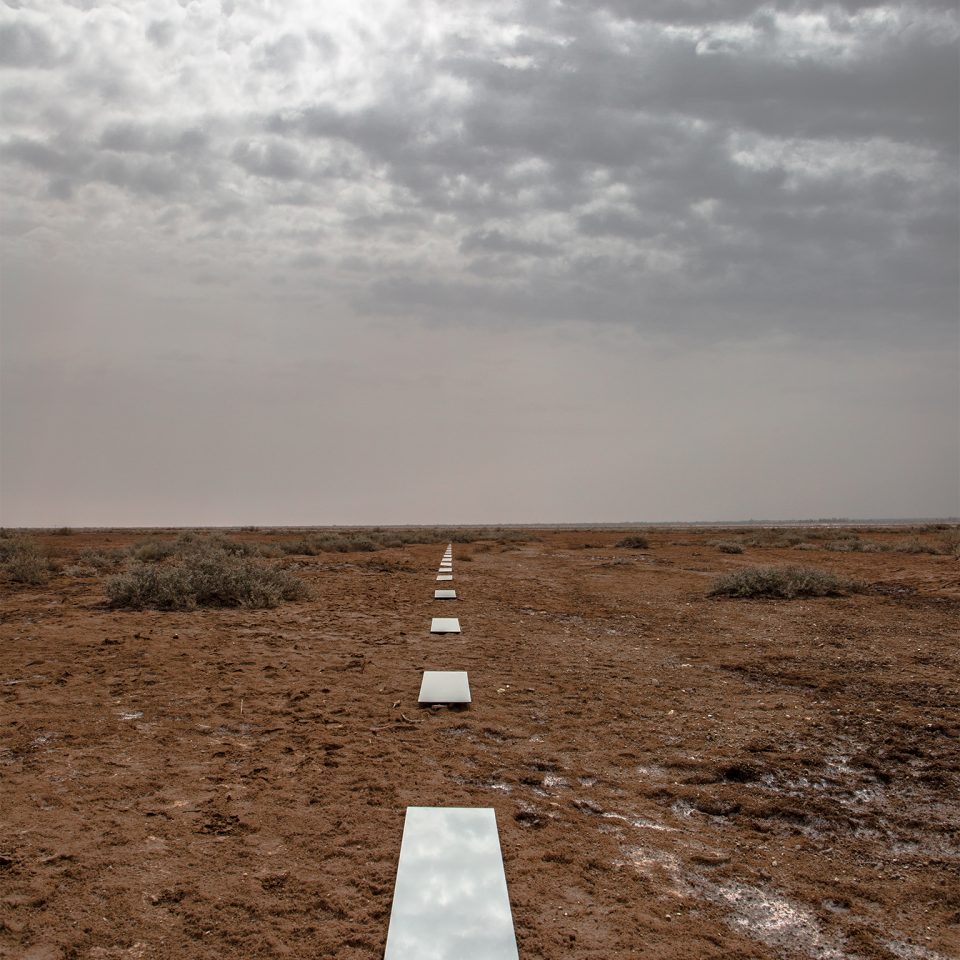
Shirin Abedinirad, The Sky Is Mine, 2016. Land art, Semnan, Iran. Created for The Absence of Paths, Tunisian Pavilion, La Biennale di Venezia, the work brings the sky down to earth as a gesture of hope, liberation, and belonging. Artwork Courtesy of our Featured Artist Shirin Abedinirad