



An interview with Rania Hussein Amin
Human beings are natural storytellers. It’s a subtle art woven into everyday life, taken for granted. In a world where people are increasingly isolated, confined to their own bubbles, and turning to social media for connection, the tradition of storytelling risks becoming extinct. So, here we are, featuring Rania Hussein Amin and her work for this issue, not only to celebrate her remarkable accomplishments: the writer, illustrator and artist she is, but also to remind ourselves of the enduring importance of storytelling. We must continue to share our stories.
Telling stories is a powerful way to truly connect, to personalize experiences, and to feel grounded. It reveals the hidden truths of reality and the beauty of imagination. It can also serve as a way to defy and resist against the challenges of our time and a means to preserve our collective memory alive.
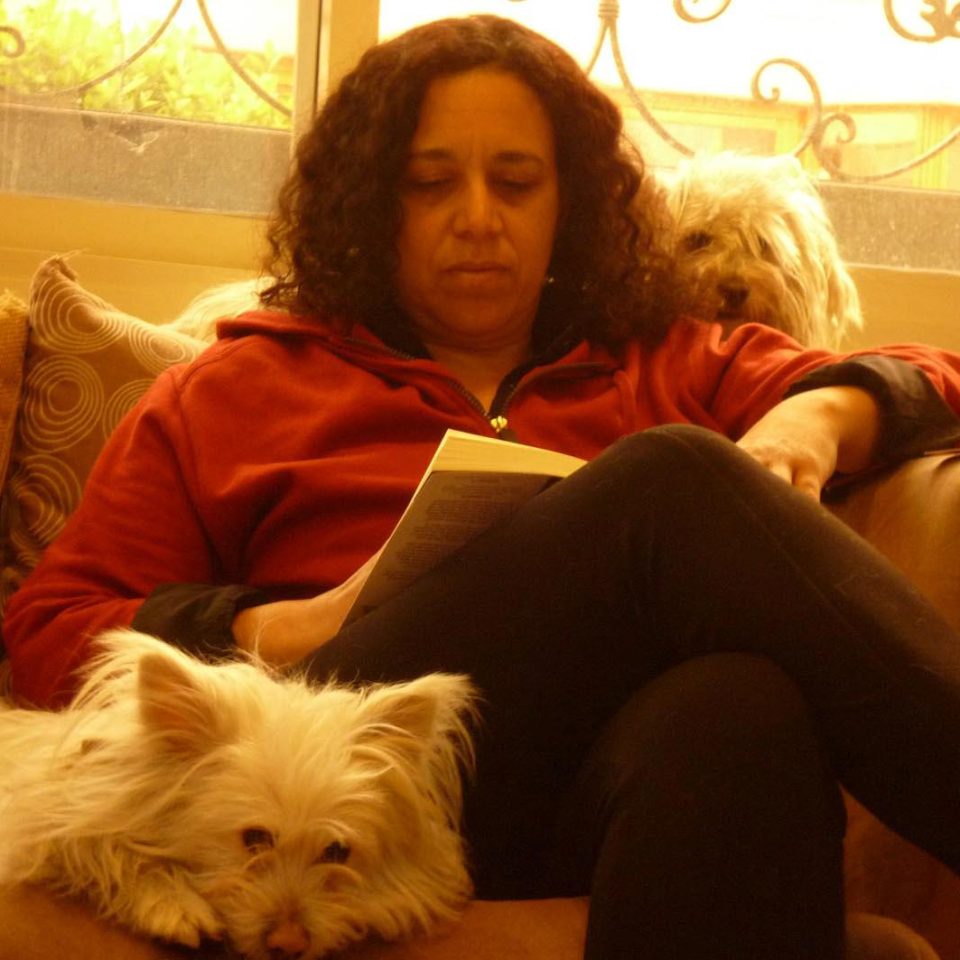
Rania Hussein Amin is an accomplished writer and illustrator of children’s books for young readers aged 3 to 16. Her career began with the beloved “Farhana” series, which she both wrote and illustrated. Over the years, Rania has received numerous literary accolades, including the Etisalat Prize for Arabic Children’s Literature in the Young Adult category for her book Screaming Behind Doors in 2016. Alongside her writing, she has worked as a school counsellor and is currently focused on creating a graphic novel for adults. Rania lives in Cairo with her daughter and two dogs.
This conversation—which took place in one of Rania’s favourite spots: Diwan’s Zamalek Bookstore—helps us learn more about Rania, her creative process, her opinions, her adventures, and her advice on how to revive our inner child.
If we ask your best friend to describe you, what would they say?
The first thing my best friend would say is that I’m calm and quiet. But that’s not how I feel inside myself, I’m actually restless. It’s a very difficult question because it’s hard to know how people perceive you. They might say that I’m helpful, maybe unpredictable, because sometimes I have these contradictions.
And how would you describe yourself?
I’m way too emotional, and it can be harmful at times. I try my best to manage my sensitivity and keep myself composed. I love quietness, but I also love people. I’m in a good place now, truly loving what I do: writing and illustrating. I love nature; living in a place full of greenery brings me a sense of comfort and ease most of the time.
What would you say is your biggest adventure, or an event that had a great impact on you?
Becoming a mother; giving birth to my daughter changed me entirely. Suddenly, I became an adult, and life became more meaningful. I became more grounded; before that I was drifting all the time, floating. I didn’t have a clear goal, I didn’t want to make decisions. I worked in so many places, I had like 60 different jobs, and I was happy. I didn’t care much about my choices. Life took me to places that I could have avoided. Now, I feel different, I’m almost 60 years old, but I have a purpose. I know what I want and how to do it.
So Motherhood is an adventure?
Yes, very much. It’s a responsibility, for the rest of your life. One has to think twice before becoming a mother, it changes everything and affects your lifestyle. Now, I have two dogs. I’m almost free of responsibilities as my daughter is getting married, but I’m starting it all over again with these two dogs.
What would you say about what we perceive as boring everyday life?
It’s a blessing; I feel so comfortable having a routine. It’s so busy and crammed inside my head, so I love that the world outside is organized. It’s not boring, it’s more about feeling secure and consistent. I don’t mind doing the same things every day.
What would you tell younger people about everyday life?
I wouldn’t encourage them to live in a routine. I would tell them to learn and do something new every day. From time to time, I like to take a new course and learn something different to trigger new ideas. It’s important to travel and see new places, and for writers, it’s a must because it’s inspiring to move around. I can’t travel for longer trips now, but every now and then, I take a one-day trip to get out of my familiar context.
“I tell stories because I’m interested in people on a deeper level.”
I would like to talk to you about different topics, the first topic is Storytelling as an art. This issue’s theme is courage and resilience. On my way here, I was thinking that telling stories is actually an act of courage because a part of us is exposed to others. So, why do you tell stories? Especially that a lot of your stories are inspired by real situations.
For many reasons, It’s mainly about sharing; there are people who want to tell others about their lives and experiences. Another reason is to set the imagination free. I myself tell stories because I’m interested in people and in understanding them on a deeper level. Maybe I’m influenced by my background as a psychologist. I don’t like shallow conversations or superficial relationships. When I know someone on a deeper level, it inspires me to write about them; to let people know about them in a way. I enjoy creating situations with different characters to see what happens and how these characters are going to react.
What about storytelling as a tradition, and how it evolved; from the traditional form of a storyteller narrating to people, to novels and books, to movies and drama series, to people sharing their daily life on social media, where do you see this going? Do you have a fear of it disappearing?
It’s terrifying. People are reading less, their attention span is becoming shorter. All of us are being conditioned to this speedy rhythm, scrolling through life. Now, there is no time to contemplate and think. So everything will be just shallow, one won’t be able to see the deeper perspectives. It’s hard to imagine.
However, regarding the traditional form of storytelling, recently, I attended a workshop about storytellers. Every participant told a story, and it hit me: I could feel the continuity and value of being a storyteller because you become involved in the story as a listener. There is eye contact and communication, you are part of the story.
I think storytelling still exists but in different forms, like stand-up comedy which is storytelling.
Yes, and it’s very creative and engaging because comedians handle normal daily topics and turn them into something funny.
The second topic explores the inner child within each of us—how and why it’s important to keep this inner child awake and present in our lives?
It’s essential because this is who we really are. When we are kids, we are closer to our real authentic selves; as we grow up, that inner child fades.
We should keep it present by being playful. We shouldn’t take life too seriously; we have to laugh, play, and see where the fun is. We have to be close to nature and animals, curious, try new things out, question things, and never stop learning. It’s really important to ask questions together with our kids and try to look things up; it’s so much fun, too.
Have you ever considered writing children’s stories for adults? Is there such a thing? Some writers refer to The Little Prince, for example, as one.
I think that any well written story could be read by both kids and adults. Sometimes stories have symbols and depth, so children will perceive it in a way, and enjoy it, while adults receive it differently, on a deeper level.
Dr. Seuss had several symbolic stories. What’s really important is that while writing a story, one shouldn’t intend to tell a direct message or give advice to the adults. I made that mistake at the beginning of my career.
But whenever I wrote as a child, when I wrote real stories about my childhood, the reaction was different. At the back of our minds, there is always a purpose in telling the story; an urge is born from an inspiring situation or maybe an amusing funny incident.
Reality is fantastic already
Is it important for a book to carry a message to the reader?
It doesn’t have to be a message or a lesson. Any story organically includes something valuable. It could be information, or even a sentiment, an emotion. There is this book about a boy on a riverboat; the whole book describes the boat ride and the river, and that’s it. But it brings to us the love of nature and how to observe the details, our environment, and our surroundings. It’s an art in the end.
You had mentioned before that it’s better to write about realistic contexts for kids under the age of 5? Why could imagination be harmful?
Some children are really sensitive, and some elements of fantasy can be scary at times, like wolves and witches in fairy tales. So, why expose children to such things, especially if there’s the possibility of leaving a negative impact? For this reason, I avoid fantasy in my stories.
Then, when I was studying Montessori, I discovered that Maria Montessori held a similar view. She believed that children under the age of 5 should be exposed to realistic contexts because it is helpful for them to understand people and learn factual information about the world. This approach helps them feel happier, more confident, and more comfortable. We shouldn’t confuse them at this early stage.
For young children, reality itself is already fantastic—even a flower or a butterfly is amazing; we don’t need fantasy to amaze them.
However, for older kids, fantasy is beneficial because it triggers and stimulates their imagination.
Okay, regarding the creative process, can you tell us about your process, from ideation to publishing?
Every book has its own process. Sometimes, the idea remains at the back of my mind for quite a while; it takes time to brew for some reason.
But I’m mainly inspired by people; for example, one of my books for young adults, Outside the Circle, is based on the story of a boy who frequently visited my office at the school where I worked as a counsellor.
He had a unique personality; he was rebellious and angry, but he was well-read and opinionated. He loved books, and everyone made fun of him. He was kind but he never showed his kindness. He was eccentric, and I wanted to write about him and how he was bullied because his character broke the stereotype of the type of kids that are bullied at school.
It was the first time for me to write for that age, so I consciously created a romantic storyline, with a girl who was inside the circle of popular kids. I was able to create struggle in the story.
Regarding the process, I start by writing notes and several outlines for the story; I also write the places and what happens in every scene. Then, I decide on a starting point. In this book, for example, each chapter is from a different point of view, alternating between the perspectives of the boy and the girl.
Do the events develop organically, or do you decide on a certain outline for the story before starting?
For this book, for example, I knew the ending before completing the story, so I had a goal in mind, and I made the story flow to reach that goal.
Then, I decide on a structure with milestones, but I also let the characters lead me through the events of the story.
The most important thing is to identify the struggle and work around it until it reaches a peak.
How is the process different, when there is an illustrator working with you on a book?
Honestly, I wrote around 50 books, including 30 books done by other illustrators, yet I was never satisfied with the final results.
It’s not that they were bad illustrators—quite the opposite. But I never experienced the process where the publisher, writer, and illustrator collaborate to create a book.
Most of the time, the publisher takes the text and sends it to the illustrator, and the writer only gets to see the final results. It’s frustrating.
But the first publishing house I worked with was an exception. They let the writer and illustrator meet. I shouldn’t generalize too much; some illustrators did a really great job. For example, with my last book, The Angry Kid, I’m really happy with the illustrations.
For that reason, I decided to develop my drawing skills to do all my books.
What happens when you get a writer’s block?
Thank God, I’ve never experienced writer’s block. There are so many ideas and projects to work on that I can barely find enough time to bring them all to life.
Do you test your books before publishing?
Unfortunately, I don’t do it as often as I’d like. I once tested one of my stories by sharing it with the kids at my school, and it made me realize that certain parts were a bit too long. Based on their feedback, I made adjustments. However, I rarely get the chance to hold such sessions.
If we ask you to suggest certain creative habits for kids and teenagers to trigger their creativity as young writers and artists, what would you suggest?
I suggest that they go to libraries and bookstores and choose books based on their interests. They should also read and write a lot in their diaries. This will help them organize their thoughts and find new topics to share. I encourage them to write their opinions on books and movies and analyze what they read and see through writing.
“We need to be funnier, and more entertaining, we are often too serious with kids.”
What do you think of the subjects or the topics discussed in children’s books, especially in the Arab region? There is always this assumption that we shouldn’t address dangerous and serious topics when writing to children.
The risky thing is that not all writers have enough knowledge when it comes to children’s psychology. So if they find themselves knowledgeable enough, or if they can get the assistance of a professional psychologist as they write, then it’s alright to delve into serious topics, such as death, loss, and divorce.
Generally, our books have improved significantly—there are now many more titles that explore emotions and feelings, which is a positive development. However, children’s books in other parts of the world tend to be much more creative. This is largely due to greater freedom in those markets, whereas here, publishers here can be more limiting. They often play it safe, focusing on how parents might react to different types of books.
Perhaps we as writers need to make more effort and take more risks to get out of our comfort zone. We also need to be funnier and more entertaining; we are often too serious with kids.
One of your books is about bird migration, which is a universal phenomenon, and you linked it to a personal story, which I found so interesting. Are there any future projects similar to this, tackling a universal issue, such as extinction or climate change.
I was really happy to do this project and would love to do more around such themes. It was actually a proposal from Dar El-Balsam, and I found it challenging.
I needed to present the idea in an attractive way so that young readers wouldn’t get bored. I tried different approaches to make it informative yet create a connection to make it personally relevant to them.
The main theme in the story is fear, and how both the bird and the boy were able to overcome their fears.
With everything going on and how the world is changing, why is it still important to read?
One has to read to develop deeper views and perspectives, to be capable of dealing with the world, to be more aware and to build character. It eventually brings some sort of happiness.
If we live by floating through social media, we can’t find our core or a true sense of fulfilment.
What kinds of efforts can be made to make people read more?
We need new engaging ideas. Attracting the attention of young readers is a difficult mission.
We have to use social media to promote books and stories.
We have to discuss more personal topics, relevant to life as it is today. We have to put a lot of effort into marketing and content development.
I read about an initiative you had for parents to read for their children. What happened to that project?
I hope I can revive that project.
It started as an initiative, and we organized several events and activities, but then it stopped.
It’s important to create that bond between children and books starting from very early childhood. It’s important for the parent to be present and to read with their kids.
They will not only receive it better, they will enjoy the process, they will create a lasting memory and a strong bond.
Letting kids read stories on their iPads is not enough. Parents must be present to discuss and ask questions.
“I learnt that when I write, I should write for myself and for the children.”
You had previously started a publishing house. Tell us about that adventure.
I decided to create my own publishing house to avoid all the frustrations of the publishing process.
It didn’t work out well, though, because I’m not a businesswoman.
It also affected my creative life as a writer.
How can we distinguish between a good book and a bad one, while buying?
It’s important to flip through the story and read parts of it. We could be fooled by how it looks.
One should buy a book for the story and the content, not just for the beautiful illustrations.
This is another problem with Egyptian publishers: They prioritize the aesthetics of the book over the story itself.
What kind of advice would you give to aspiring writers for children?
It’s important to read a bit of psychology, be around children and observe their behaviour and nature.
Writers should also read extensively and stay connected with their own inner child by revisiting their childhood, writing about it and all the emotions it brings.
These memories and experiences are what create the stories. It’s important to remember that emotions are always involved and are the heart of the stories.
What did you learn from being a writer for children?
I’m still learning. I want to be more daring and joyful while working.
I want to find new ideas.
But with time, I learnt that when I write, I should write for myself and for the children.
Over time, I’ve learned not to reflect too much on what publishers want or what grants and awards prefer. I try to break these shackles regardless of the results. Even if the book isn’t published, what matters most is the joy of creating it.
Is that your favourite part?
Yes, the creation of the story.
Once it’s all clear in my head, that’s my favourite moment.
Once it’s finished and published, I completely forget about it, it’s in the past.
I have become excited about newer projects.
What’s your favourite book/project?
I love the books I wrote for young adults, such as A Heavy Arm Around My Shoulders and The Seat Next to Me.
I love these two books as they include some really interesting characters.
Rania is currently working on writing and illustrating a graphic novel. She follows a routine where she starts her day with a long walk around her block to let out negative thoughts and give space for ideas to flow. She didn’t say that about herself, but from my short conversation with Rania, I could tell that she is a person who is grateful for all her experiences, feeling no regrets and so much hope for the future. She is down-to-earth, open to new ideas and has such a beautiful laugh. We are definitely lucky to have her as a storyteller.
Please let us know if you have more questions for Rania!


