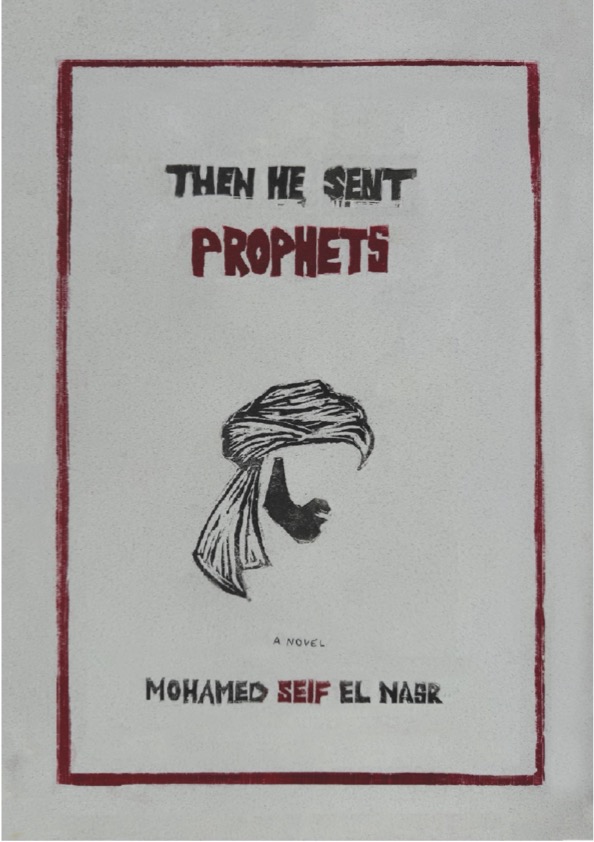




Book Review of Mohamed Seif El Nasr’s debut novel, Then He Sent Prophets
Mohamed Seif El Nasr’s debut novel, Then He Sent Prophets, is a sweeping historical narrative set in the 14th century, a period marked by the decline of the Marinid dynasty in Morocco and the tumultuous Emirate of Granada in Islamic Spain. It is a masterful blend of historical fiction, philosophical inquiry, and human drama featuring real historical figures like Ibn Khaldun, Pedro I, and Muhammad V. For example, Ibn Khaldun’s observation that “when a ruler makes his people too weak to keep their affairs going, their weakness recoils on him and weakens him” critiques Sultan Abu Salem’s governance, reinforcing the cyclical nature of oppression. This insight is paired with vivid depictions of medieval society, such as the fleeting legacy of Sultan Abu Salem: “Of the short reign of Sultan Abu Salem, people have a recollection of only two events: the giraffe from Mali and the day the overthrown king of Granada departed to reclaim his throne.”
Through the novel’s characters and their interactions with these politicians and philosophers, the reader is able to be immersed in discussions of the political turmoil in Granada, the intricate political machinations and the philosophical questions they are grappling with.
Through the lens of these larger historical movements, the story follows Zakaria, a scholar and reluctant court advisor, as he wrestles with his conscience, navigating political intrigues, personal loss, and moral compromises in an era of economic decline and oppressive regimes. The plot is a rich mosaic of human struggles: family ties, political betrayal, and the search for spiritual enlightenment. With the shadow of history looming large, the novel masterfully juxtaposes the collapse of kingdoms with Zakaria’s internal turmoil, revealing how external and internal worlds mirror each other.
The historical setting is vividly rendered, transporting readers through the bustling streets of Fes, with its Qarawiyyin Mosque, Guissa Gate, and the districts of Fes el-Jedid and Fes el-Bali. We travel alongside Zakaria to Ceuta, Ronda, Málaga, Écija, Iznájar and the imposing walls of the Alhambra in Granada, culminating in Seville. Each location is meticulously chosen, serving both narrative and thematic purposes. For example, Granada is less an idealized beauty and bastion of Muslim culture and more a conflicted society, whose internal failings contributed to its eventual decline and its protagonist hopes to save it, “Zakaria would mold Ibn Yusuf into the greatest monarch that had ever lived, a true philosopher king, and ensure that on his death, the small Emirate of Granada would be so powerful and prosperous that it would survive, at least for a hundred years.”
Seif El Nasr’s meticulous research shines through in his evocative descriptions of architecture:
“Zakaria returned the greeting as he contemplated the large receiving room. Unlike his old house with its gloomy black and white tiles, the floors of the new house were adorned with geometrical tiles in several shades of blue, green, and yellow. Embroidered silk drapes of unbelievable softness sheltered the windows overlooking the inner courtyard and gave a feeling of luxury.”
–geography:
“The garden where those meetings took place had the same feel as the famous Generalife of the Alhambra. It was nicely planted, had several water fountains, and commanded an unobstructed view of the hills, mountains, and green fields surrounding Ronda.”
–and cultural details, which transport readers into a world that feels both distant and eerily familiar—
“Similar to all principal mosques in Islamic cities, the Qarawiyyin acted as a focal point in Fes and was surrounded by numerous alleys leading to different parts of the city. A symbol, perhaps intended by the ancients but now forgotten, that the ways to God are as numerous as the breaths of humankind.
This central location, and how the alleys fragmented, usually made exiting the mosque a relatively painless experience. And it would have been the same today, barring the special occasion. For it was one of the undeniable misfortunes of the sultan attending the Friday prayer at the Qarawiyyin that, naturally, no one could depart the mosque until the sovereign and his entourage had left. To make the situation worse, some official had also decided that even after the sultan’s departure only three doors would be opened as an additional security measure. The multitude of worshippers were confined in the main hall, and when the three doors were finally opened, a terrible scene unfolded. The throng of people shouted, shoved, and pushed as they tried to escape from the mosque. Each man avenged himself against the injustice of the untouchable sultan by attacking those in his surroundings, as oppressed people usually do.”
Seif El Nasr skillfully infuses levity into the narrative, not just through character interactions, but also through his sharp and often sardonic descriptions. This humour is particularly evident in the sensory details of Zakaria’s neighbourhood:
“Even the famous Chouara tannery was positioned in such a way that the smell of dead animals and their skins carried to this area… The neighbourhood’s position was so sunken that its people sometimes jested that if the sultan farted, the wind would carry his fart to their houses.”
These wry observations highlight the absurdity of Zakaria’s circumstances while offering a moment of comic relief amidst the novel’s heavier themes.
We are introduced to Zakaria, the protagonist, as a multifaceted character deeply shaped by historical figures such as Muhammad al-Abili and Ibn Khaldun. Zakaria’s principles are sharply defined when he declares, “I consider myself to be different from others. I know right from wrong without having to be told of it, and I would rather die than live with a guilty conscience.” This unwavering stance contrasts with the compromises he faces within the palace, creating a tension that keeps readers deeply invested in his journey. There are excerpts of Zakaria’s manuscript in the novel, which is a constant source of tension “a bundle of paper, tightly wrapped, as if the person who wrapped it was cautious no ideas would trickle from it,” symbolizing the fragility and danger of free thought in such a world.
Ibn Khaldun warmly acknowledges Zakaria’s potential: “Here is the young man we were talking about,” Ibn Khaldun said cheerfully as soon as Zakaria appeared. “The young man my great sheikh, al-Abili, considered his son.” This recognition reinforces Zakaria’s role as a torchbearer of intellectual inquiry. He sees his own teaching of Zayd as a continuation of al-Abili’s legacy: “He liked to think of himself as a bearer of a torch, an advocate of the pursuit of real knowledge, in a world where everyone accepted everything without inquisition.”
Zakaria’s intellectual convictions, however, put him at odds with the world around him. His philosophical ideals clash with the pragmatic demands of his society, forcing him into uncomfortable compromises. This tension surfaces in his frustration after attending a politically charged sermon: “It was tolerable at the beginning but tiresome at the end,” he said. “The sultan was present, and the preacher was shameless in trying to appease him.” Through these scenes, we get a sense of Zakaria’s struggles and the moral and intellectual compromises that he is pressured to make under oppressive systems, a theme that resonates deeply in our contemporary world.
Ibn Khaldun himself reflects on the challenges faced by those who pursue lofty ideals. His conversation with Hajib reveals a reluctant understanding of Zakaria’s position: “It is the curse of great intellects to follow elusive goals,” Ibn Khaldun added. “I would kill to have him assist me in the palace, but I know he wouldn’t accept. Some individuals simply cannot employ their talents to compete with worldly creatures like us.” Ibn Khaldun’s admiration for Zakaria—and his own desire to one day retreat from worldly affairs to devote himself to knowledge—“For those who preach about religion in novel ways without having the power to enforce their ideas can only perish. That is the way of the world,” highlights the broader philosophical struggle between ambition, survival, and the pursuit of truth.
The novel is divided into four symbolic sections—Earth, Water, Air, and Fire—reflecting Zakaria’s spiritual and moral evolution. Earth symbolizes his material entanglements and survival. Water reflects his emotional transformations through grief and adaptation. Air embodies his intellectual aspirations and detachment, while Fire represents the purification and destruction of ego, leading to rebirth. This cyclical framework aligns with Sufi traditions, reinforcing themes of unity, transformation, and renewal. For example, in the first ten chapters, we are grounded in Fes through sections entitled Earth—where Zakaria’s entanglement with material concerns, his family’s survival, the birth of his daughter and the compromises he makes for professional stability and responsibility, symbolize his surrender to the “earthly” realm.
The characters come alive through intricate family dynamics and relationships that reveal layers of personal and societal tension. Zakaria’s relationship with his wife, Salma, is tender yet strained by his inner conflicts. At the beginning of the novel, she is pregnant with their daughter Maryam, a responsibility that grounds Zakaria in worldly concerns and exposes his vulnerability to pride and ambition. This grounding is further complicated by his relationship with his mother-in-law, Hind, who embodies the financial pressures Zakaria faces. Her sharp observations cut through his composure: “It would be nice, for a change, if you didn’t return empty-handed this time around, dear son-in-law. My poor daughter. Sometimes I feel we are both without a husband.” Hind’s veiled criticism highlights the burdens of expectation and survival, adding another layer to Zakaria’s moral struggle.
Zakaria’s maternal grandmother, Tamima, known as Um al-Wazir, provides a spiritual anchor, but their bond is fraught with tension. She offers a contrasting emotional connection steeped in tradition and mythical tales. “Not one soul is ignorant of its fate, son of my daughter. They just need to remember it.” Tamima’s disappointment in Zakaria’s marriage outside the clan and her disdain for his friend Musa reveal the weight of generational expectations. Her home, crammed with “strange relics and antiques”—leather shields, jeweled daggers, and ancient rugs—becomes a metaphor for the weight of the past. The house, “dark, un-aging, and with faded grandeur,” reflects the unchanging nature of tradition, a world where “everything was permanently in its exact place.” This rigid environment symbolizes the cultural expectations Zakaria wrestles with, and his fear of disrupting tradition even as he wrestles with his own evolving beliefs. The relationship escalates further when Tamima refuses to sell her valuable heirlooms for Maryam’s care exacerbating his sense of betrayal. In a fit of anger and despair, Zakaria hurls Tamima’s sacred Andalusite stone—his lifelong talisman—“He clenched the stone so hard that his hand bled. Then, without thinking, he cast the stone into the dark, rainy night.” Zakaria’s rejection of faith and tradition in a moment of existential crisis reflect the novel’s cyclical themes of destruction and renewal, emphasizing the fragility of human existence.
Zakaria’s friendship with Musa, his best friend and brother-in-law, is one of the novel’s most compelling relationships. Musa serves as Zakaria’s foil—where Zakaria hesitates and compromises, Musa stands firm in his convictions. Their bond, forged in their youth, is rich with shared laughter, memories, and unspoken truths. Yet, as Zakaria navigates the court’s political labyrinth, their friendship is tested. Musa becomes increasingly frustrated by Zakaria’s compromises, accusing him of betraying his principles. This tension culminates in a powerful scene where Musa, his voice filled with disillusionment, declares: “If it turns out that the sultan and Ibn Marzuq ordered the killing of those children, I will not let this one pass… By Allah, I will not!”
Zakaria’s response reflects his conflicted conscience: “Do you really think that Ibn Marzuq, who has recently lost his son and suffered greatly for it, would find it in his heart to kill children?” Their conversation spirals into an emotionally charged confrontation, with Musa condemning Zakaria’s silence and complicity: “People following orders commit the worst evils in the world… Everyone who works for the sultan is now complicit in my eyes. Everyone, including your dear Ibn Khaldun.” This moment lays bare the chasm growing between them—Musa’s unwavering integrity against Zakaria’s reluctant pragmatism.
The depth of their friendship is further revealed in Zakaria’s realization that Musa’s clenched fist might be directed at him.
“You sit here, Musa, drinking wine and condemning the people for their subjugation while most of them don’t have the time to think about anything other than sustaining their families. From your ivory tower, you condemn others as immoral. Well, let me tell you this: If there’s anyone to blame, it’s people like you. It’s the people who grew up without being burdened by need and having to stomp on their dignity day after day just to keep on living. The opposite of poverty isn’t riches; it’s dignity and enablement. You think you’re a hero for interfering in today’s affair, but can you deny that you did it knowing that once they recognized who you were, you would be released within hours? Can you deny that if a common man had interfered, he would have disappeared forever?”
Zakaria expresses the quiet despair of those forced to compromise under systemic oppression. Their physical altercation “Hypocrite, you say!” Musa shouted as he rushed toward Zakaria and pushed him in the back with such force that he tripped and fell to the floor,” a manifestation of their clash of ideals and realities reflects the broader societal decay the novel critiques.
Despite their conflict, the bond between Zakaria and Musa endures. Their reconciliation near the end of the novel is profoundly moving. Musa, in a moment of selflessness, suggests that Zakaria marry Zahra, the woman he himself has loved, recognizing that Maryam needs a mother: “You need a wife, and Maryam needs a mother. It’s an opportunity to start anew. Please don’t waste it.” This gesture of sacrifice reaffirms the strength of their brotherhood.
In the final scene, the two men sit together, reminiscing about childhood, their laughter dissolving months of tension. “They say that a brother is like gold and a friend is like a diamond. If gold cracks, one can melt it and make it just like it was before. If a diamond cracks, it can never be like it used to be. As Zakaria and Musa sat together for what felt like the last time, they proved to themselves that they were brothers.” This reconciliation, though fragile, offers a glimmer of hope and closure, emphasizing that even in a world fractured by moral ambiguity, the bonds of friendship can remain unbroken.
But this novel is so much more than its richly drawn characters, evocative settings, and probing questions about morality and compromise, Then He Sent Prophets is a triumph of storytelling. It is a book that demands patience but rewards readers with profound insights, inviting them to reflect on their beliefs and actions in the face of a complex world.
The philosophical inquiry woven throughout the novel is both timeless and daring. Zakaria’s manuscript challenges conventional theology, arguing that morality supersedes ritual: “There is no doubt in my mind that a person with a good character who neglects religious rites is closer to God than another who treats people immorally but never misses a prayer.” This radical thought places Zakaria at odds with his society, highlighting a tension that resonates deeply with modern readers.
There are so many moments in the novel that Zakaria’s reflections, like when he states that “a person with a good character who neglects religious rites is closer to God than another who treats people immorally but never misses a prayer” challenges rigid theological norms. His question, “Is it blasphemous to return to the simple definitions… and suggest that anyone… who follows that by hurting no one is a ‘Muslim’?” –parallel discussions that might occur today but sometimes are even more avant-garde and progressive than what is permitted by society today to discuss. “Islam is an urban religion and was born out of Mecca’s injustice. Before settling in Mecca, the nomadic Arabs… despised those who hoard wealth. But after settling in Mecca… they lost their ethics, and the weak among them suffered,” reveal the thematic depth of the novel. This critique of societal decay is woven into Zakaria’s manuscript and mirrors his struggle for intellectual and moral authenticity within a rigid and corrupt world.
Seif El Nasr explores the internal moral dilemmas faced by rulers, scholars, and communities, revealing how power, ego, and self-interest gradually corrode even the noblest ideals. Zakaria’s journey—from a self-righteous intellectual to a humbled seeker of truth—reflects the moral struggles that many readers grapple with. His exhaustion is achingly vivid: “In the past year, he had tried to be like other people… but it was killing him on the inside—this apathy, this resignation, this weakness.” This depiction of inner turmoil captures the universal challenge of preserving integrity in a corrupt and decaying society.
Zakaria’s bleak observation, “Evil prevails when absolute and only begins to fail when tainted by acts of good conscience,” underscores the torment of justifying inaction while confronting systemic injustice. His struggle serves as a powerful meditation on the fine line between complicity and resistance, resonating deeply with the dilemmas of modern life.
The novel’s narrative blends not just philosophy and history, but poetry and Arabic sayings, too, all these together infuse the text with the language, tone and vocabulary of the era with precision and poetic prose. For example, in a scene featuring Lissan al-Din Ibn al-Khatib, the description of his attire and demeanour—“A man wearing a Yemeni crimson garment made of silk brocade and embroidered with flowers walked with heavy steps to the middle of the hall”—immerses the reader in the scene. The poetry that follows, “My sky, in whose nest grew my wing. Now, I am left without wing and without nest,” resonates with themes of loss, exile, and nostalgia.
This novel contains so much intrigue, detail, and depth that no number of reviews could fully encapsulate its richness. I find myself repeatedly returning to its passages—not only for the historical insights and the vividly rendered historical figures but also for the profound relationships and daily struggles it captures. The narrative masterfully explores how we aim to live by our philosophies and beliefs, while the realities of lived experience, political upheavals, and financial pressures inevitably shape our paths.
Zakaria’s inner transformation—his struggle with questions of morality, ego, and purpose—reveals that societal decline is fueled not only by external forces but by internal failings as well. His journey from self-righteous scholar to humbled seeker of truth resonates deeply, inviting readers to reflect on their own struggles with integrity, compromise, and self-awareness. The novel transcends political resistance, delving into existential and spiritual inquiries: What is the cost of holding onto one’s ideals? How do we balance love for humanity with the instinct for personal survival? This universal relevance is what makes Then He Sent Prophets so impactful.
Like Zakaria, many of us today grapple with the tension between activism and personal ego, between retreating into individual sanctuaries and confronting systemic injustices. Seif El Nasr captures this struggle with precision, making the novel both timeless and timely. It is not just Zakaria’s story—it is a reflection of the human condition and the quest for meaning in an ever-changing world.
Mohamed Seif El Nasr grew up in Cairo, Egypt, attended the Collège de la Sainte Famille du Caire, received his bachelor’s degree in history and political science from the American University in Cairo, and worked for over a decade in corporate banking before changing paths and pursuing a career in writing. His published work includes several historical and political pieces in Mada Masr, Mondoweiss, Truthout, and elsewhere. Then He Sent Prophets is his first novel.