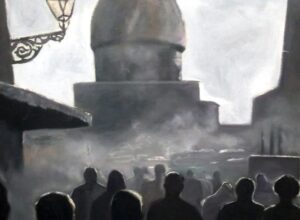



Châtelet’s long grey corridors seemed to stretch forever into the silence of the night. The more we walked, the more we felt engulfed by the metro station, almost empty in the late hours after the last train, erring more and more into its maze-like structure. I tried to focus on our steady footsteps on the floor instead of the rats sneaking through the tunnels and the myths about people who came in and never got out. We weren’t the only two people in the station; every couple of meters, when we guessed at a turn, we found a few strangers walking around here and there, grumpy Parisians who had missed the last train after a day at work or tipsy tourists whose night of fun went on too long. I guess we were somewhere in between, not exactly Parisians with the complacency of knowing their city by heart, nor the light-hearted tourists who were here for a few days and pronounced it “Chatelette” because they didn’t know the ‘t’ was silent, as many letters often are in French.
But we all had the same air of being lost, searching for which of the sixteen exits would be open to lead us to the outside world, to the night buses or Ubers or anything that would get us back home before the sun went up. We had already tried two exits, with no luck: metal bars blocked the passage, forcing us back into the depths of the underground. But for once, I was able to see Châtelet clearly, without the overcrowdedness every day and the brouhaha of sounds and smells that threatened to drive me crazy, though the bad smells were still there in the thick air, sticking to our clothes and hair and the shopping bags I still held in my hand. We stopped at what I imagined was the middle of the station, looking at signs that seemed to be as useless to us as if they were written in Chinese. Yet even with all this, my mood seemed to still be light, laughing at the absurdity of it all and perhaps also happy to be spending a little more time with him, he whom I’d only known for a few hours but whose confident and easy demeanor made hopeful that we would go back up soon, that I would be able to catch my flight tomorrow and go back to normal life in Algeria after my week of touristic fun in Paris.
It was only the two of us when we heard it. A deafening sound, like a siren screaming into the night above us and muffled by the distance between the outside world and the tunnels we stood in. Then hurried footsteps and the sounds of yelling, but this time from down here. Carl gripped my arm at the blaring sounds, and suddenly we weren’t alone anymore. The strangers we saw walking around earlier ran in all directions, trying to understand the meaning of the alarms overhead and the danger that mingled with the station’s smell. Looking at Carl’s face, I saw the panic flashing across his eyes before he tried to hide it from me. That’s when I saw them far behind him: three police officers, walking towards our group of people with a look of worried sternness and the sense of something very wrong.
***
What happened next was a blur of events. Suddenly, we weren’t alone anymore, and everyone wandering around the station had gathered around the police officers. An attack. Terrorist. On the run. Closed. Protect. Stay underground. I could barely hear over the panic of the others and the buzz in my ears. I could feel the rapid pulses of my heart everywhere, in my stomach, behind my knees, and racing through my head. I thought I could feel Carl trying to speak next to me, but my vision was coming in and out of focus.
“Hey, hey, are you listening to me?” said a voice, and my eyes finally settled on the man in the police uniform standing right in my face.
“You need to take a deep breath and sit down. We will have to stay here until we are sure the perimeter above is completely secured.”
I must have looked very worried because he had started to comfort me when his female counterpart interrupted our conversation aggressively.
“What are you doing, Bertrand?” she yelled. “Look, jeune femme, you find any corner, and you sit down with your friend here, right now before I handcuff you. We don’t have time for this.”
***
“Are you okay?” came Carl’s voice next to me.
Sitting on the dirty asphalt, breathing in the suffocating air of the station that suddenly seemed somehow smaller and even more oppressive, I was far from being okay. And I knew he wasn’t, either. How did we end up here? said the voice in my head. Our day actually hadn’t started out so bad. After tiredly climbing the Arc de Triomphe, then having burgers on the Champs-Elysées, we lost track of time sitting around on a rooftop sipping virgin mojitos and watching the panoramic view of Paris until even the Tour Eiffel’s lights went out and we walked – ran, actually – to catch the last metro. We managed to catch it just in time, but I needed two metros to get back home, and we ended up stuck in the deepest and probably most hated metro station in Paris, where most metro lines connected and everyone bumped into everyone else as they tried to figure out their way from the numerous, often confusing signs.
That was the first day I met him. Less than 24 hours ago, when my roommate’s friend introduced him as her friend, he joined our group to lead us around his favourite places as a long-time resident of Paris. I learned then that his perfect French was a product of his Franco-Lebanese family, who raised him in Bordeaux until he reached university and moved.
Something suddenly brushed my feet in the span of a second, and I jumped, letting out a shriek that startled Carl and the few people around us, who responded with a glare. I instinctively latched onto Carl’s arm as I looked to see the gigantic rat running to hide far from us. My stomach flipped as I grew less scared and more nauseous in this hellhole. I realized, looking around, that we were only a handful of people stuck there: a couple of foreigners who seemed too enamoured with each other to notice us, a seemingly homeless man with a scruffy grey dog, and a kind-looking elderly woman who held onto a young boy with blue hair messed up by his headphones.
As I turned away from them, I saw Carl laugh uproariously as I let go of his arm, hitting him in the process for mocking me in my distress. He threw his head back as a high-pitched laugh ricocheted in the underground walls, and a strange warmth engulfed me. He seemed so different from the person I had met that morning. He had been cold and distant, reserved in a way that said he thought he was better than us all. He had talked with an air of arrogance and a hint of disdain when I disagreed with him, rarely gracing us with a smile or a nod. So, when he had offered to accompany me home because my roommate was sleeping over at her friend’s house and it was dangerously late, I was surprised he would choose to spend more time with me when my hot-blooded personality had led me to strike up debate after debate with him.
But the guy in front of me now had an easy and warm laugh, letting his eyes settle on me, eyes that I could swear were a lighter brown than this morning. So, for some reason, despite the disgusting feeling of the rat running by my ankle that had threatened to make me sick, I started laughing too. We must have looked delirious, standing next to the grey wall in the tension-packed atmosphere, laughing and bending over as if we were drunk. But no one really paid attention to us, and it wasn’t until the police officer assigned to watch over us, who came and went around the station, glared at us, that we sat back down, muffling our bursts of laughter with hands on our mouths.
***
The tension was almost palpable. Hours had passed since they had detained us here, with no food, no phone service, and minimal information. Even the homeless man, who looked as though he often spent nights in metro stations, was growing weary. The grandmother was the first to speak up when the officer passed by, in a surprisingly daring tone that didn’t match her frail old body.
“How long are you going to keep us here? We want to go home.”
“I understand, madame,” he answered. “But the situation above is very risky. We will let you know when you can go up, hopefully soon.”
At least they had left us with the nice officer. Well, nice was an overstatement. He was simply the only one who showed a modicum of concern for us, though it was virtually useless, as his fellow, more aggressive officers were the ones issuing constant commands. But I’ll hand it to her: the old woman pressing him gave us more information than we initially had. A man had opened fire in the crowded outdoor area of the Châtelet-les-Halles mall, killing two and injuring several who were transported to hospitals. But when the police forces arrived, the man had somehow escaped them, and they were still looking for him in the area that was now under heavy surveillance.
“Sales arabes, va,” came the woman’s voice. She was glaring right at us.
***
My mouth stayed agape for a few seconds before I closed it again when I found no words coming out. I looked at Carl, who just sighed. Then I turned to the police officer, who pretended not to hear as he tried to walk away from us. It was she who called out to him again.
“You should just get rid of all of them already!” she yelled at his back as he went. “They are plaguing our country, stealing our jobs, killing our children! And no one’s doing anything about it!”
All the blood rushed to my ears as I tried to make out what I was hearing. I felt my heart sink as I was surprised to find neither anger nor fear in me. Instead, I found a stabbing sadness, a disappointment bordering on frustration. I simply did not understand.
“Let’s just go back to where we were sitting,” I heard Carl say.
“But,” I started, turning to look at her, “the shooter isn’t even Arab. I mean, we don’t know anything about him yet. He could be –“
“Ha!” She interrupted, laughing like I was truly amusing to her. “Weak-minded girl, what else could he be? Are they not all dirty Muslims who shout Allah Akbar before they bomb our cities? What else do you want from us? To kill us all? Get out already, it’s not your country!”
“But… we’re not like that! I swear, look at us! I mean, these people don’t represent us,” I pleaded.
“Sarah…” I heard Carl say, but I kept going. “I mean, look at him!” I said, “he’s not even Muslim!”
“Sarah, what are you doing?” came Carl’s annoyed voice.
“He is half Arab, and half French! From Bordeaux! And he is a Christian!”
“Oh, cut it out!” she yelled.
“Sarah, let it go,” Carl warned.
“You are all the same!” she continued. “The audacity to look me in the eyes and tell me he is French! Look at him, with his skin and beard! Are you making fun of me?”
“How can you say that?” I heard myself shout as my voice began to tremble.
I then felt Carl’s grip on my arm pull me with force to turn us around to go back to our seating places. But the second I turned my back to her, I suddenly felt an intense pull from behind. My head jerked back with force as my neck strained and I felt pain rush from the tips of my hair all the way to the roots. It took me a second of complete shock before I quickly understood exactly what had happened. I felt an unusual gust of wind through my hair as my satin scarf, with its brown and yellow patterns, lay crumpled on the station floor. The woman had just pulled off my hijab.
It was probably the time when I saw Carl the most startled. I almost felt bad for him as he quickly turned around in a panic that turned his face tomato-red, not knowing how to act or what to say. I didn’t either. Never had I been put in a situation like that before. As I turned to see if the woman was going to do more, aggressive barking sounds filled the station. The homeless man who had been lying down quasi-invisible till this moment seemed to have set his small dog free on the old woman. I could have sworn I saw a hint of satisfaction in his eyes as he saw her squirm for a few seconds while the dog barked at her feet before he called/pulled him back. While she gave him one of her dirty looks, his trick seemed to push her away from us for the time being. That is when I watched him pick up the fabric from the floor and hold it out to me, not caring to either particularly look at me or look away. I extended a shaking hand to take back my scarf and thanked him before folding it and pulling it over my head again. It might have looked the same as before to everyone else, but to me it was like wearing a completely different scarf, one that was taken from me in a deeply painful violation of my being.
***
We were both silent as we sat down on the floor again, far away from the old woman who went back to cuddling her grandson. I expected him to pretend that nothing had happened. Perhaps that he would even go back to his standoffish personality that he seemed so comfortable in. But in the midst of a silence so long I almost started to doze off, his words came in a low voice:
“Why do you do that?” he began. I couldn’t yet understand if his tone was accusatory or simply curious.
“Do what?” I replied.
“All this.” He gestured with his hand, drawing vague circles in the air.
“You mean respond to the grandmother? Well –”
“I mean try to make everyone like you.” He looked at me.
I paused, opened my mouth, closed it again.
“What?” I managed. “I don’t –”
“She’s a racist old woman, Sarah. She doesn’t have to like you.”
“No, that’s not… That’s not what I was doing,” I mumbled. “I was just trying to show her that, well, she has just gotten some things twisted. She probably watches the news too much, or has only had bad experiences in the past. If she knew the truth, she wouldn’t think that way.”
“You don’t have to keep making excuses for them,” Carl said. “There are racist and violent bigots who see us as subhuman. Nothing would change their minds. And even so, that’s not your job. It is not your job to prove to them that you are worthy of respect.”
I didn’t know what to say.
“And,” he went on, “not everyone must like you. I think it’s a good thing that evil people don’t like you.”
I responded nonchalantly, like I had no idea what he was talking about. Like he hadn’t just unveiled soul-deep things about me that even I hadn’t known, in just a few hours. Like it didn’t scare me how fast he saw through me.
“I’m not like that,” I laughed.
“Oh, you’re not?” he mused. He turned his whole body towards me to look me straight in the eyes, a challenging smile tugging at his lips. “The rooftop debate. I was completely disregarding and opposing your stance on women’s rights, and you still told me on three separate occasions, “I don’t mean to offend you”, “please don’t take this the wrong way,” and “sorry, it’s not against you, really, we’re good, right? You’re sure, right?”
“Oh, you’re exaggerating! I don’t even talk like that,” I said. “And I’m surprised you even remember that; I didn’t think you were that focused on our conversations.”
He looked at me intently, and I was suddenly aware of how close we were sitting as he replied:
“I was.”
He told me he was always standoffish and cold when he met new people. That it was because, unlike me, he did not care to have everyone like him. But looking at his new boyish personality, I was sure there was more to the story, a deeper explanation of his rigid armour, just like there was one for my desperate people pleasing. And that is what we talked about, on the dirty floors of Châtelet as hours passed with no news, as the old woman kept cuddling her grandson and the homeless man his dog, and the couple each other; as we started to slur our words, take longer pauses, and eventually doze off.
***
I woke up at the faint barking sound coming from the other side of the corridor, but I suddenly jerked awake when I realized I had somehow ended up leaning my head on Carl’s shoulder, thankful that he had not yet woken up. The three police officers gathered to let us know they were finally going to let us out after five long hours at the station. The night had turned into morning, not that we could see any light from down there, and the station was going to reopen. The shooter had finally been caught and jailed. He turned out to be Arab and Muslim. Well, there goes my argument, I thought.
But I paid no more attention to the old woman or how she perceived us. Contrary to my fairytale imagination, she had not seen how nice we were and come to the conclusion that she would not be racist anymore. She was still the same grandmother who looked incredibly kind with her grandson while simultaneously willing to attack people who looked like me. But I was not as desperate for her attention anymore. I would not see her again, just as I would not see the homeless man and his dog who defended me better than a police officer, nor the foreign couple with whom I had not exchanged a single word, despite spending a long and life-changing night in the same couple of square meters as them.
And as for Carl, well, it was strange to feel like I knew him better after one day than I did many people I had known for years. Everything that diametrically opposed us dissolved in the depth of Châtelet, when for a few hours the real world was a faraway fantasy. As we prepared to walk up the stairs that would lead us to the light of day and part ways, we planned brunches, cinema outings, and museum visits for another time. Deep down, I knew it would never happen. But in that moment, standing forty meters underground, it didn’t really matter.
Shirin Abedinirad, Heaven on Earth, 2014. Installation art, Treviso, Italy. Presented at Fabrica, the Research Center of United Colors of Benetton, the work draws on Persian architectural traditions and Islamic geometry to transform a staircase into a mirrored passage of light, where sky becomes ground and reflection opens a fleeting vision of paradise, wonder, and spiritual transformation. Artwork Courtesy of our featured artist Shirin Abedinirad.