

The rain sang against the windowpanes of my trailer, its clouds blackening the November night. I sat cross-legged by the woodstove, sewing old pages into new books, accompanied only by Dylan Thomas reciting poetry through scratched vinyl and the ravens that lived loudly in the trees above. The needle reached the disk’s center and returned to its resting place in silence, just as the phone began to ring.
“Mon ami, can you deliver?” Your voice was slurred by the bubbling up of long-drunk drinks.
“Of course.”
“Aïe, you know I cannot live without it.”
Yellow lines and stars blurred as I drove through the Pacific wind, each gust carrying my car like a sailboat across asphalt waves. I parked and peeled loose curls from my dampened face. These days, the rain took the place of showers; baths were the luxury of few others I knew. I walked across the dock, which was rocking in the unsettled harbour, slipping on the ocean’s spit upon the front steps of your door. I laughed at myself and the clumsy night.
“Aïe, Amika!” You nearly fell out the door upon opening it, your laughter taking hold of the moon and reining it in close for support. Sitting back at the linoleum table, you picked up your phone, “Marian, I have to go… Marian?” You hung up and raised your head to me, a large mound of a man seeming small, wedged behind the tabletop on the cushioned bench seat. I glanced about your trailer, taking in a torn box advertising a microwave dinner and an empty can of beef and beans, a fork turned amber with sauce and rust sticking out the top. I thought of the barley and vegetable stew I had sitting on the stove at home: another delivery, another day.
“Sit down, love, sit,” you said, gesturing across you. Your words were splintered, a serrated knife sawing through a language foreign to your French tongue. I sat on the bench opposite you, and our knees bumped beneath the table as we inched toward the wall. Pill bottles rattled, and glasses with remnants of spirits chimed long after I stopped moving. My eyes took in the tablecloth of receipts and ashtrays while your eyes stayed on me. A grin crawled across your face with bravado; your eyes watered with something else altogether. Calloused hands poured a shot of vodka, and your head fell back, limp, and forward again.
“Mon ami, I love you,” vodka spilled from the gullies of frown lines bordering your lips. “I do not know how to thank you; you brought my addiction.” Again, that grin went crawling.
I felt the dampness of the rain seep through my skin as I slid the flowers into your eager fingers. “Do not thank me, Pipot; you gave me a reason to see a friend today.” Your nose, swollen and red, dripped above your chattering, waxy teeth. You clacked your molars together and poured another shot.
“I saw your book. The man out front of the liquor store had it in his guitar case.”
“Yes, Douglas,” I smiled, thinking of him and his blues. “I gave him a copy. I’d love to bring you one as well; I can bring it by tomorrow.”
“I can’t wait to read your book,” you carried on as though you hadn’t heard me, but your face glowed with understanding nonetheless. “Not this one, though. No, I already know what’s in this book. I mean the big one. You know, the way we walk into this life? One, two, three,” your fingers walked across pebbles of pills; you glared into my eyes.
“You don’t do that. You just keep walking through life already in it,” you said. I flinched.
“You are going to change the world. In twenty years, the glaciers will be gone. We must save the planet, Amika. The planet will be saved.”
The air in my ears vibrated with remnants of your words. You lifted an empty glass to your thin lips and threw your head back. I was still, unmoving, surrendering my undivided attention to the image you cast. I knew you were not finished.
“I am tired, mon ami. I have done everything I can: for the birds, for the whales, for everything. Today, I am tired. I don’t want to go to work. Not in any way did I want to work today, you see? Amika, I am 58. When you get old, you’re in pain. You’re dying. Your body is dying.”
Between words, you coughed and spit and choked. You clacked your teeth so hard it was as though that was the only way to keep them lodged within your gums. Your tongue fell out of your mouth like a dog’s, and I saw how very few teeth you had left. I said nothing still. I could only sit and wait, writhing under the weight of your loneliness.
“You do realize I am speaking your language?”
“Yes.”
“Okay. Let us change to Spanish then,” and you went off on an unintelligible tangent in what I could only trust was fluent Spanish.
I stared at the stars in your eyes as you rambled from language to language, racing through Arabic, Italian, and French without a slur.
“Do you know what I said, mon ami?”
“No, tell me.”
“Thank you. I love you.
I will pray to my Gods for you.
Gracias. Te amo.
Renaré a mis Dioses por ti.
Grazie. Ti voglio bene.
Pregherò i miei dei per te.
Je vous remercie. Je t’aime.
Je prierai mes Dieux pour vous.
Thank you. I love you.
I will pray to my Gods for you.”
“I lay here, on this floor, in full body prayer. I will pray to my Gods for you, and if you would like to meet them, I will introduce you.”
Without warning or heed, you stood, intoxication about you once again, mumbling roughly about the bank and paying for the flowers I delivered. You began to pull on your rain boots, first with the toes turned toward your heel, then with the left on the right foot and right on the left. I was embarrassed and said nothing, watching as you struggled to bend so far and for so long until, finally, your swollen feet were snug in the correct boots, and you were standing as though I had no clue as to your ailment. We each lit a cigarette and headed into the void of the storm beyond the door. The dock swayed, and I stumbled, but it seemed to be in your rhythm, and you raced ahead to the gate. The wind pushed the limits of all that sat in the dark on the dock, threatening to strip the whole place naked. A Canadian flag ripped the night sky above; you hung it at half-mast in mourning for an RCMP woman murdered the previous night in Vancouver. Inside my car, the storm is mum, and the radio blasts through.
Next door to the bank is the liquor store, and you happened to forget to go to the bank. You wrestled back into the car, cradling two bottles of whiskey and a flask of vodka. I reminded you of the bank. You chuckled and tripped over the curb on your way back out of the car. The night caught you and led you to the bank doors. You returned with three twenty-dollar bills and handed them to me. I started the car.
“I hear you are leaving,” you say in between puffs of smoke.
“Yes, I am going back to the mainland for the winter. I leave in a week.”
“And you will come pulling on my neck then?”
“You want to come with?”
“Anywhere.”
Back at the dock, you shut the car door and danced to the gate, the wind holding you upright. You turned around to meet the wondering expression I had borne all evening and grinned a final grin, jigged a final jig, waved your arms vigorously above your head, then turned on your rubber heels and dissolved into the dark beyond it. I caught a glimpse of your straight back caving upon itself when you thought I could no longer see. I reversed the car and drove home, yellow lines and stars blurred, the rain still singing against the windows of my trailer.
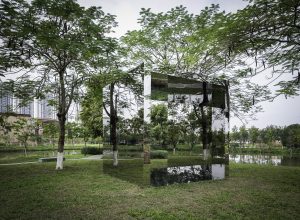
Shirin Abedinirad, Reflective Journey, 2023. Land art, Kâhta, Adıyaman, Türkiye. Presented at the Commagene Land and River Art Biennial, the work brings together doors salvaged from the aftermath of the February 2023 earthquake and mirrored panels that open onto the surrounding landscape, transforming obstruction into reflection and honouring the resilience, grief, and hope of a community remaking itself after devastation. Artwork courtesy of featured artist Shirin Abedinirad.