


1. Origins
This is Rozy’s story.
It’s a story about growing up in Gaza City, about holding your people close during a war, about adapting to a new and unfamiliar country, about family and violence and resilience and hope. But it is also a story about a young woman: a whole and complex person whose experience transcends newspaper headlines and stereotypes about Palestinian refugees. It’s a story about bombs and border crossings, but also about childhood friends and music concerts and family squabbles and black jeans and hair dye and period pads and a beloved cat.

This is not my story, but I will briefly introduce myself, because I interviewed Rozy for this piece, and because our origins orient our engagement with other people’s journeys. I’m a British-American dual citizen, and I’ve moved around all my life — most recently to Egypt, where I am an Assistant Professor of English and Comparative Literature at the American University in Cairo. I’m an immigrant, and a very lucky one, with all the advantages of the citizenships allotted to me by birth and by coincidence.
This semester, I designed an introductory freshman class on ‘Literary Rebels’, for which we’re reading Shakespeare, Mary Wortley Montagu, Frederick Douglass, Samuel Delany, Allen Ginsberg, Lucia Berlin, and Ahdaf Soueif, and exploring what makes their writing rebellious. It is through this class that I met Rozy, who is one of my students, a twenty-year-old freshman who arrived in Egypt in December, 2023, after fleeing from Gaza. Rozy is not her given name — it’s the nickname she has chosen to go by to signal a fresh start, and, she hopes, a happier period of her life. She likes its positive, ‘rosy’ connotations, and the fact that it’s a play on her family name. In our classes, she has particularly responded to the writer Lucia Berlin, and to her short story about adolescence in Chile, ‘La Vie en Rose’.
Rozy recently moved to the dorms on AUC’s campus, while her parents and two younger siblings live in the same neighborhood as me, Maadi, half an hour’s drive away. Rozy visits them as often as she can. She and her family were displaced within Gaza for two months, and then separated for four months while they waited for Rozy’s father to be given permission to enter Egypt.
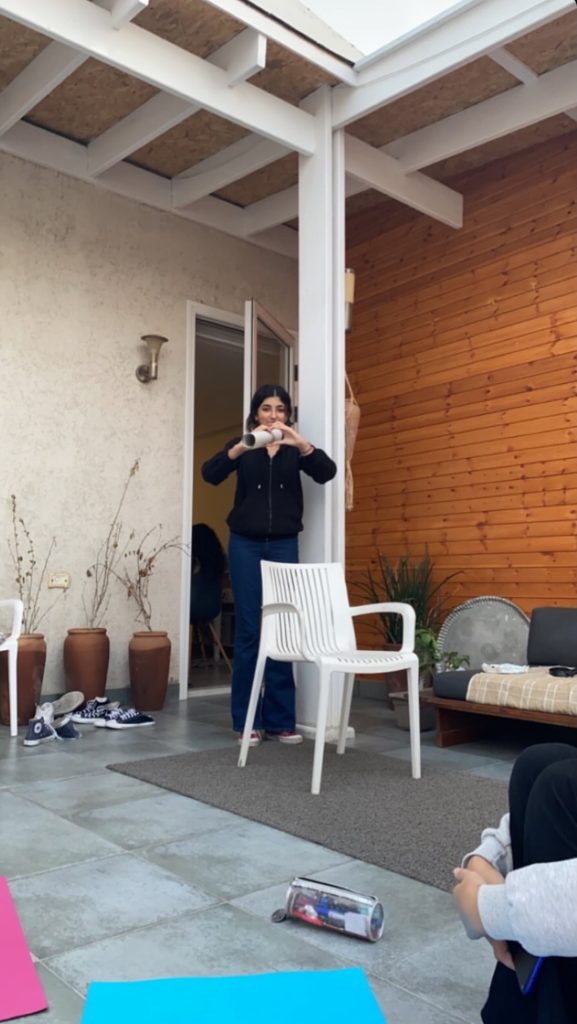
Rozy’s experiences of belonging and of displacement are very different to mine. I have moved around the world by choice, in safety, whereas her moves have been forced, responses to the genocide in her birthplace and original home. Together, we decided to examine her journey in a conversation in my office in the Comparative Literature department, as our own act of literary rebellion. We are grateful for this platform to tell Rozy’s tale of movement, violence, beauty, fear, love, kinship, and bonds forged across borders.
Please note that names have been changed in the conversation that follows.
2. Journeys
NINA
Where did you first feel that you belonged?
ROZY
The place where I was born and raised is where I feel I belong: Gaza City, in Palestine. I had my routine there, people I would see every day, and things that happened regularly, like our relatives’ visits for Eid and Christmas. I loved those repeating rituals. That was home, for me.
I lived with my parents and siblings in our apartment on the top two floors of a building in Rimal, which was the best neighborhood in Gaza City. It was a big apartment, and designed the way we liked, because my parents are both architects. Actually, I built my own tiny wooden house — a little room, really — on the roof, just for me to be alone in with my paintings and my three violins. I filled it with all the things that I feel are me, Rozy, like sheet music, books, and boxes of letters from my classmates and friends. So many things that I didn’t have the chance to take with me.

NINA
Are they still there?
ROZY
Yes, but we’ve lost part of the upper story of the house, the top floor. I think my little wooden house on the roof is still standing, though.
Inside, our apartment was painted white, but with lots of strong colors, like yellow, red and the same turquoise-blue color you see on window shutters in Cairo. You could hear the sound of the sea from our apartment — it was just five minutes away. Our home was high up, so if you looked out the windows on one side, you would see Israel, and from the windows on the other side, you would see the sea.
NINA
Is the sea important to you?
ROZY
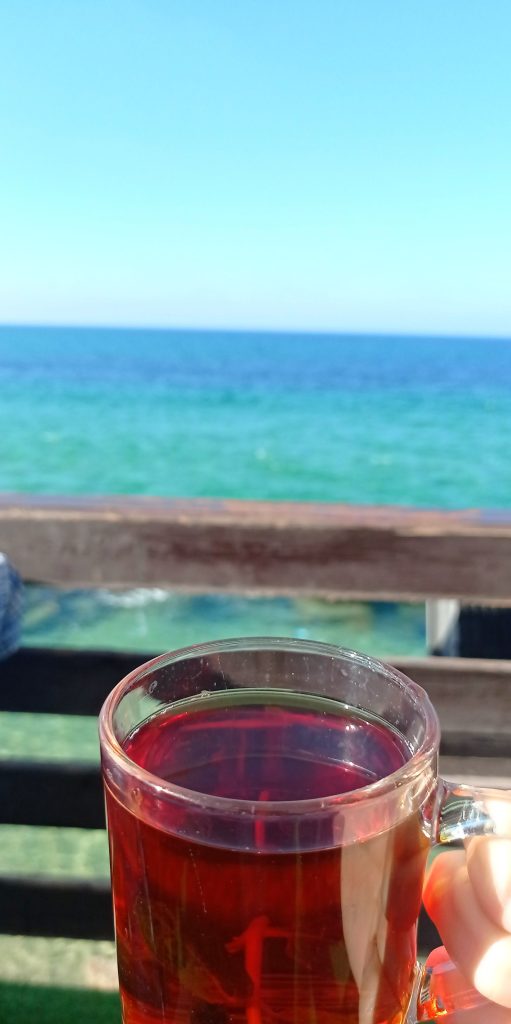
Oh yes. It’s home for me! I struggle in Cairo, without the sea. In Gaza, I would go down to the edge of the city all the time, and look out at those endless views of the sea. It was like therapy.
In some places along the coast, the water was blue and turquoise and perfect. But in other places, it had turned a muddy green, because Israel wouldn’t let us dispose of our sewage, so it would be piped directly into the sea. They forced us to do that. So you’d be there, admiring the view, and suddenly you would see the sewage.
NINA
So you weren’t able to swim?
ROZY
[Laughs.] People still swam, but only in places in the north, closer to Israel, which are less contaminated.
NINA
What objects do you remember most clearly from your childhood home?
ROZY
You know, I’m obsessed with objects. I crowded many of them into my tiny house on the roof. For example, my grandpa’s rotary telephone and my father’s film projector. And all my letters, of course, in their huge, colorful box.
My dream is that one day I’ll own a house that I can design myself and fill with all the things I love. And I’ll paint the walls different colors, and even draw on the walls, like my parents encouraged me to do in Gaza City when I was a child. They didn’t care about rules, they just wanted me to experiment with colors.
NINA
What do you miss most about the world of your childhood?
ROZY
I miss how easy things were. Even with friendships. Maybe it’s because I was younger, but I didn’t overthink things. And my life in Gaza City felt peaceful, even though I’ve lived through five wars — I was born in 2005, so there was 2008, 2012, 2014 and 2021, and then the war of 2023. My life was full of activities outside of school. We had a huge library, which was free for everyone, and which had art spaces and labs and courses. That’s where I learned to paint.
NINA
What do you remember of those earlier wars?
ROZY
A lot. I even remember the first one, which happened when I was three. Our building shook because tanks were in the streets. And I remember my mother putting wet fabric on my face to protect me from the toxic gas. We did that during the latest war, too. You soak the fabric in water and onions, and it helps.
During one of the earlier wars, I was able to come here, to Egypt, because my father works for the United Nations. We were really lucky.
NINA
Tell me about your family.
ROZY
My whole extended family lived in Gaza City. My grandparents from both sides moved there after 1948, but my mother’s side is originally from Jaffa, and my dad’s side is from Ramla.
Gaza City is small, like living on a university campus, so we would see our whole family, from both my mother’s side and my father’s side, at least once a week. We would stay at each other’s homes, or go to my cousin’s farm or to the beach.
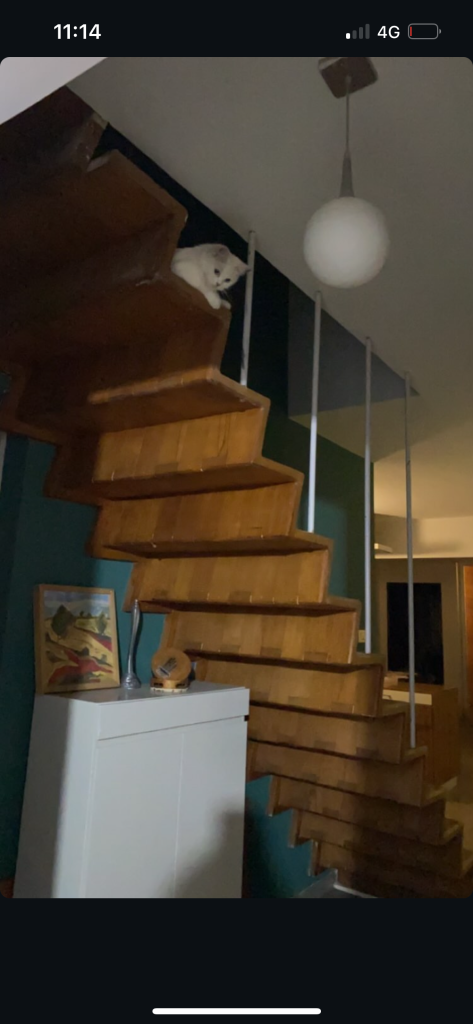
It’s just the five of us now, in Cairo — my parents, my two siblings, and me. But it used to be six, because there was also Hembel, my cat, whom we left in Gaza. We were very close, him and me. I felt like he was a real human being, not a cat. He was a real gentleman.
We didn’t bring him with us when we left our apartment in October, 2023, because we thought we would be home in a day or two. We left lots of food out for him, but then we were never able to go back. Our neighbor said that he disappeared, probably out the window and over the roof. I hope he’s alright.
NINA
Tell me about the circumstances of your move to Cairo.
ROZY
[Sighs.] Life was perfect, I would say, until that day. I woke up early to study calculus because I had an exam. And suddenly, I heard these strange sounds. I didn’t know what they were, honestly, because they were weird. I know the sounds of bombs very well, but these sounds were different, and that’s how it started for me. I thought, These are my last moments in this life. I knew it right away.Actually, I have a video of the sounds that I can play you. [She does. I can see a slice of blue sky through lace curtains. Silence, and then a shrill ripping noise, almost like fabric tearing, or like a zipper in the sky.]
My first thought that it was a whale. [Rozy laughs.] Do you remember the whale that someone saw off the coast of Gaza in 2018? I thought the bombs were a whale singing. I thought that it was anything other than a war, because we’d already had one in 2023. So I thought, Okay, they might do it next year, but not this year.
We stayed in our apartment for two days, wondering whether we should evacuate from Rimal. We had received notifications warning us that they were going to erase it from the map. And my parents didn’t really believe that they would, but I cried and begged them to take us away. I didn’t want to die that day. And within five minutes, we had taken a decision. Our bags had been ready since morning, and they were waiting for us by the door.

NINA
Had you packed your bags like that before?
ROZY
Yes, many times, and it’s hard each time. It’s even harder because you don’t really know what to take. And as I said, I’m obsessed with all my objects, my paintings from childhood, my boxes of letters, my father’s film projector. But you can’t fit a projector into a small bag.
It was an impossible decision, and my mother told me to only bring the most important things. I wasn’t sure what to take, so in the end, I left everything behind. I couldn’t choose, and I had this weird feeling that the things I didn’t take would be jealous. I told myself that I would return to my home soon, and that nothing would really happen.
So I just packed my black jeans that I hate, and two shirts and my tablet and headphones, and that’s it. And the red hairband that I still wear to class sometimes.
NINA
I know the one you mean.
ROZY
And then we left. The first place we went to was a hotel, also in Gaza City. Only foreigners and people they trusted were allowed to go there, including us, because my father works for the UN. It was our first time checking into a hotel and not choosing a room with a view, because that would have meant that the room looked towards the sea, and the sea had become risky because they were bombing us from the ocean, from boats.
NINA
So the sea that you loved became dangerous.
ROZY
Yes. It became something I didn’t want to look at. So we chose a room with no view — just one room for all five of us, my parents, my siblings, and me. We were too scared to be separated. And we didn’t even stay in the room much, because there were so many bombings, it was safer to sleep in the lobby or the basement. I kept thinking that I would die because of all the bombs, and then the electricity went off.
Soon, we had to move again, when they sent us instructions to evacuate to the south. And that was a hard decision because of all the bombing in the streets, but we did it. We left the hotel and tried to get in our car, but the gas tank had exploded. Everything was falling down around us —the towers, everything. We managed to join a UN convoy, where we ran into some people we knew, who made space in their car for me and my siblings. We had to leave my parents in the street, and I thought I would never see them again.
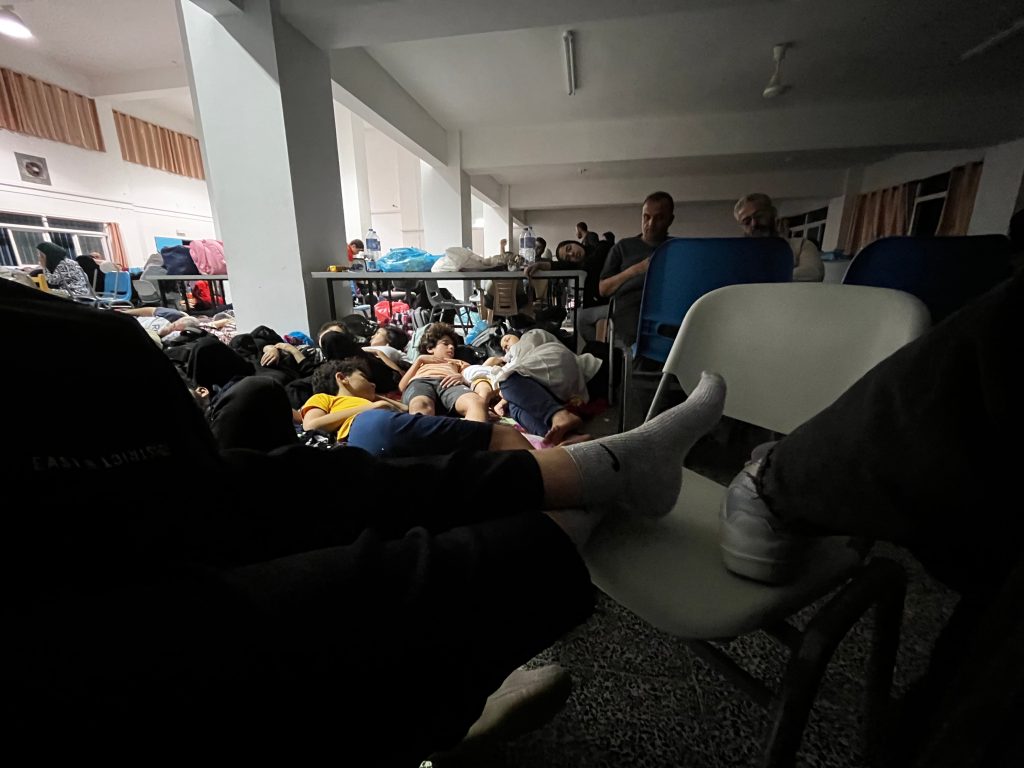
We fled to a college to take refuge, and it was incredibly crowded. There were 40,000 people in it, and only four toilets. It smelled terrible. But my parents managed to join us there.
NINA
Where did you sleep?
ROZY
By this point, we were in a group of 14. My family, my aunt’s family and my uncle’s family. My father managed to get two mattresses for all 14 of us, and he put them in a space about this big. [She gestures to half of my office, which is not a large room.] And we made a schedule so that each of us could sleep for two hours at a time, and of course we were all sleeping on top of each other.
My whole trauma comes from that place, because I got my period that same week, and my periods are always very intense. I need medicine, painkillers, which were not available there. It was very difficult to even find me pads: my father spent a whole day trying to get some. A hot water bottle helps with my pain, but we didn’t have one, and there was no space for me to even lie down. Of course, I was scared too, and starving. There was no food — we had managed to find some Malto in a supermarket, but no real food.
You see, I’m used to living in my home, where I have my own room and my own toilet. So it was hard! I didn’t take a shower for the first two weeks that we lived in that place. Finally, I made my way to the kitchens — because the place was a college, it had big kitchens, with sinks for washing vegetables — and I found the place where they used to wash the potatoes. And I washed myself with cold water, like a potato. [Laughs.]
The only way I managed to live through this was by keeping my headphones on, because it was all too much. Too many people.
NINA
From what I know of you, you’re someone who likes privacy and quiet.
ROZY
Yes! Even with my family. That’s why I built my tiny house on our roof. So that time we lived in the college was the worst ever.
After that, we moved to a chalet in Hamad City, Khan Yunis, which was also a small space shared with people we didn’t know, but it was better. We had a shower, a toilet, a kitchen. I was so relieved when I saw them. I felt — you know, there are so many things in our lives that we don’t really value. And the biggest one, for me, is showers. Every time I have a shower now, I really feel it. Sometimes I stay in there for three hours.
NINA
I think that’s the least you deserve, after what you’ve been through.
ROZY
Most of my time in the war was spent in this chalet. And then they started to bomb the area, and when I saw videos of the bombing later on, I couldn’t believe that we had been living there at the time. We never left the house. We never went outside. We could hear the bombings, huge bombings, but we were stuck inside that small space, me and my family and the other people we shared the chalet with. And there were lots of problems with them, and even within our own family because we were all under so much stress. In a war, managing family dynamics gets more difficult, because you’re all in survival mode.
One day, my father managed to rent a car so that we could escape Khan Yunis. But my mother asked him to delay leaving, because she wanted to dye her hair, which had begun to turn grey with the stress. She’d been wanting to dye it for weeks, and she thought that the bombings were lighter that day, so she would have time. And she was in the kitchen, doing the color treatment, when she raised her head from the sink to look out the window, which had a view of the whole city. And of course she saw that the bombings had started again, and that we had to leave immediately.
[Rozy laughs.] My mother said, “Of all the days, they chose the day when I was finally dyeing my hair.” It was funny, honestly.
So we got our bags, put them in the car, and left. We didn’t know where we were going. We just followed the traffic, and it got darker, and then it was nighttime and we were at the Rafah border crossing with Egypt.
There are these lists of who is allowed to cross, and we’d been waiting for two months for our names to be put on a list. Finally, they were there, but there were only four names on the list: me, my mother, and my siblings. Not my father. So we didn’t know what to do, because we didn’t want to be separated, but we knew that we couldn’t stay in Gaza any longer.
We waited at the border crossing until one o’clock in the morning. I really hate that place. It’s disgusting. But the good thing is that they had food. We hadn’t eaten for a long time. We’d spent weeks saving items, waiting to eat them until we had no other choice and we were really starving.
NINA
I am so sorry. It is so wrong that you should ever have had to experience that.
ROZY
I’m like… [She shrugs.] I’m glad that I had this in my life. And I’m glad that it’s finished, and that I’m here and that I can be Rozy now, not my previous self. That’s why I decided to change my name. I feel like Rozy has more to do with who I am, and it means that I can keep my old self in the past. I want to start a new beginning now.
So we were at the Rafah border crossing, and they made us wait for a long time, even though we were the only people there. Eventually, they said that we could cross in the morning, and they took us to a room and locked us in from the outside.
At that point, I really needed to get out of Gaza. Honestly, I don’t really care about myself dying, but at the same time, I didn’t want to see my family members die, and I didn’t want to lose an arm or a leg. One of my friends, Noor, lost her eye and both of her parents. Another friend of mine, who was also called Noor, died on November 5th, 2023, even though her parents survived. That was very hard for me. We had been friends for 11 years. We were at the same school, and we even sat at the same desk. Our last hangout was at the beach in October, 2023. Somehow, we had never been to the sea together before, and we sat there and had this deep talk, and then we walked around Gaza, and it already felt like we were saying goodbye.
A few weeks later, I got a call from another girl I knew, and she said, ‘Your friend was Noor Mohamed, right?’ And I confirmed that that was her name and asked what was going on. And the girl said, ‘Ah, you don’t know…’ So that’s how I found out. [Rozy tears up.] I still can’t believe it. I need Noor, honestly. She always had this dream of one day living in Spain. So now that’s my dream, to go to Spain and work as an architect there.
NINA
I am so sorry, Rozy. Let me pause the recording for a moment.
ROZY
[Resuming after a pause.] So we were at the Rafah border crossing, and my dad said, “Okay, listen, don’t think about me. I will join you as soon as I can.” That was one of the worst moments of my life. He would have to go back into Gaza, and we could still hear the bombing. But we said goodbye and then we crossed, just me, my siblings and my mother.We began the crossing process on the 4th of December, 2023, and we arrived in Cairo on the 6th. We thought my father would make it across soon, too — within one or two days — but it was four months before he was allowed to join us. And that felt even more painful because it only takes six hours to get to Cairo from Gaza City. It’s closer than Aswan.
NINA
Where did you stay in Cairo?
ROZY
To begin with, we were in a hotel. Later, we moved to Maadi, and it’s funny: I had always had this idea of going to visit Maadi, but I never imagined living there. Suddenly, there I was, and I thought to myself, Oh, I’m in Egypt. I couldn’t believe it. The first shower was amazing. I think I used up all the water in the neighborhood.
NINA
You can have all the water in Maadi, that’s fine with me.
ROZY
And everything felt strange. We chose to all sleep in one room in the hotel, my mother and my siblings and me. We had lived within the same two meters squared for so many weeks, we felt this connection. And the hotel staff didn’t understand why we only wanted one room. You can’t if you haven’t been through what we went through.
Whenever I went out or even went to the bathroom, my mother got very anxious. She just wanted us to be with her all the time. And that was hard. I was trying to live my life, and I couldn’t. I wanted to make my mother feel comfortable, but at the same time, I wanted to explore this city. It seemed so huge — so scary, honestly — and all the cars made these loud sounds! Actually, once, I was walking outside with my mother and my siblings, and a car backfired and in that moment, we all dropped down to the ground in the street, because we thought it was a bomb.
NINA
Of course. You’ve all been traumatized by what you went through.
ROZY
Yeah. I struggle with the sounds here, especially at night. I try not to dwell on what I’ve been through, and then suddenly I wake up, thinking that I’m in Gaza.
You how what is really different here? The sound of silence. Even in Cairo, with all the traffic, there’s silence. We didn’t have that in Gaza City, even before this latest war, because of all the drones. They would always be flying overhead, even on a normal day. I didn’t notice them, back then, but when I watch my old videos now, I hear them.
So when I came to Cairo, at first, I couldn’t sleep. Luckily, there are the air conditioning units in the AUC dorms, and their humming helps.
But you know, something good happened in Cairo recently. There was a guy I knew back home, a special person, a dear friend. He evacuated to a place near to where we evacuated to, actually. We never managed to see each other during the bombings, and then as we were leaving, I saw them bombing the place where I knew he was staying. After that, I thought, I’m done. I couldn’t even tell the people around me, because everyone was losing their people, not just me. So I stayed silent, but I could see the bombings from the bus window.
Later, I heard that he had survived, and he came to Egypt after he crossed the border in 2024. We spent the best days together here in Cairo, because he was also living in Maadi and we were able to go out together. In Gaza City, we had never been able to meet in public, because you can’t do that there. It’s very conservative, and it’s tiny, so everyone knows you. Once, I went to a café to study with my friends after school, and the owner called my mother to report on me, as though I were committing a crime. I don’t even know how he had her number. She called me and we laughed.
So when my friend came to Cairo, we were finally able to go out in the city together.
NINA
Tell me more about your new life in Cairo.
ROZY
Well, it’s all so different, because I’ve never travelled before, except when I came to Egypt during the previous war. I’ve never had the chance to explore new communities the way I am now. And I’m slowly realizing how small Gaza City was. Whereas Cairo is so big, it’s too much. The speed of the cars! When I first arrived, even the Metro was overwhelming for me.
I’ve got used to it now, though. And really, when I arrived in Egypt, I decided that I wanted to fit in as much as possible. That’s why I’m learning Egyptian Arabic. It’s very different from Palestinian Arabic. Sometimes, when I talk to Egyptian people, they reply to me in English, thinking that I’ve never spoken Arabic before.
It can be exhausting. At the end of each day, I lie down on my bed, close my eyes, and see flashbacks of myself entering our home in Gaza City, walking into our kitchen, or walking down our street, and I keep reminding myself of what my home was like.



NINA
I hope that you’ll be able to go back one day, but I also hope that you’ll be able to travel the world like you want to.
ROZY
[Shakes her head.] Gaza City is so different now from what I have in my memories. I want to leave it as beautiful for me as it always was.Another nice thing that happened: soon after I arrived in Cairo, I was introduced to a member of a band I really like, through my uncle. And because I paint and play the violin, they suggested that we collaborate.
So in my first week here, I joined the band for this concert, under the theme of Palestine and Gaza. I was so excited, but before the concert began, they played the sound of bombs — to make the audience feel Gaza’s pain, I think. I was standing by my artwork when that happened. I froze and wanted to run away, to escape. I was already overwhelmed by the sound, the crowd, the lights, so when they played the sound of bombs I was terrified.
But I pulled myself together. The band introduced me and explained that I was from Palestine, and everyone wanted to take photos with me. I felt like a celebrity. I’d go take a little break to cry, and then I would come back out and smile, because I know there’s this image of Palestinians… Everyone pictures babies crying, with missing arms and legs, and I wanted them to see a different side of us. I wanted to act cool.
You know, sometimes I reach the point where I don’t want to even tell people that I’m Palestinian, because I don’t want to be pitied, you know? I just want to live my life and have cool talks like this one. I want to be someone. I want to be Rozy.

NINA
Yes, I think I understand.
Finally, can you tell me about some of the new bonds you have forged in Cairo?
ROZY
So many. I can’t even believe how many new friends I’ve made. And I’ve changed. I have a new way of thinking, which has changed some of my beliefs.
NINA
And has your idea of home changed, too, since arriving in Cairo?
ROZY
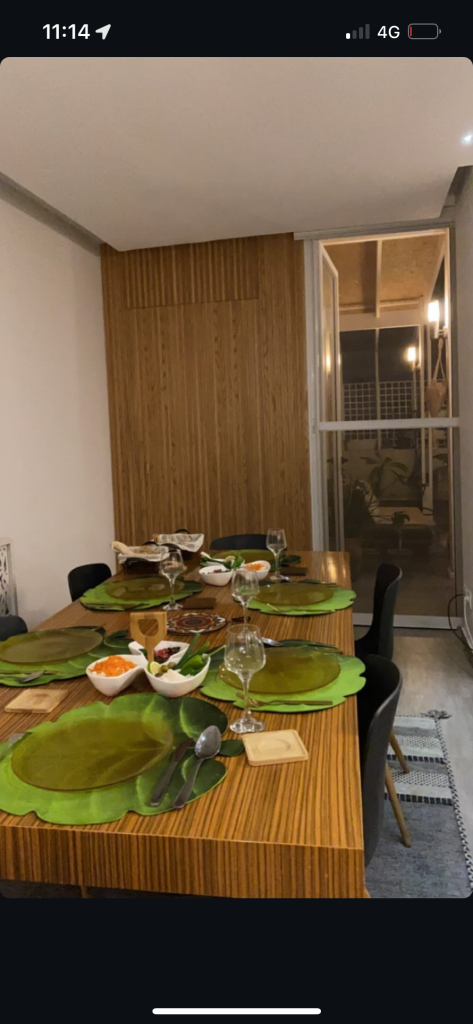
You know, in the beginning, I thought home was just the land. But now, honestly, I feel like it’s what you do in a place, and the memories you make there. So I’ve realized that I still have those memories from Gaza City — and also that here, even in my dorm or in rented apartments that I don’t like, I can create my own space. I can arrange things in a way that I like, a way that feels like home. I can create my own world.
Photos Courtesy of Rozy