


In Fiqh, Islamic jurisprudence, menopausal women are literally women who have reached the age of “despair.” At least, that’s the term commonly used in scholarly jargon to designate this somewhat separate category, as something in-between. Neither women nor men. Women with the physical appearance of women but who can no longer demonstrate their capacity to be women, that is, to “give birth,” to bear children. Women, certainly, but women who can no longer “hope.” Hence their despair.
When I was still young, curious and passionate about historical and religious books, I delved into religious texts that concerned the onset and cessation of menstruation in the Islamic tradition, and I was constantly struck by this term, “the age of despair.” In fact, it was the word “despair” that bothered me the most, or rather, that I didn’t understand. Why stop hoping when one is still alive? Why was it that only women lost hope when their reproductive years ended, while men in the same age group were supposed to retain it even when everything else in their lives at that time might be going wrong: baldness, enlarged prostates, atrophied muscles, slowing careers, crumbling and fragile relationships, and children leaving home? So why did hope disappear for women while hope remained, or at least lingered, for men? A great mystery to add to the long list of mysteries secretly held by women of faith like myself, who only reveal the “bright side” of their bodies — face and hands — and of their beliefs, peace and serenity.
No one helped me to unravel this mystery until “despair” started heading my way and crawling under my skin. Despair began to rear its ugly head. Hot flashes started to grip my throat, climb into my head, then slide back down to my stomach before quickly moving down my legs. That was how despair entered my life, a sudden choking sensation and an urge to undress to seek some relief from the suffocating heat. But it wasn’t just the choking sensation and the feeling of suffocation. Despair had several tricks up its sleeve.
There were also the copious amounts of blood that I could no longer absorb with regular sanitary pads. It was a bit like tsunamis of postpartum bleeding. Mini-pregnancies that ended each month in the bathroom at home, at the office, in public restrooms, or in leaks on chairs during events where I had to sit for too long. Yes, this was the second weapon that despair wielded and hurled at me, draining me of all my blood each month and humiliating me in front of others. Small reddish puddles appearing on the back of my long skirts, furtively washing the stains in restaurant restrooms with liquid hand soap, or brown paper soaked in water. Despair was winning its battle against me, and I found comfort only in the hope that soon it would all be over. The blood, the sanitary pads, the missed workdays, the mood swings, the debilitating migraines that kept me bedridden for two days, and the hormonal imbalances that turned my head into a battleground between severe and acute obsession. Despair would set me free. Soon I would be a free woman.
And one day the blood did stop. It vanished. I enthusiastically gave all the packages of sanitary pads to women’s shelters. I bought new underwear. Not the kind my daughter recommended, supposed to absorb the incredible amounts of that viscous red liquid that flowed from my insides, no, just plain underwear that reminded me of a time when blood hadn’t yet invaded my life.
But despair continued to use its weapons against me. To those I have already mentioned was added one of the most formidable: I couldn’t sleep. Despair kept me awake. At first, I resisted. I used these sleepless nights as a bonus for my days, which I found too short. At night, I continued to think about what I was going to do in the morning. I thought about my presentations. I thought about the characters in my stories. The best ideas came when my mind was poised between torpor and alertness. Between hope and despair. Between life and death. At first, I thanked despair for keeping me awake, but quickly I realized I wasn’t doing very well. One morning I couldn’t find my car after yoga class. Who had stolen it? Who would have moved it without my keys and without my consent? I wandered around the parking lot, trying not to give the impression that I had lost something important. In fact, I had indeed lost my car. I couldn’t remember where I had parked it only an hour earlier. And when, finally, after repeatedly activating the alarm built into my key, I found my car, I was overwhelmed by a feeling of shame and fear. Was it possible that despair was making me lose my memory?
But one day, things changed. On the radio, I heard the voice of a Supreme Court judge whom I didn’t particularly like. She had previously made a statement against women who looked like me, that is, those who are sometimes called submissive, veiled, crazy, those who can only have children (those who perhaps still have hope), in short, against Muslim women who wear a hijab. I no longer remember exactly what she said. I had tried to forget. I call it selective amnesia.
But this time this judge said something intelligent. Perhaps not overly intelligent, but very important for me to remember. This just goes to show that intelligent people don’t always say stupid things. They sometimes speak the truth. Speaking from her own experience, this judge said that she suffered from insomnia and only slept a few hours a night. I don’t know if her insomnia was exacerbated by the same despair that gnawed at me from within, or if it was the result of other medical causes. But this judge had noticed that lack of sleep affected her memory, and that the less she slept, the more her memory became blurry and unreliable. I immediately felt a connection with the woman who, at another time, had insulted women who looked like me. But she redeemed herself. Her words became ingrained in my brain, not the part that forgets but the temporal lobe or the frontal lobe.
And so, armed with the story of the judge who forgot and sought treatment to get a little more sleep and save her memory, I told myself to overcome despair and go see a doctor, to salvage what little hope remained.
Later, when I had become a self-proclaimed expert on despair, I heard an American gynecologist on a podcast say that family doctors receive only one hour during their entire medical training on the period before and during despair. But it’s worth noting that the gynecologist was American, and these days you have to be wary of anything American. Perhaps here in Canada we did things differently, and our doctors were more educated on the subjects of hope and despair.
My doctor quickly diagnosed me with generalized anxiety and prescribed antidepressants. I kept telling myself I wasn’t depressed, that I wanted to live, that I didn’t feel the need to stay in bed. But the verdict was clear: to sleep I needed pills, and they were going to give me hope again.
Amidst all the upheaval in my life, my father had stopped answering my phone calls. He had gone to Tunis for a few months. A week earlier he had promised he would buy a plane ticket to return home to Ottawa. But now he wasn’t answering his phone. I started to worry. Usually, my father would immediately pick up when I rang, but my calls went unanswered.
The pills no longer had any effect on me. Despair had taken hold once more. I was suffering the effects of insomnia again. My memory might be failing but at least I didn’t have to worry about cleaning up blood or scrubbing stains out of my clothes. Just insomnia, obsessive thoughts, the suffocating heat, and now, of course, my father not answering my calls.
Soon, another verdict would come. Despair had crept into every corner of my life. Death. The faint smell of blood mingled with the staunch smell of death. A call from my uncle in Tunis with the news that I feared most: my father had died. The loss of my biological father. Despair had swallowed me up and settled into every corner of my life, even claiming the person I loved most.
I boarded a plane. I was dressed in a long red dress, burgundy, the colour of blood, a relic from a time of hope, or perhaps from the prelude to despair. I didn’t move from my tiny seat for almost eight hours. The plane was filled with children’s cries, reminders of hope. My legs were numb and my mind was swallowed by the abyss of my soul. Death and despair paralyzed me. I didn’t know how I would bury my father, or where. My mind raced. Insomnia held me captive, and I was losing every battle. The battle for life and the battle for hope. The great Islamic jurists were perhaps right. I had indeed reached the age of despair.
But as my father was being placed in the same grave that had received the withered and despairing body of his own mother more than twenty years earlier, as I stood in contemplation before this mound of freshly turned earth not far from the telephone pole and the large cypress tree, the words my father had scribbled on a small scrap of paper to remember his own mother’s grave location, my body rebelled. As I stood in the cemetery, a veritable labyrinth where the dead lay among the shrubs, amid the plastic bottles discarded by thirsty visitors, and the birdseed sold by street vendors in newspaper cones for relatives to lure birds to fly over the graves and sing for the dead, seeds that looked strangely like the flax seeds that North American women religiously grind and sprinkle into their morning green smoothies to feel beautiful and energetic and, above all, to ward off signs of despair, a strange thing happened to me. As I wept uncontrollably for this being who had left me without my being able to tell him I loved him, I felt a strange sensation. The blood flowed again. Hope found its usual channel. My ovaries decided to resume the work they had done for some forty years. Work they had suddenly refused to do for the past few months. Yes, hope had returned without warning, without announcing itself. In saying goodbye to my father, hope made its way to me. I was hoping again in the company of death.
But this was not the end of the story.
To prepare my father’s death certificate, I needed my parents’ marriage certificate, proof that I and my brother were children born of that marriage and therefore the patriarch’s rightful heirs. But it was a near-impossible task. My parents’ marriage certificate was nowhere to be found in the civil registry; there was no certificate in my father’s name. My uncle drove me from one civil registry office to another. I waited patiently, hoping that my father’s name would suddenly pop up on the screen. And at each office, the answer was the same: Are you sure of your father’s name? And your mother’s? What date were they married? I knew the date of the wedding ceremony, but not the date that the religious contract had been drawn up. I called my mother to ask her when the notary had registered their union.
“You think I remember that date? At my age, you forget everything, or almost everything.” She was right. Perhaps it is the age of despair, a little voice said in my head. The Islamic jurists always won.
And then, in my uncle’s car, I felt the blood flowing freely. My mother, who couldn’t remember the date of her religious wedding; the civil registrars with their tight smiles. But then hope returned to me, announcing itself with a bright red colour. I suddenly needed pads, and large ones. The one I was wearing was almost soaked through. I was in the car, feeling like a little girl, too embarrassed to ask my uncle to stop so I could go into a pharmacy to buy sanitary pads. I cursed hope with all my being. Let despair return with its suffocating strangulation and benevolent insomnia but at least let me be done with this red liquid.
“It’s time for the Dhuhr prayer,” my uncle said. The midday prayer had saved me. We were going to stop, and I would find a pharmacy to buy my sanitary pads. “What a great idea,” I said, pretending to want to pray, even though menstruating women are not permitted to. My uncle stopped the car, and we agreed to meet again in fifteen minutes in front of the mosque. My plan was set. I would find a pharmacy and go to the mosque’s restrooms. I would embrace hope and banish despair and then meet my uncle. No one would be the wiser.
But there wasn’t a single pharmacy open in the area. I stood before a half-open metal door. It was lunchtime. Here people took their time to eat their snacks and share all the day’s gossip. But I didn’t give in to despair. I put my nose right up to the shop window. Inside, two young. women stared at me in astonishment. “What does she want? Doesn’t she understand that the pharmacy is closed?” they seemed to be saying to each other.
I moved closer to the window, until my nose was practically touching it. I tapped lightly on the door. I gestured for them to come over.
“Ma’am, we’re closed,” one of the women said. “Come back later.”
“Yes, I understand. I’m so sorry but I’m really in a bind. I desperately need sanitary pads. Please, can I buy some?” I was like a teenager who had forgotten to pack, not like a woman in her fifties who had regained hope.
Hope and despair were on the battlefield. Each in their own camp and me in the middle, torn between shame and discomfort.
The young woman furtively handed me a package, which I quickly slipped into my bag. I paid for it and apologized, whispering gazillions of thanks. It was the most significant moment of female intergenerational solidarity in my life.
I practically ran to the mosque’s restroom. A few more minutes later I was smiling as if nothing had happened, waiting for my uncle in the mosque’s vestibule.
My uncle told me there was a civil registry office on Rue d’Angleterre, not far from the mosque, and that I should go there to request proof that my parents were married. Otherwise, I wouldn’t exist or, at the very least, I wouldn’t be my parents’ daughter. This marriage certificate mystery had raised existential questions. I was desperate to prove that my parents had been married, never mind that I was in my fifties. I was torn between hope and despair.
But the response I received in the registry office was the same, but this time the officer, a woman, in yet another display of female solidarity, said, “Why don’t you try the civil registry archives? You can check if there is indeed a copy of your parents’ marriage certificate.” It was like touching the black stone in Mecca. Soon the mystery would be solved.
The civil registry archives were deep within a large building dating from the 1970s. Concrete blocks and glass windows piled one atop the other formed a trapezoidal structure reminiscent of an ocean liner moored on a field of asphalt. I climbed the stairs and found myself face to face with the great bureaucratic machine, an ogre with bulging eyes and drooling saliva. The civil servants looked grumpy. One more or less word and the hoped-for document, for which I had driven for miles with my uncle, going around in circles in vain, for which I had to interrupt pharmacy assistants during their break to buy a pack of sanitary pads, and for which I had almost stained my skirt with the red liquid that had reappeared in my life in the depths of despair, would either be found or my hopes would be crushed. The ogre had me in his grip.
My father’s death certificate hinged on my parents’ marriage, which hinged on a scrap of paper, which hinged on a civil registry stamp, which hinged on a civil servant’s mood and willingness to make an effort and search through the vast civil registers.
Finally, a clerk asked me what I wanted, and I explained the situation. “Come with me,” she said. We walked down a long, dark corridor lined with shelves stacked with large notebooks bound in dark brown leather. We had to search alphabetically. We needed the letter “M”, neither perfectly in the middle nor totally at the end of the alphabet, for both Latin and Arabic. The clerk’s gaze was scrutinizing the large notebooks, which must have contained the entire population of the country. From north to south, from the biggest city to the smallest village. From births to marriages to deaths, our lives were trapped here in a dimly lit corridor. It made me want to run away. I held my breath.
“I found the year and the letter.” She was holding several large notebooks, three times the size of a school notebook. The pages, yellowed by years and misfortunes, turned, and my mind fluttered. The age of despair, the death of my father, hope reappearing, and the blood that beats in my veins. The dance of the pages and the waltz of my thoughts.
A small cry of joy, or perhaps relief, signalled that my father’s name had been found. Next to it were those of my mother, the two witnesses and the notary, complete strangers in the company of my parents: without them, I wouldn’t exist. Long live bureaucracy, which grips us by the gut. Long live the registers that prove people exist. The ogre had released me. I was a free woman once more.
Outside the corridor, in an office lit by fluorescent tubes, the certificate number written down on a scrap of paper, I rushed to a counter, hopeful that this time the computer search would finally deliver my parents’ marriage certificate. After what seemed like an interminable wait, during which I still imagined myself a prisoner of the ogre, hope returned and I had a copy of my parents’ marriage certificate in my hands.
During the digitization of civil records in the early 2000s, my father’s name on his marriage certificate had been replaced in error with a completely different surname. Perhaps it was the name of someone who had come before him, or after him, on the alphabetical list. It was an innocent human error that had never been caught. Except by death. This was why his name had not appeared in the computer searches. He had ceased to exist decades before, even when he was still alive. Digitization had killed him long before the angel of death. Worse still, it was as if my mother had been married to another man who existed only on the state’s computer disks.
Upon returning to Canada, despair returned once more. With it came all the weapons that kept me awake at night. I was still suffocating from the heat and consumed by dark thoughts.
I had stopped taking antidepressants. I needed something else. I went to see my doctor.
“So, are you menopausal?” he asked.
“Yes and no.”
He smiled.
“I think I was going through menopause, but the blood came back.” I almost added that “hope” had come back.
“Then you’re not going through menopause. You have to wait exactly twelve consecutive months without any period to be absolutely certain you’re officially in menopause. In the meantime, you’re in perimenopause.”
Hope and despair stared at each other. And that was the moment everything clicked in my mind. Science serving religion, religion serving science. In the Quran, the divine word mentions “those who have given up hope of menstruation” (Surah 34, Al-Talaq, Verse 4). Never in the sacred text is the word “despair” linked to an age or to a condition. Despair, or rather the state of “those who no longer hope” (yaeesna in Arabic), proscribed the way to be certain of the end of menstruation, something more than relying on a woman’s mental and physical age.
How, from a description that supposedly confirms the end of menstruation (waiting twelve consecutive months, according to science), did great Islamic scholars create an “age of despair” linked to the despair of no longer having functioning ovaries and a uterus capable of carrying a foetus? Even worse, an “age of despair” that hinted you would soon be dead?
In the doctor’s office, as I prepared to leave, a prescription for hormone therapy in my hand, I felt proud to have solved this mystery that had troubled me. For years it had made me somewhat defensive about my position as both a woman of books and of faith. It took the loss of hope, the death of my father, the reappearance of hope, a humiliating moment in a pharmacy, a journey into the belly of the ogre, and a lot of scientific and religious reading to better understand the distortion of words, whether distorted by malice or simple ignorance. I could now help my body and mind enter peacefully into this new stage of my life. I had hope (the real kind) and a certain amount of despair (again, the real kind).
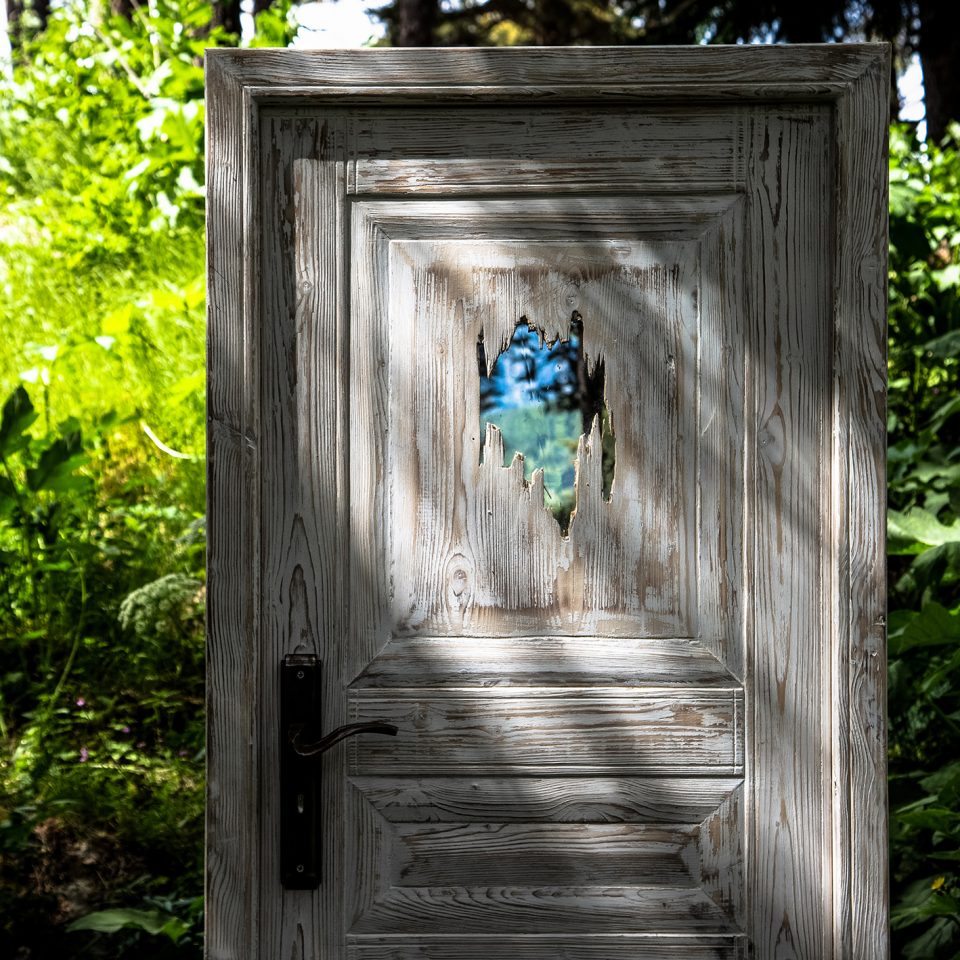
Shirin Abedinirad, Mirror of the Heart #2, 2019. Land art, Andorra la Vella, Andorra. Presented at the Andorra Land Art Biennale, the work transforms the door into a reflective threshold, inviting viewers to face the landscape behind them, their immediate past, and the possibility of change. Artwork Courtesy of our Featured Artist Shirin Abedinirad