


Paintings and Drawings by a Sudanese Master
“No politics,” this was the artist’s only request when I asked to interview him.
It was understandable that Mohamed Abdalla Otaybi would choose to speak about his art, rather than the three-year war still raging in his home country of Sudan.
At the age of seventy-eight, he finds himself living as a refugee in Cairo.
As ever, he remains committed to his artistic practice.

The war in Sudan is now in its fourth year, with no sign of an end to the violence. The conflict has involved a wide variety of actors, the main parties being the state’s national army, the Sudan Armed Forces (SAF), and the paramilitary fighters known as the Rapid Support Forces (RSF). Importantly, regional powers — from the Gulf to eastern Africa — have chosen to support different armed forces in Sudan for their own ends, whether to create instability in the wider region or to control the trade and profits from gold and gum arabic.
Civilians have been abused or killed in large numbers, with estimates ranging from tens of thousands to hundreds of thousands. The RSF has laid siege to major cities and committed grave atrocities, as in the western city of El Fasher in October 2025; the central Sudanese city of El Obeid, home to half a million people, is currently besieged, and fears are growing that the RSF may soon carry out massacres there.
There are also countless cultural losses, including the looting of the Sudan National Museum in Khartoum and the destruction of state archives, institutions, and artworks. The museum, now destroyed, was home to the world’s largest Nubian archaeological collection, with objects from the Paleolithic era through to the Islamic period.
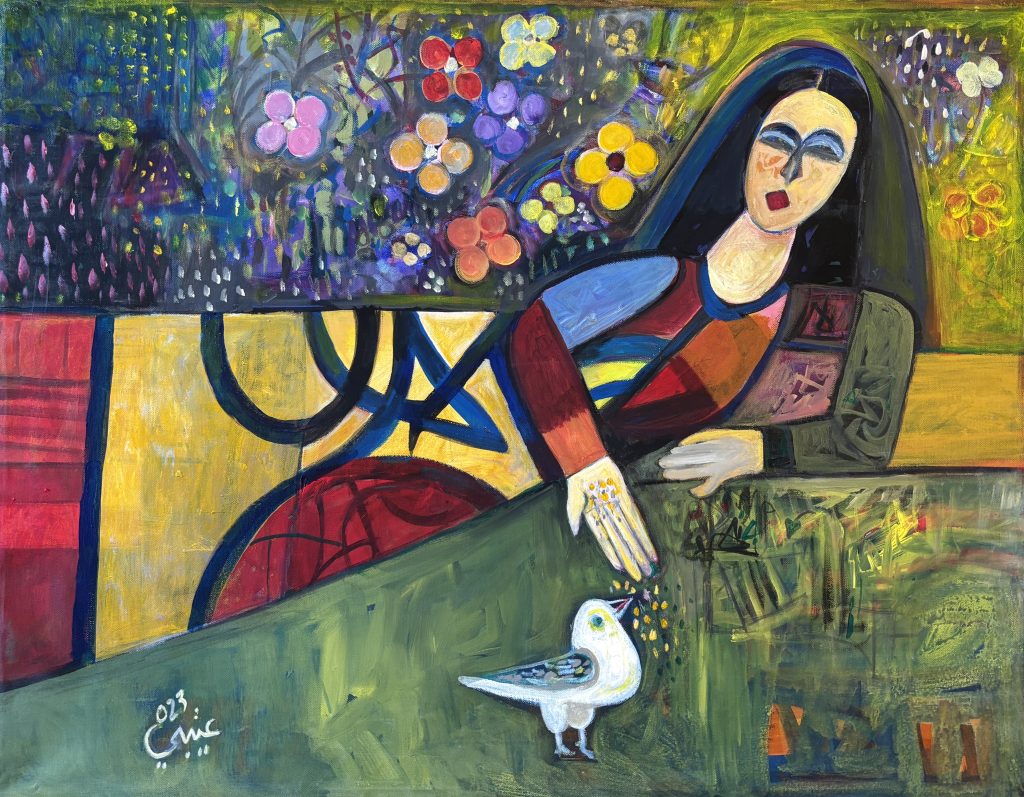
Swailem Art Gallery, one of Cairo’s newest sites for art, recently exhibited sixty new works by Otaybi, forty-six acrylic-on-canvas paintings and fourteen ink-on-paper drawings.
“Lighting”
It’s the show’s title; it’s filled with Otaybi’s trademark bright colours and front-facing subjects: people, beasts, birds and fish.
The artist’s statement reads:
The exhibition is an attempt to dispel the darkness that currently dominates the world. It stands against all forms of violence, injustice and darkness. It is an effort to plant seeds of goodness, beauty and love — symbolized by the soaring bird that appears in most of the works, as well as by the presence of a woman as a symbol of fertility and life. This exhibition is a call for optimism, dialogue and peaceful coexistence among human beings, as an alternnative to conflict and armed confrontation.
Among the more than four million people who have fled the war to neighbouring countries — to Egypt, South Sudan, Ethiopia and Libya — are many artists like Mohamed Abdalla Otaybi.
Otaybi is among the most storied painters and writers who emerged following Sudan’s independence in 1956, which ended the joint British and Egyptian colonial administration, known as the Anglo-Egyptian Condominium. He graduated from the College of Fine and Applied Arts in Khartoum in 1970 and later became a co-founder of the “One School” (“Madrasat Al-Wahid”). The One School dates from the 1990s and draws on Islamic and Sufi philosophy. It is considered the successor to earlier modernist movements, including the Khartoum School and the Forest and Desert School (Al-Ghaba wa Al-Sahraa).
Oytabi has held many high-level positions, both within and outside of government, taught at Sudan University, and founded and served as director of the Otaybi Gallery in Omdurman, Khartoum’s sister city on the west bank of the Nile. He has exhibited in Cairo, Kuwait, Algeria and other countries in the region. Otaybi’s works are held in private and institutional collections. His mastery of form and composition distinguishes his art, as does his use of symbols drawn from Sudanese folklore.
When asked who has influenced his art, Otaybi named some of Sudan’s most important poets and writers:
- Mohamed El-Mekki Ibrahim (1930-2024),
- Mohamed Abdul-Hai (1944-1989)
- and Al Noor Osman Abker (1938-2009).
They were, along with Otaybi, among the first generation of post-colonial Sudanese artists and writers. Their work has continued to reverberate over the decades. El-Mekki Ibrahim’s poem “Green October” (“October Al Akhdar”), written during the 1964 uprising against the military regime of Ibrahim Abboud, became a rallying cry six decades later, as Sudanese civilians at home and in the diaspora called for solidarity during the current war.
“He is a poet,” Diab said of the painter Otaybi. “He is a Sufi. He is a peaceful man. He wants to show this tranquillity, this peace. He’s very simple in his pictures, but he’s saying a lot.”
The Madrid-based Rashid Diab is a celebrated Sudanese painter, printmaker and art historian. He is the author of Visual Arts in Sudan (London: Almas Art Foundation, 2025), the first book to be published on the subject. The book gives an expansive account of Sudanese visual art from 1940 to the early 2000s, including painters, sculptors, calligraphers and folk artists.
When I asked Oytabi what he wants for his art, he hesitated and then said,
“Beauty and goodness for all the people of the world. To light a candle is better than cursing the darkness. This is my candle.”
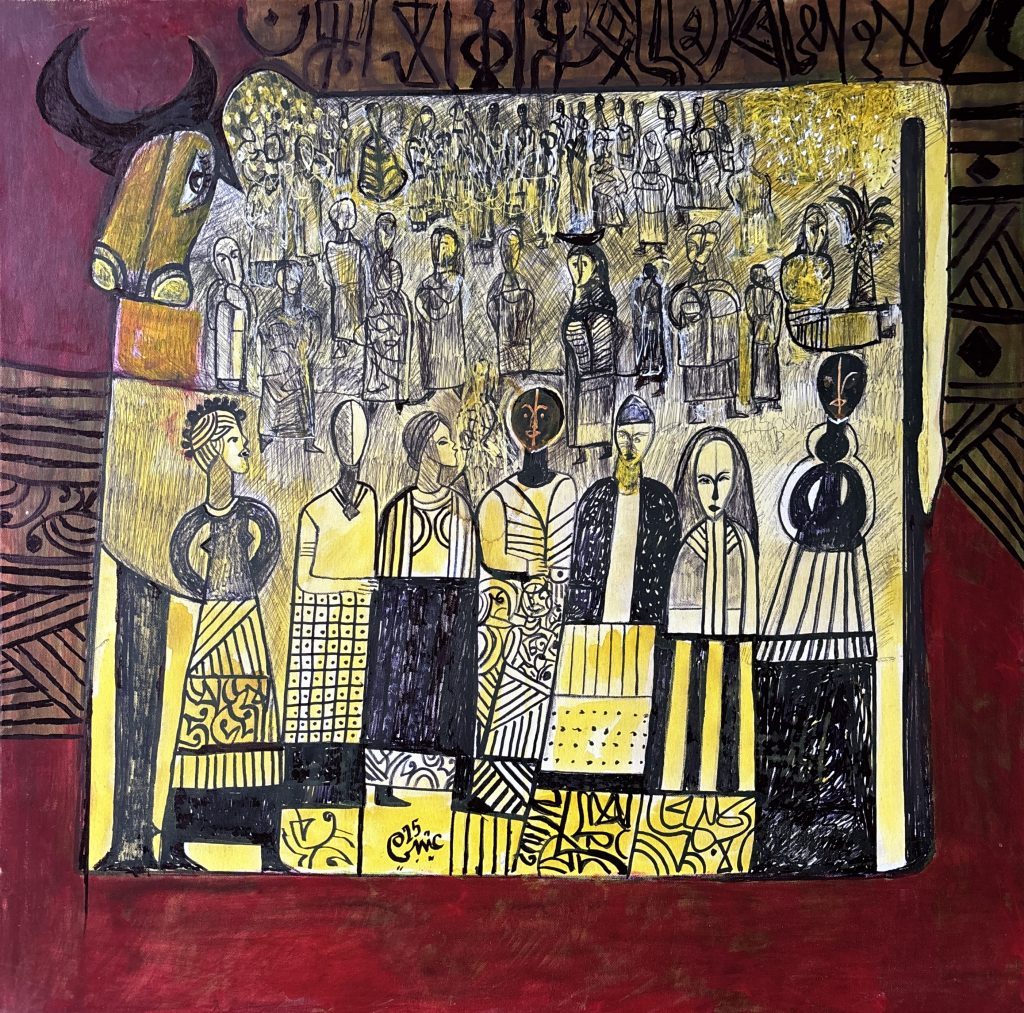
Artworks are from the exhibit “Lighting,” by Mohamed Abdalla Otaybi. They are featured at Swailem Art Gallery, 14 El Saleh Ayoub St., Zamalek, Cairo.