

Preface
When I was younger and my father was still alive, I often thought that I should record all of his stories, the ones he had told me in bits and pieces over the years. I never did, and I regret it. A few years after he passed away I stumbled upon pictures I had taken of the book he frequently spoke about and hoped to publish. In truth, it is perhaps less of a conventional book than a personal essay about his lifelong love of fishing. But to him it was always a book. Through it, I think he wanted to show people the story of how he became the fisherman he was: how a boy who first fished on the banks of the Nile ended up spending most of his free time on the banks of a tiny river in Iceland, called Hólaá.
Fishing was central to my upbringing in Iceland. I vividly remember getting up at five in the morning to drive out of town and spend entire days fishing with him. I also remember his disappointment when as a teenager, I no longer wanted to wake up early to join him.
My father was born in Cairo in 1942. His family lived in Heliopolis and, from what I gathered, he had a relatively happy childhood. During the Suez War my grandfather sent him abroad to continue his education. He never moved back to Egypt and eventually ended up in Iceland, of all places. In his writing he sheds light on how fishing helped him settle into his new life. Through his hobby he surely met more Icelanders than most other immigrants did. In a country where immigrants are still accused of failing to integrate, and where muslims are sometimes treated as incompatible with Icelandic society, he became deeply engaged in one of the most recognisably Icelandic traditions of all. How could anyone tell him he wasn’t doing enough to fit in when he was dressed in his full fishing gear, with a rod in hand? Unfortunately for him, in his daily life it wasn’t always obvious that he was a fisherman. Like many others, he was perpetually seen as an outsider.
When he acquired Icelandic citizenship a few years after his arrival, the law required him to take up an Icelandic name. For years, his legal name was not the one he was given at birth to honour his grandfather, but a name he picked from a list of approved Icelandic names: Ómar Aronsson. Maybe this was just the most obvious way that his identity became more Icelandic than Egyptian, but he also didn’t uphold many Egyptian traditions. He didn’t cook Egyptian food or speak Arabic to his children. I sometimes wonder whether his desire to be accepted played a part in these choices.
Our conversations were usually a mix of Icelandic and English, up to the point where I sometimes didn’t know where one language began and the other one ended, and it felt completely normal. I didn’t even notice he had an accent in Icelandic and I didn’t think of his English as different from other Anglophones, although in hindsight, I saw that it bore the mark of his upbringing in Egypt.
He was later allowed to change his name to Ómar Hafez Awad, a mix of both names. By then, most people knew him as Ómar. Later in life, he chose to be Ahmed again, although the name Ómar is still present in the family. His name had come full circle, back to his roots, and I believe he also had a personal reckoning with his origins around the same time. He became more enthusiastic about speaking to me in Arabic and started buying and cooking ful medames (can you believe I tried the dish for the first time as a teenager?). Although his homes had always borne the mark of his Egyptian heritage through carpets and decorative pieces, I think that once he stepped outside and interacted with others, it felt safer simply to be Ómar the fisherman.
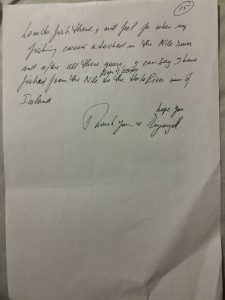
On our last trip to Egypt together, while he was terminally ill with cancer, I noticed that he had brought his book with him. I think he wanted to show it to someone. The manuscript consists of a few printed pages covered with scribbles, while the rest is handwritten on blank white paper. It was as if he had simply taken the first pages out of the printer and continued by hand. I imagine him sitting on his sofa, his cup of tea beside him, the sheets spread across the coffee table, where he preferred to write. One day during that trip, he let me take pictures of every page with my phone, in case they were ever lost. I still remember the hunch I had, a gut feeling that told me to do it. After he died, the papers disappeared somewhere among the things he left behind.
Although his book is about fishing, it also offers an insight into parts of his childhood, with details he never told me in person. The text also includes some lessons on patience, which I find slightly ironic because I do not remember him as the most patient man: he would always arrive ten to fifteen minutes earlier than the time scheduled to pick me up, and then scold me for being late. Reading this book is like looking into a mirror and seeing a world that I thought had been completely lost. I can still hear his voice and his way of storytelling in the rhythm of the text. It’s unmistakably his voice, telling a story that I’m not sure many people had the chance to hear. While some editing was necessary before publishing the piece, the editors and I have tried to preserve the particular style and idiosyncrasies of his writing, so that this voice remains present on the page.
My father passed away exactly a month and a half after I took the pictures. It wasn’t until four or five years later that I began transcribing the manuscript, a process that brought me even closer to him. It was almost as if he had come back to life through the text. Having the chance to dig into his writing was like having one more conversation with him, years after his death. And not just a conversation while driving through town on a rainy day, as we often did, but one in writing that I could return to whenever I wanted to hear his voice.
I had never known some of the names of the places he used to visit with his family in Egypt during summer breaks, and now I could look them up and see where they were on the map. When he talked about his childhood, it often felt like he was describing a magical world, but seeing those places clearly marked on a map made them real. We had also never discussed the circumstances of him leaving Egypt in much detail; he used to tell me bits and pieces but never discussed how he felt during that time. The text put the puzzle pieces in place for me. Finally, I became acutely aware of how well he knew Iceland. He mentions locations in the text that I initially thought were misspelled or not even real. Turns out he knew places in Iceland I didn’t even know existed.
I frequently drive by one of those places on my way out of town. Now, every time I drive past, I know my father once stood on the banks of that river during his first years in Iceland. Perhaps standing there, while waiting for the next fish, offered him a kind of continuity with the childhood he had left behind.
My hope by publishing this story is to honor a dream he was not able to fulfill himself. In many ways, his story is inseparable from my own, as my mixed origins are inextricably linked to it. Even in its simplicity, I think this text sheds light on the complexities of migration. I often get told how incredible it is that he ended up in Iceland of all places. But that’s what migration is, it’s not straightforward, it’s not always deliberate and people end up in places they never imagined existed. Almost like a bottle thrown into a river that washes ashore on the other side of the world.
Publishing his story is one way of honoring his memory: keeping his words alive and sharing some of the wisdom he found in fishing, and I hope to allow others to encounter him in his own voice, as I did while transcribing and reading these pages, moving from the Nile to Hólaá.
Reykjavík, April 5th 2026,
Miriam Petra Ómarsdóttir Awad
From the Nile to Hólaá
It all started in 1949, this fishing hobby of mine. I even remember the day: it was the 22nd of June, my dear mother’s birthday. To celebrate the day, my father decided to take a day off from his duties as a doctor and drove us up to Alexandria. There are two routes to get there: one is by way of the desert road, the other is by way of the agricultural road, as it is known to the Egyptians. The latter runs through the fertile valley of the mighty river Nile, with green fields on both sides. I was seven years old and it was my first summer holiday from school.
We left our home at 26 Shar’a el Agam in Heliopolis and were soon driving along the banks of the Nile. After an hour and a half, my mother wanted to get out of the car and stretch her legs. I think we all wanted to. My brother, only three years old at the time, stayed in the car and the rest of us went out for some fresh air. I walked towards the river and I noticed an elderly man. Mind you, he could have been only 35 years old for that matter, which was old to me. The man stood there, fishing in the Nile. Many years later, I would say it was just my luck that daddy happened to stop exactly in this spot.
I stood beside the man, watching his every move and I soon became very intrigued and excited. I ran back to my father and asked him if we could stay a bit longer, which he agreed to after I had explained to him what it was all about.
I went back to the fisherman. There and then he was pulling in the first fish I had ever seen caught in such a way. It was a Nile carp, a giant of a fish. My God, I was so excited, I felt the adrenaline pumping in my veins. Right at that moment I knew that this was what I wanted to do: to fish, to be a good fisherman.
My father interrupted my thoughts and called me from the other side of the road to come and eat with the family. They had put out the picnic basket and were sitting on the grass under a tree, eating whatever had been prepared for the trip. I shouted back that I wasn’t hungry because truly I was not hungry for food, but I was starving to learn more about the techniques of fishing. I stayed in the same place, beside the fisherman, studying his every movement. As he stopped to have his lunchtime snack, he started sharing some words of wisdom with me from a learned fisherman to a beginner.
In his words, fishing is one of the most noble sports: it teaches patience and open-heartedness, along with the ability to help and aid others. I listened to this man’s wise words and I know they must have sunk in very well, and even today as I write my story, I am practising the advice from the unknown fisherman.
Time passes quickly when you are watching someone fish, and, as I learned many years later, it even goes quicker when you’re actually fishing yourself. It’s the fun of it all. Before I knew it, daddy called me to “return to the car immediately” as he put it, we were late and he wanted to arrive in Alexandria before nightfall. So, there I was, saying goodbye to my first fishing experience. Looking out of the rear window of the car as we drove away, I saw the fisherman slowly disappearing into the distance.
Alexandria
We arrived in Alexandria just at sunset and went straight to our summer home, where we would stay for a few days. Allow me to mention that on our way to Alexandria, after the experience with the lone fisherman along the Nile, I did not stop asking Father that I would be very happy if he “would please buy me fishing gear!”. And the begging went on the next morning and throughout the day, until he gave in! “Alright, alright,” he repeated. Wishing to rid himself of my nagging he took me to the angler’s shop to buy what I needed. “Hurrah,” I thought: sometimes persistence works!
We drove to downtown Alexandria and entered a fishing gear shop. An hour or so later, we were heading back home and I was equipped with a two bit bamboo fishing rod, two floats, a few hooks, two or three weights, a bait basket and of course, a fisherman’s hat.
The following morning I woke up very early, dressed in my khaki shorts and proudly put the fisherman’s hat on my head. Armed to the teeth, I was on my way to the sea shore along the Alexandria coast. This was the beginning of my fishing hobby. En route, I stopped at a vendor and bought a handful of small shrimps for bait. I put them in my bait basket and carried on walking until I arrived at a spot my juvenile mind felt “ could be fishy”!
My first cast. Yes, my first time ever. The excitement and adrenaline worked up to my head. I stood there, not knowing what to expect, what would happen, or if anything would happen at all, and how I should react if it did. The float was there, bobbing at the surface. The shrimp was on a small little hook that sank down into the deep blue sea. Many minutes had passed and still nothing had happened. Then I recalled: fishing teaches you patience. I waited and waited. Then, all of a sudden, something happened! The float plunged underwater and nearly disappeared before I realised. I took a grip of myself, and even a stronger grip on the rod, and pulled upwards, slowly but defiantly. Then I felt, for the first time in my fishing career, the vibration of a fish pulling on the line. I felt excitement and energy shoot throughout my body. There was a fish on the hook and I was so pleased with myself.
After a few efforts with the rod, I managed to pull the fish in, and my first catch was safe in the bag, so to speak.
That experience, in the summer of 1949, was my first and definitely not the last. The summers went by and many fish were bagged. I became a fairly good fisherman, even the older men fishing in the area had gotten familiar with me. Whenever I approached the fishing spots, they said between themselves: “Oh, here comes Shorty. Be careful he’s good – he might even empty the whole sea of fish!” And then they all laughed.
Fortunately, with my fishing luck, I did catch many fish. Without exaggeration, quite a lot of fish. With every summer we spent in Alexandria, there came an emptiness when I had to return to Cairo to go back to school. The feeling of leaving something important, something dear to your heart, was hard. I was indeed really hooked on this fishing sport, and even now, many years later, I’m still glad that I was blessed with such a healthy and fascinating hobby.
One morning years later, I was coming up to 13 years of age and my fishing rod was getting shorter (smiling, I realise that a clever fisherman will know what I mean). Anyway, I went to my famous fishing area, about three km away from our summer dwelling on the Alexandria corniche, and prepared my fishing gear on the spot. The weather was fairly good, a sea breeze from the north and a few people on the walkway along the coastal road.
I was already deep into fishing, catching a fish every now and then and enjoying the sunshine and the good weather so far. Because I realised at this point of the day that the weather was changing. The waves were bobbing and the breeze was getting stronger. Of course, whatever the weather, a good fisherman will fish in any conditions. And I did as well on this occasion; I just kept on catching the fish and enjoying myself.
It was coming up to about four hours of fishing, which is the time I recommend fishermen stick to, because if you continue for an hour or even two, concentration starts to fade and fatigue crawls in.
Yes, the weather was getting worse, and the sea was rougher, considerably rougher, and I was finding it difficult to stand still. At one point, the float, as it was bobbing up and down, took a quick plunge and disappeared; yes, a nice fish was on! It took me a few minutes to bag this one which was quite a good fish of the bolti family; a flat, silver-scaled fish and very good on the grill.
Unfortunately I had to decide there and then, what my next move would be. Should I pack and flee the worsening weather, or stick it out? I decided on the former and started getting my gear ready for departing. Then the waves got very rough, and rose in height. No sooner had I climbed over one of the big boulders lining the shore as wave breakers, than a heavy wave lashed the spot where I’d been standing, no more than a minute before. I was lucky then! But my rod was not. As I stumbled to save myself from the angry sea, rod in one hand and bait basket in the other, I slipped on the wet stone and in a matter of seconds it was smashed into three pieces. Of course I was disappointed, thinking more of my rod than of my own safety. But, I got home safely, minus a fishing rod.
Balteem
The following summer, we had to go to the north of the Nile Delta, to a small village called Balteem. My father had developed rheumatism in his legs and it was recommended by a British doctor, a friend of his, that he stick his legs in the hot sand every day for two hours or so, around noon. He was to do this for at least two weeks. In that little village, the landscape was sand and sea, and the odd grape bushes flourishing with the sweetest grapes I have ever tasted. Here the homes were like small bungalows, made of straw and wood. Due to the hot climate in the summer, the straw and the sea breeze worked together as an air conditioner to cool what otherwise would be an unbearable heat to live in.
I remember so well, as I write these lines, how wonderful the nights were. In the dark one could see the stars through the small holes in the straw roof. All the while the sea breeze cooled down the bungalow. On those nights, one fell asleep in no time.
Nearly every morning after breakfast I was on my way to the sea, armed with my fishing rod and gear, in my bathing suit and sun hat. I walked as far as I could, but not too far, so I could manoeuvre the fishing rod in an upright position and be able to cast. I caught many fish, all kinds: from small silver ones, to long brownish ones. All very good for the palate, especially when grilled, as grilling was my father’s specialty.
By midday, the sun would be very strong and I would take a break. I would run back to the bungalow and put a light shirt on to save my shoulders from burning. In the meantime, my father would be doing his ritual to rid himself of rheumatism. We went to Balteem for two summers in a row, I was then coming up to 15 years of age.
Daddy’s rheumatism was gone and he declared this would be our last summer in Balteem. Once in Cairo the school days went by very slowly. As I was not the brightest of the students, I often found myself daydreaming about fishing.
At times, when Daddy took us for a drive downtown Cairo, he drove along the Nile road. If he stopped for a rest of some kind, I would run out of the car and stare down to the running waters of the mighty River Nile in the hope of catching a glance of the great Nile carp, but I was never lucky.
When the family gathered together at home, my brother, my mother, Daddy and myself, he would hint once in a while that he intended to send me abroad to England to carry on with my studies.
Leaving Egypt
To expand a bit about this phase of my life, which is of interest and does have a sort of direct connection to why I ended up in Iceland: in 1956, the British, French and Israelis went to war with the Egyptians over the Suez Canal and Egypt’s decision to nationalise it. When the war broke out, my British-run school, the English School Cairo, was forced to close down, and nearly all British and French citizens were asked to leave the country. Being without a school was of course not acceptable; I was thrilled, but my father was not. And therefore the talks of sending me away were becoming closer to reality, day by day.
I was hardly 17 years old when I arrived by train from Italy to London’s Victoria Station. I spent the next five years in the United Kingdom, got myself a few G.C.E. subjects to my name, and took a French examination at the University of London. Then I headed to Glasgow to attend a hotel school and from there I went to Germany where I attended another hotel administrative school. There I met some Icelanders who told me that there was no military in Iceland, a fact that appealed to me very nicely. So, on the 22nd of December 1965 my plane from London landed at Reykjavik airport. I had filled the last available seat on that last flight before Christmas. By the time the new year came in 1966, I already had a job waiting on government high dignitaries and was soon getting grips with my new culture.
Iceland
It took me less than a month to find out which activities were available in Iceland. I noticed that Icelanders are very proud of their country. I don’t really blame them; it is the most beautiful place to live. Incidentally, fishing is a big part of the Icelandic economy, and fishing in lakes and rivers was a big thing among Icelanders. Did I feel at home there and then? You better believe it! Fishing in Iceland. I was the luckiest man to end up in a fishing paradise (among the other things about this wonderful country that made me happy to be here).
It didn’t take me long to know my way around town. Reykjavik is a mere village compared to the cities I have known, such as Cairo, London, or Paris, with populations in the millions. It took me a few visits to the local sporting gear store downtown Reykjavik and I was soon bulking my weaponry with a fishing rod, fishing reel, floats, hooks, weights and waders. I still use the same float, years later, although its condition, to say the least, has deteriorated to the extent that other fishermen make fun of it.
Low and behold, my first day of fishing arrived, and I was at Elliðavatn early morning, casting my line into the water. I was using mudworms as bait, with a float and a spinning wheel. Yes, I was catching fish and mostly it was arctic char.
I soon was able to master the new fishing techniques in Iceland, as compared to the equipment I used in the Mediterranean Sea and the Nile; it was two different worlds. Rather than spending three to four hours fishing, I would stay by the lakeside all day. My advice is, four hours of fishing can be just as good as a whole day of fishing. So when you feel tired and your concentration is dwindling, pack it up and think, “There’s always another day”.
Fly fishing
One day I was scheduled to go to Sogið to fish with my friends from work, and I went to meet them at a place called Bíldsfell. I took my fishing gear and upon arrival I discovered that I was the only one with a casting rod and reel, and the others had fly fishing equipment. They were amazed that I had a “flot og fluga” fishing method (that is to say, a line, a float and a fly!) and they did not envisage that I could catch anything.
My turn came to fish. We fished two at a time per area. I had a very very long taumur (loader), a circular float and my kaststöng as mentioned above. My bait was a Þingeyjar-streamer and believe it or not, within about thirty minutes I had a 14 pound salmon. It took me about 40 minutes to get him to land. At the end of this fishing trip there were four of us and there was only one salmon going home. Hurrah!
The next day at work my friend Björgvin mentioned, or rather asked me, if I did not want to try fly fishing, and I asked him why he mentioned that. “Það væri margfalt skemmtilegra” he said. Fly fishing was many times more interesting and exciting than ordinary casting. That weekend, we decided to go to Hólaá and Laugarvatn and try fishing there. Björgvin, my friend, and I had already gone to the Veiðivon fishing shop and bought the following items:
1) Fly rod for lines 4-5.
2) Fly reel loaded with a floating line nr. 6
3) 7 lbs leader and a strike indicator which I always use now.
Björgvin started to teach me. Soon I was being instructed how to cast, and at the top of the river’s mouth I caught my first fish with a fly line and rod. The lure was a very small black nr. 184 nymph, with a golden beadhead.
After this I would go a few days in a row, fishing becoming quite important in my life. It never failed. Come February, I was preparing my fishing gear for the new season starting typically on the 1st of April. Mind you, from February till April seemed a very, very long time, much longer than from October till February. By the way, before I forget, it is good practice to lubricate your fishing reels at the end of the season, cleaning the mechanism and applying a drop or two of oil.
Lake Mývatn
One summer I decided to go up north to fish in one of the many mountain lakes near Mývatn, where access was mostly over very tough terrain and having a 4×4 car is a must. Armed with my 4×4, plus all the fishing gear and a picnic basket which emptied far too quickly, I set off. The excitement of travelling toward a new fishing destination makes you hungry. I drove up north, north east, close to lake Mývatn. I turned off the main road and drove slowly over the rough terrain up into the mountains. After about 30 minutes of rough, careful driving, I came to the most beautiful surroundings I had seen, or ever would see in my life. Ahead of me lay this wonderful, lovely blue, dark blue mountain lake.
My heart was beating faster, my hands were sweating, and I could feel the anxiety of my being. Every passing second made me wish I were already in the water casting my rod. But oh no, not so fast, my friend. You have to take off your shoes, fit your legs into the waders, strap the waders around your shoulders, put on your fishing jacket, make sure everything is in place, check your leader spools, your strike indicators, your mittens, and your fishing hat and finally your Polaroid glasses (very, very important). No glasses, NO FISHING!
Having dressed up, finally, and what seemed to be ages of time elapsing, I was trudging along the banks of the lake, heading toward an unknown place, where my instinct told me fish would be found. After a few minutes, I arrived at “my spot” and parked my rod and picnic bag nearby. I waded through unknown terrain, in knee-deep water, until, as I stood away from the shore, I noticed the color of the lake getting darker, indicating a deeper area ahead. So I decided to stop there and start casting.
With the rod on the ready, so to speak, I was set and let go of my first cast in this vast but friendly lake. I had at the end of my leader, a no. 14 nymph with a beadhead, completely black.
My first and second cast gave no results, so I tried a few times with the black nymph but still with no result. In my previous fishing experiences I knew that changing lure, nymphs or whatever, as often as possible, would excite the fish and give them an array of choices. So, after five to ten minutes without results, I pulled in the fly by slowly dragging my float line, cut the nymph off the leader and tied another nymph, of the same size. This time I chose Björgvin, with the red collar under the head and a black body.
Yes my fishing friends, my first cast and a fish was on, and it was not a small one. The fish pulled at my line and my 8ft, four piece rod was bent to its limit, arching left and right. I could not lift the break on the reel, and the fight was on. Within three or four minutes, the fish finally got tired and slowly, I reached for my net at the back of my fishing jacket, and I slowly netted the fish; a lovely char, about 2 ½ lbs in weight.
I checked the nymph and checked if the knot it was tied with it, and satisfied all was “on well” I cast again, not knowing beforehand that I was fishing in a bonanza, of an area of the lake. I assure you, my dear fishermen, see the adjacent photograph that in about five and a half hours I caught sixty-nine fish, all arctic chars, most of which were over 2 lbs in weight. 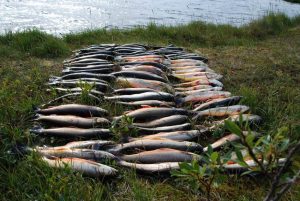
Now I ask you; Can fishing be any better? Can any fisherman not be proud of such an Achievement?
I was sure in my mind that this would be a moment that I would not repeat for a long time: sixty-nine fish in such a period of time! Yes! As the day wore on, I had to burden myself with transporting the catch back to the car. Driving back was a relief as I was getting tired, and had spent an hour or more too long fishing, causing me to lose my concentration and my fishing skills were dwindling. Like I mentioned earlier in this book, a four hour fishing stretch is the ideal time a fly-casting fisherman should allow himself on any given day.
I drove back to the farm where I was staying and after packing the fish, three or four in a plastic bag and placing the bags in the freezer, I went inside the house, sat on the sofa. Whoosh! In a matter of minutes I had fallen asleep. My farmer friend kept me in the same spot all night as, when I woke up, I noticed that a nice, soft, warm blanket had been placed over me.
I woke up to another day. The afternoon came so quickly and, before I knew it, I had bid my goodbyes and was heading south once more.
Days passed, months and years kept rolling by, and my fishing expertise had become such that I was beginning to hear my name mentioned in circles outside the fishing grounds.
“Ómar?” Oh yes, that fellow. Oh yes! A good fisherman!”
Hólaá
Years passed by, summers came and summers went, and the same routine continued: getting things ready for spring, and travelling to distant fishing grounds, lakes and rivers. The diversity of it all made this sport deserve all the merit used in the world. Fishing of any kind is known as fishing, but believe me, fly fishing is the noblest of the fishing strata.
As I was discovering new and better fishing spots, I stumbled one morning upon a farm called Útey, on the Laugarvatn lake. Bold and armed with my fishing gear, I drove up to the farmhouse, paid for the fishing licence and was instructed to drive down to the lakeside. In about 20 minutes, I was wading up to my waist in Laugarvatn again, casting and dragging my line slowly, then waiting a few seconds, then dragging again, and “bang” a strike, a good fish was on. The days’ fishing ended up with about twelve very fine arctic char and two brown trout. Then I drove back home, satisfied with a lovely day out. A proper fishing day out. One year, when the 1st of April came I drove out of Reykjavik early, to arrive at Útey no later than seven am, got my fishing gear ready and walked down to Lake Laugarvatn.

Depending on the winter months and the mean temperatures, the lake would be either frozen along its shoreline after a harsh winter, or frozen along its banks after a mild one. It was there, along these frozen edges, that most of the fish would lay, as if waiting for the 1st of April to arrive and for fishermen like myself to come and try their luck. Yes, luck, as many think and profess that fishing is largely a matter of luck. I personally do not believe in that myth. Fishing to me is a talent and a “know how”: you’re either good at it or you are not, there is no in-between.
Towards the end of May, on a fine Saturday morning, I left home early. The morning sun was just coming up the eastern horizon, with hardly any cars on the southeast road except perhaps the newspaper van and the milk truck. I arrived at Útey and drove down to the lake, and having geared myself up, I walked through the wet and muddy path that led to the river Hólaá.
It is in this river that my real fishing career in Iceland solidified. I was about to get so hooked on that river, that for the next 24 years I fished there year after year. Good fishing, perfect river, slow-running water, running from the mouth of Lake Laugarvatn down, slowly, to Lake Apavatn, some 10 km away. The river Hólaá was full of fish, though it took me at least 2 summers to master the art of catching the fish there.
I used tens and tens of nymphs and flies, until I found the utmost striker, a no. 14 nymph, which I designed myself and have caught many good fish with. So until today, before or after this book has gone to the printer, I still visit the Hólaá River. I love to fish there and think back to when my fishing career started in the Nile. After all these years, I can say that I have fished from the mighty River Nile in Egypt to the Hólaá River in Iceland.
Thank you, and I hope you enjoyed it.
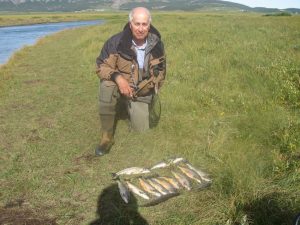
Ahmed Hafez Awad
Ahmed fishing on a summer day by
Hólaá, Iceland.
Preface by Miriam Petra Ómarsdóttir Awad
Photos courtesy of Ahmed Hafez Awad