

I have a farm in Africa. How ridiculous that sounds, so pompous and unnecessary. Those words bring to mind the darkened, gravelly voice Meryl Streep used in the movie Out of Africa, about Danish baroness writer Karen Blixen, who owned a coffee plantation in Kenya in the early 1900s, back when Kenya was unfortunately referred to as “British East Africa.” I first watched this movie as an engrossed adolescent in Southern California, and later mocked it as a critical New York City adult. The opening line in the book of the same name is “I had a farm in Africa, at the foot of the Ngong Hills.” Ironically, for me, it’s true. I do.
It’s hard to imagine my farm without first thinking of ancestors and illness, and my farm is nothing without imagination. A mess of family history exposes our tendencies toward neglect and secrecy, interrupted only by spurts of crisis-inspired attention and struggles with bureaucracy. When I imagine my farm, I don’t really think about land. I think about my ancestors. I long to be in that place, near them; to really own it even for a few minutes before it vanishes again, because it connects us. But this land came to me only as something I am required to shed, to be rid of. This is my farm in Africa.
I use Blixen’s sentence as a sort of rune and riddle to test other people. I can guess what was conjured up for them by their reactions; a game of interpretation. A colleague probably sees acres upon acres of well-tended rolling hills and outstretched oaks, with staff in Civil War-era costumes; a manager sees me dressed as Scarlett O’Hara or a 20th-century European baroness; friends probably imagine piles of cash layered in stacks all around me. But Scarlett and Karen Blixen were white women, and I’m not. Depending on who you ask, of course. My story gets messier.
My farm in Africa is only accessible by rowboat, they tell me. This makes me think of Charon, ferryman of Hades, carrier of souls across the river Styx. The river, in my case, is not Styx but the Nile, and the farm is in Egypt. To get there, I’m told I would first need to sign in at an administrative office in a particular town, check in, and receive official permission to pass through, somewhat like boarding at an airport. Only then could I take a rowboat to the location. I long to see this place. The truth is, I’ll probably never get there.
Once this land appeared in my life, I crawled into a sort of uncanny dumbwaiter delivering me to my ancestral history. There I was, shuffling along in my ‘Severance’-style life in New York as a dissatisfied, undervalued, underpaid ‘independent contractor, then I stepped out of that resurfaced elevator to find my extended Egyptian family abuzz over a farm I had previously never heard a word about, which had already been in my father’s family long before I was born. I was only finding out about it at the same time that I was slowly becoming the land’s keeper, in charge of its future, its destiny, its justice. Seeking redress for the grievances of my ancestors was going to become my responsibility.
It all started in 2017, when my father had fallen for the fourth time. He wasn’t well. Maybe he sensed that his time was coming to an end, and that motivated him to finally talk. My sister Elena visited him in Southern California, where she and I grew up. Our German mom and Egyptian dad were still living there in our family home.
Can you do me a favour? Dad asked her.
Of course, Dad, anything.
Can you go to Cairo for me?
Um, sure, Dad.
Elena had first assumed he had some simple tasks in mind; his tone was too casual to denote something as momentous as an international errand. But then he revealed the inheritance tale, a family farm that had been languishing for five years, and which he now wanted her to see to.
I had heard vague murmurs about this inheritance before 2017, and my father had often gone up to Los Angeles to handle paperwork at the Egyptian consulate. When that flurry of activity stopped just a few years before his series of falls, I innocently assumed that story had found its tidy, organic end.
I ask myself to interpret the runes and solve the riddle, too. The farm I imagine has tall, marshy wild grasses and windswept trees where I dock my rowboat on an overcast day. The weather is more Scottish than Egyptian. I’ve built a modest but comfortable home on the farm’s hills that provide an endless, atmospheric view. Once inside the house, I take a seat at my writing desk. My makeup is flawless.
The Western world has properly trained me to worship an expansive horizon, but then I catch myself. In my fantasy, my farm in Africa is like my own personal retreat waiting to be built, ready for me to gentrify and exploit it, as a good Westerner should. African land is always passive, always waiting. Isn’t it?
*
The backstory reads like an old myth or Hollywood adaptation of a Naguib Mahfouz novel. For one hundred twenty years, this 250 acres of land belonged to my great-great-grandmother’s brother. He didn’t have children, so he enlisted an administrative entity to manage the land for 100 years and distribute the proceeds to people experiencing poverty. After that, the land would revert to the lawful inheritors: my dad, his siblings, and some cousins. However, some thieves allegedly forged the paperwork and took the land for themselves.
When my family managed to get a portion of land back the goal was to sell. But my father refused an offer, saying the price was too low, and family fighting ensued. Years later, an unverified will appeared, giving my father a deceased relative’s neighbouring property as well. As the firstborn son, this was his right. But then came more alleged false claims to the land, and even squatters on our farm. Litigation began, stalled, and my father passed away in 2019, with the will and litigation nowhere near settled. And so, according to Islamic law, the responsibility of the matter passed to the offspring of the firstborn son: two American citizen sisters who had a German mom, were raised in Southern California, and didn’t speak Arabic. We were possibly the most ill-suited family members to be in charge of the situation, and also had the most to gain. My farm in Africa is an initiation. It is a secret, a legacy, a burden, an aggrieved piece of land. I see a cluster of tales rooted into this soil. Charon guides souls to the underworld, to the land of the dead. My farm is a place where all of our family’s departed have gathered for resurrection or atonement. Are my ancestors waiting for me to show up? Are they imploring me to stop being a faraway dot on the horizon and fully enter the foreground of their original scene, Egypt? The real inheritance is the family history I have been divorced from, as an American.
I love my ancestral piece of land for our stories, for the kinship it delivers. But it doesn’t take long to get twisty. First of all, I’m writing this in 2025, and my sister has already died. But that’s getting ahead of the story.
I figured I’d read Karen Blixen/Isak Dinesen, Out of Africa. Might as well. In just the first few pages, I learned she had squatters on her farm too, an irony I savour. Placing her on the spectrum of adventuring, imperialistic, white fantasy Westerner forces me to ask myself where this places me. Except I’m not just out planting coffee: I was minding my own business when family history hunted me down.
Maybe a farm in Africa ends up expanding my consciousness, my grasp of things. What else is there to do with a farm that has my family stalled in legal woes? This isn’t a flex as much as a way to practice making more room in my heart. It’s there to grow my empathy, imagination and patience.
Back to 2017. The languishing inheritance came through two brothers, one of whom I’ll call Cousin F. He left behind that neighbouring portion of farmland, a Cairo apartment, and an alleged London apartment. As per our father’s request, my sister Elena left for Cairo to deal with all the bureaucracy involved, helped by cousins. And she had to go through Cousin F’s Cairo apartment.
I sat on the sidelines in New York and fantasized. Bless my heart: at the time this unfolded, I fixated on the London part of the story. I was immediately distracted by the Western capital of an old empire that once ran Egypt into the ground. My Western bias embarrassingly got the better of me. I wanted to inherit a London apartment because it sounded sexy. I dreamed about what it might look like: did it have high ceilings, tall windows? Did it have a magnificent view onto some important piece of architecture? Would I get laid there? More runes and riddles.
Cousin F had possibly been a lawyer or an accountant, but it was all speculation. What kind of job would enable him to buy an apartment in London? No one could say for sure; nor did anyone know the London address. The entire story was disorganized, and papers were said to be missing. Cousin F had fallen ill in Egypt and had apparently gone into hospital with a bag of sensitive documents, which allegedly vanished. He never made it out of the hospital alive.
But Cousin F’s Cairo apartment was clearly known. We had keys. In the photos and videos my sister sent from inside that apartment, everything looked like debris after a flood, or the aftermath of a crime scene. Had Cousin F lived this way, or was this just the result of five years of neglect? It was assumed that at least one incident of theft had already occurred, maybe two. We navigated the disarray and clutter of a life we never knew while trying to piece the story together.
What is that gigantic rectangular object taking up half of the living room? I had texted Elena. It looked like a giant sarcophagus.
Commercial ice cream freezer. This is our family, remember? Nothing makes sense, Elena replied.
Wait, what? I texted back, somehow unable to let the information sink in. He had a nice living room, if viewed from an angle without the freezer.
Cousin F had been a café owner in his Cairo neighbourhood for a while. When the business closed, he must have moved the equipment into his apartment. So, what did he do then?
Oh, he tried all kinds of things. That was the vague answer from cousins and aunts. A relative no one saw, who tried all kinds of jobs, seemingly to no avail. Just like me. Hidden away in New York City, far from the rest of the family, I had tried office work, television editing, restaurant work, freelance writing, other random gigs in between: photo stylist assistant, painter’s (clothed) model, failed ballerina, secret astrologer and Tarot reader. Nobody ever knew what I was doing. Are we that hard to pin down in my family? What was his message to me, what was his story conveying to me about my own life, about us? The industrial ice cream freezer in the living room felt like too accurate a metaphor for our familial dysfunctions and flaws.
We found out that Cousin F had a brother. We’ll call him Cousin G. Amongst other documents, there was a carbon copy of a letter from a doctor’s assistant in a London psychiatric ward. Apparently, at some point Cousin G had gone to London to join his brother and get a job, but had shown signs of “acute schizophrenic psychosis.” After undergoing treatment in London, he went home to Egypt with an escort and a week’s supply of an antipsychotic. With the letter, there was also a prescription for more of the medication, Thorazine. Cousin G had gone to London for a job, but instead got a diagnosis and a prescription for Thorazine.
*
While there was unhappy land in Egypt to rectify, I made plans to visit California. And in the last few weeks before heading out to my parents, I’d been in contact with two London lawyers. After many emails, we had a conference call in which I immediately greeted them as You guys. I felt them freak out across the Atlantic. As our conversation progressed, I went into vocal fry, then listened to them distractedly while I gazed out the window at workers fiddling with some construction project on my East Village street. I wasn’t taking nearly as many notes as I thought I would.
The lawyers had asked if the deceased cousin’s estate had been administered. I drew a complete blank. The term was so foreign to me. I had moved into a time in my life when all of the language around me was changing. Had the estate been administered? Obviously not. But would anyone in the family ever be able to answer that question definitively? We were the family that left everything to rot.
In California, I noticed how my parents and I moved differently through the house. My dad just stayed upstairs. He was no longer allowed to risk the descent to the ground floor anymore. There was no official diagnosis because he wouldn’t allow a doctor near him long enough to make one. I brought him his dinner in a basket and spread it out on a tray. Sometimes I cooked, sometimes it was takeout. When I brought him Mexican food, he needed help understanding what a tortilla was. I hoped that he couldn’t register the look of shock on my face. It was already that far along, whatever it was, whatever combination of illnesses he had.
And my mother stayed downstairs for a while, after a successful hip replacement surgery. A physical therapist made house calls twice a week and gave my mother exercises to get her new hip going. Mom leaned on the walker like a determined goat, and the physical therapist and I walked with her in a loop three times through the kitchen, deep in conversation (what on earth were we talking about? I can’t even remember anymore) as if we were on vacation, at a beach with a view.
For Elena and me, our farm in Africa meant repairing our parents. It meant we were putting Cousin F back into his body to interview him, witness his life with its ice cream freezer, Egyptian café, supposed London assets, and his brother. We were meeting our ancestors, the family members we’d never known. Cousin F took over my imagination that year; he seemed to be reaching out across the abyss to tell me everything, making up for all the time we’d never spent together. He and his brother were imaginary space I could invest in; their life stories a form of inherited property. If we were healthier communicators, would our farm inheritance story have had a smoother, happier trajectory? Was the state of our family health intertwined with our family land?
The London apartment dissolved almost as quickly as it had first appeared. We had no solid evidence, and it drifted off as a mirage, a ghost. Instead, the apartment had turned into a brother diagnosed with schizophrenia. Cousin G had died even before Cousin F; I was sad to learn. We found no further details about the cause of his death, or what his situation had been before his passing.
By the end of that summer of 2017, our chores around land inheritance, illness and home conflated with one another into a jumbled episode that can only be explained as the mystery of family. Out of that emerged one perfectly antiquated, guilty, heart-wrenching phrase: I have a farm in Africa.
*
I finally saw the farm on Google Maps. My cousin sent a link to the satellite view and had marked two pieces of land with a red outline on a screenshot. I stared at the image on my laptop like I was gazing down from a plane window before landing. Karen Blixen, at the end of her book, also admired her farm from a plane overhead. There it was, my farm in Africa. Our farm. It belongs to the family, not just me. I studied the satellite image with some embarrassment, the way an amateur painter assesses how well their first effort matches up to expectations.
The land was divided into tidy squares of green and beige crops, maybe sugar cane and wheat and maize, common enough in the area. There wasn’t a hill in sight. No space for tall grasses or windswept trees. Maybe those gray rooftops were houses built by the alleged thieves who stole our land, and maybe the adjacent parcels were once part of our 250 acres. A tinge of shame warmed my face as I remembered the fantasy my Americanized imagination had created of turning the farm into a retreat. I could never build cabins on that land. Even if it was never in earnest, I felt relieved to let it go.
My father passed in 2019, my mother in 2024, and my sister in 2025. Now I’m backstage, rehearsing for my new role as the person about to push paperwork around. My nuclear family is gone and yet the farm remains. Astonishing.
But this mystery, which has been part of the family lore for over 120 years, will come to an end in my lifetime if I do my job correctly. In the diaspora, we turn history into liquid assets. If I accomplish this, it means I have served my family well. It’s been a long, slow history of dissolution and detachment. That’s the takeaway from having a farm in Africa: it’s a spiritual experience of distance, a patient slog towards justice that may never come. A vapour that hangs in the air. Participation in the collapse of time. And yet it’s also that moment our family connectedness arrives in its most realized, tangible form.
I finally watched the movie again, Out of Africa. Why had I been so resistant to rewatching it? What was I afraid the movie would tell me about myself? Karen Blixen’s husband was always off hunting or womanizing. She was left to take care of the farm, and her Kenyan staff existed merely to serve the white woman. Karen said to her husband in the movie, “It [the farm] won’t take care of itself.” But she had to return to Denmark to treat the syphilis her husband had given her. She went home to slowly poison herself, and told him to take care of the farm.
Karen’s life as depicted in the movie was so loveless. I’m surprised to realize it’s similar to mine. Unstable love affairs do not make the cut. Did I internalize this story when I watched the film as an adolescent? I must have thought, Oh, this must be what adulthood looks like: sham marriage, loneliness, illness, landscapes to tend.
I’ve seen my farm from all angles except for the one where I’m standing on the land itself, with my feet on that inherited ground. I’ve seen it from above, digitally, via satellite view.
I’ve seen it from the family’s perspective, blundering and yet also protective, patient, and enduring. I’ve seen the farm through the eyes of my American friends and colleagues who can’t understand it, or immediately assume it’s some working farm bringing in millions of US dollars. Some offer a brusque, dismissive framework: why is it relevant? Why spend your time on this? How are you even allowed to inherit anything at all since you’re a woman? Don’t they forbid you from things like that ‘over there’? I suppose their veiled racism and Western white saviour misogyny is supposed to be a compliment.
Everyone shows their cards when it comes to the farm in Africa. My farm is a truth teller, a soothsayer. I’m going to see this thing through. As Karen Blixen said in the movie, the farm isn’t going to take care of itself. These runes won’t interpret themselves, I say to the portraits of my dead family on the wall. My parents are there, my sister, my Egyptian grandfather is, too. It almost feels like we’re in on a sly joke together. Even if we never finish grappling with the farm itself, the story holds us tight, and in that story we’re together.
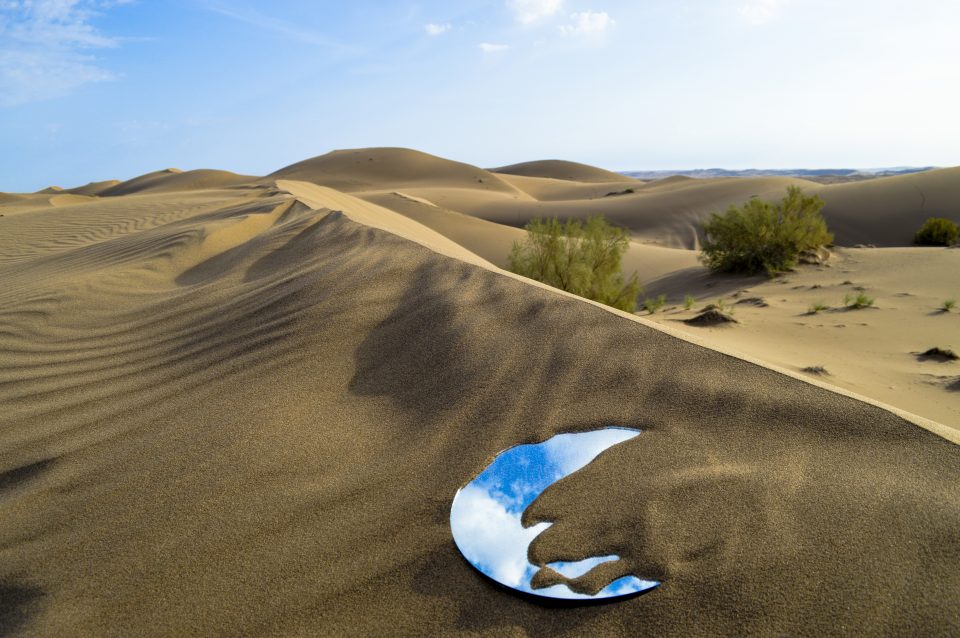
Shirin Abedinirad, Magic Carpet, 2022. Land art and fibre art, Tehran, Iran. Inspired by the enchanted carpet of One Thousand and One Nights, the work uses mirrored surfaces to create the optical illusion of flight, evoking a passage into wonder, desire, and transformation “in the twinkling of an eye.” Artwork courtesy of featured artist Shirin Abedinirad.