



Days after my third round of IVF ended in failure, I let a friend of mine pull me out to a bar in the old city of Ramallah. I said yes because saying no would have required an energy I no longer possessed. Despair, at least, is efficient: it simplifies everything, narrows life to a handful of manageable irrelevancies. But that night refused to be managed. The air itself felt offensive, too breezy, too alive, brushing past my face as if nothing had happened, as if my body hadn’t just staged its own coup d’état.
The courtyard was packed. Beer puddles sweated into wooden tables, arak glasses glowed under fairy lights, salted lupines snapping between fingers. In one corner, a small band tuned up—strings whining, drums testing their pulse—while at the center, an old olive tree stood dressed for a celebration it hadn’t consented to. Someone had strung it with balloons in shades of red, yellow, and a particularly aggressive orange. The tree looked defeated, as though it had RSVP’d no but been dragged here anyway. I recognized something of myself in it: two tired bodies dressed up for other people’s eyes.
“Balloons on an olive tree,” a voice behind me said. “Now, that’s pretentious.”
I turned. He was annoyingly tall, careless in a way that passes for charm, with beautiful brown eyes.
“It’s like the tree’s trying to convince itself it belongs,” I said.
“Aren’t we all just trees faking it?” he said.
“Ah, don’t you start.”
He laughed and introduced himself as Raphael. “Raph. No angel.”
“Disappointing,” I said. “I was hoping for a miracle.”
The word slipped out too easily, and when it did, I felt it catch somewhere inside. In Palestine, miracles are a kind of currency, badly inflated though. We spend them everywhere: in protests facing armed soldiers, in hospital corridors shadowed by bulldozers, in the endless Inshallahs with which we try to negotiate with reality. Under occupation, you had to multiply your hopes, diversify your beliefs, just to balance the math of loss. Maybe that’s why the IVF felt weirdly familiar, another system built on probabilities, endless waiting, and managed disappointment.
The first IVF failure hadn’t hurt much. It felt expected, almost routine, as if the universe were easing my husband and me into disappointment gently. He held my hand when the doctors spoke, both of us nodding obediently as they repeated, “Nothing works the first time, these things take time,” dangling hope in front of us like a carrot, as the “good” egg they meticulously implanted never fertilized. The second round was harsher. My body ballooned, my mind blurred, but we clung to that brittle thread of hope, telling ourselves that science and love might just bend fate a little in our direction.
Music suddenly rose from the corner, and Raph emerged beneath the olive tree, now with a guitar slung low across his body. When he began to sing, his voice didn’t ask for attention, it just took it. Soft at first, then spilling over tables and glasses, settling into people’s shoulders. As he sang, the balloons trembled slightly, the fairy lights flickered like a faulty pulse, and somewhere in my chest there was a small shift, a window opening in a room I had long sealed shut. I realized, with astonishment, that I had been holding my breath for months.
When the set ended, he was swallowed by friends—hands, laughter, smoke. Later, he found his way back to me, and we settled into a loose circle drinking and arguing about politics, poetry, and the slow, moral collapse of the world. We agreed on almost nothing, except for the best knafeh in Ramallah, which, for the record, is Al Omara (Princes, plural, because why stop at one?). When he asked the group if we wanted to keep the night going, I said yes before the responsible part of me, the married part, could intervene—the same part that had been making poor decisions anyway. My friend and his friends erupted in cheers, drunk on the naive conviction that nights, like youth or miracles, don’t really end.
The five of us squeezed into Raph’s Toyota, while the rest followed behind in another car. I sat in the front as the others folded themselves into the backseat. He apologized for the mess: empty coffee cups, crumpled papers, a bag of gummy bears that melted into a single, philosophical entity, and a strawberry air freshener losing a dignified battle against cigarettes.
As we drove through the sleepy streets of Ramallah, the windows cracked open, the night rushed in and hit my face hard enough to remind me I still had skin. When he stopped at a corner store on Deir al-Rum Street for cigarettes and beer, I caught my reflection in the side mirror. Under the flickering streetlights, I almost looked beautiful, you know, the kind of beauty that sneaks up when you forget to hate yourself.
“You look happy,” he said when he got back into the car.
“No, I’m pretty sure I’ve spent my lifetime share of it. This is just the face of regret,” I said.
“Regret’s overrated,” he said, starting the engine again. Then, after a pause, “And honestly, so’s happiness.”
He was right. Before all of this, before my body became a site of negotiations, my husband, B—bless his eternal sunshine—dwelt in the possibility of happiness. And happiness, to him, was family. He wanted five children, declared it just weeks into dating. Names were discussed, eye colors imagined, a house alive with music and movement planned. When he spoke of it, it sounded less like a gamble and more like a safety net, something warm enough to sleep inside. He wanted our imagined children to have my eyes, his rhythm (“someone has to make sure they don’t embarrass themselves dancing at weddings,” he’d joke), my stubbornness, his humor. I wanted them to be his, mostly, to inherit not only his dabka moves but his way of seeing the world, which, despite everything, remained generous. Back then, I wanted them too, if only because he did. Yet my wants never lasted long enough to be trusted. They shifted with the month, the mood, the world’s latest catastrophe. Some days, I craved the soft chaos of motherhood, the endless questions, the sense of belonging unmanufactured. Other days, the very idea repelled me: the permanence, the loss of a self I had barely assembled.
Time, however, proved indifferent to our plans. Years passed, and nothing happened. My body behaved impeccably: regular cycles, balanced hormones, no obvious explanation. So we escalated: ovulation tracking, then IUI, then IVF. Each step presented as progress, a longer ladder toward the same unreachable sky. After each failure, I came to hate science—not for what it achieved, but for what it prolonged: the suffering, the endless attempts, the promise of hope where perhaps none should have been. The language of it: follicles, percentages, viability. Even the nurses’ kindness began to irritate me, their soft voices threaded with Inshallahs as they prepared me for each round of retrieval. Everything was Inshallah, while I was certain their Allah had long stopped listening.
By then, the rounds had become a strange rhythm: we almost never argued about what mattered. We fought over undercooked rice, lights left on, trivial things, stupid things. It was easier to snap over a flat maklouba than the upside-downness of our life. But by the third IVF round, exhaustion had taken residence in our bones. Unlike the frantic anticipation of the first two attempts—symptom-checking, desperate googling—there was nothing. My period arrived early, almost ceremoniously, a final, clear message: my body posting in bold letters, “Closed, indefinitely. Better luck never.”
Perhaps fittingly, B was away that week. When I called with the news of the third failure, his silence on the phone was shattering—I think I aged a year or two in that pause. When he finally spoke—“It’s okay”—it was clear that it wasn’t. We cried together, choking on our words as if we had lost a child, not a microscopic cluster of cells. Doubts arrived soon after, tumbling one after another: Was it me? Was age catching up? Had I waited too long, eaten the wrong things, breathed the wrong air? Yet in the days that followed, a different kind of question began to surface, not whether I could have a child, but whether I truly wanted one.
B, meanwhile, carried his longing more openly. Since the day we married, there was always a pregnancy, another birth, another baby passed around the room. He became a khalo, an uncle, even a siddo to some, everything except a baba. I watched the ache settle into him, the way he looked at other people’s babies, and then, sometimes, at me.
I had quit smoking during the IVF—a small surrender in a war I still believed I could win—but in Raph’s crowded car, lighting up after months of abstaining, I felt a strange, temporary freedom. I was no longer required to be a body in pursuit of something. I was simply a person moving through the night, away from
the hormones
the pinprick bruises
the cold gel on my stomach
the probes inside me
the clinical chill that lingered long after
the smell of antiseptic and fingers.
As we reached his place, the group collapsed across cushions, the music spilling loud, smoke curling up like an unanswered prayer, like steam rising from a kitchen where no child ever came running in. Everyone talked at once. They sang, laughed, shared love stories, half-true, half-performance. I said very little. Not because I had nothing to offer, but because my own stories felt too sharp, too unfinished. I’ve always believed you only tell a story once it has softened inside you, once you have carried it long enough for the edges to dull, enough for it to stop wounding you on the way out.
By the time the first light seeped in, the music had faded, the smoke thinned, and the world slowly began to regain its shape. When I got home, the sky was beginning to blush pink, and I felt my heart crack, mend, and crack again, a rhythm I had grown used to. I sank into the bed and decided to write a letter to the daughter I had named but would never meet. I told her the truth, or something close to it: that I might not have wanted her with the certainty the world demands of mothers, but that, had she come, I would have carried her through the shards, guarded her from the sharp edges of the world, knowing that her heart—mine—would shatter like glass, time and time again, and yet she’d learn to live with the cracks.
I folded the letter and placed it in the drawer, beneath ultrasound images that showed nothing, beneath fertility charts that mapped hope like a war plan. Then I slept, not like someone who had lost, but like someone who had finally stopped fighting.
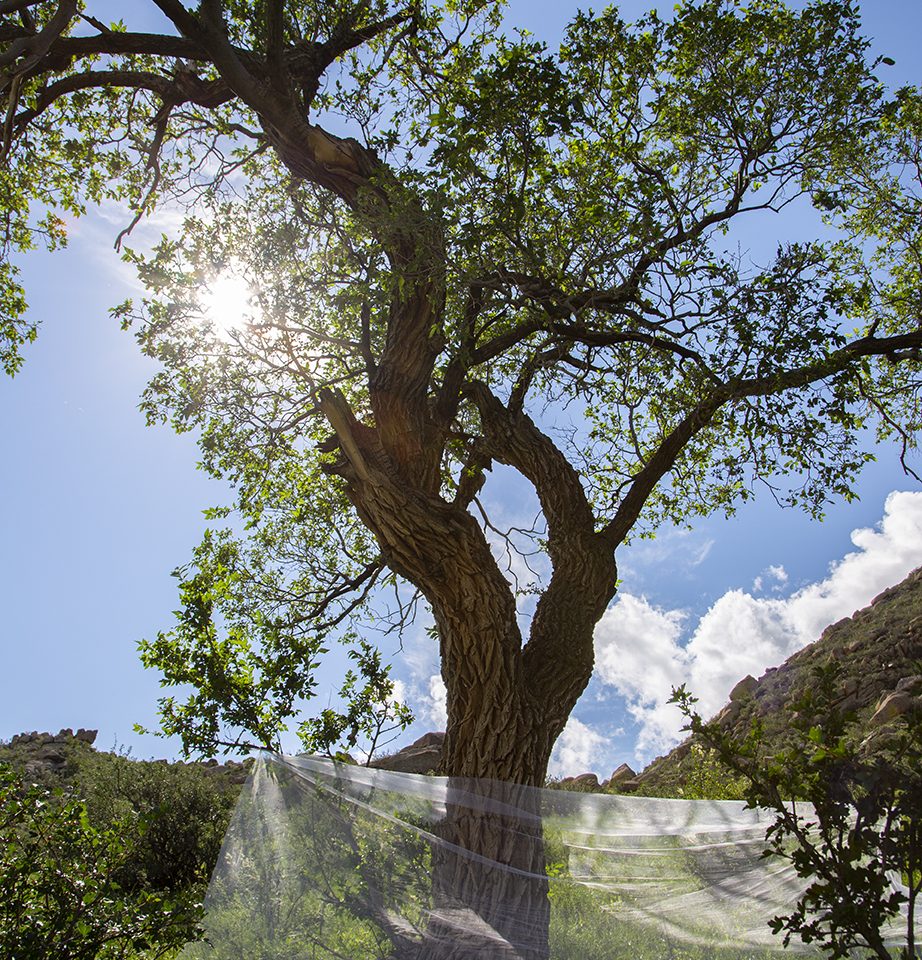
Shirin Abedinirad, Dance of Tree, 2018. Land art, Mongolia. Presented at the 5th Land Art Biennial LAM 360°: Who Are We Now?, the work uses translucent fabric to gather the moving shadows of a tree, allowing wind, branches, and light to choreograph a quiet performance between nature and the viewer. Artwork courtesy of featured artist Shirin Abedinirad.