

The village sage did not trust mirrors. He preferred a stream that ran between two palms and a lone olive tree, as if truth required a current to remain pure. He would gaze into the moving surface and see his face, or the memory of it, layered over the shadows of those who came to seek his counsel. He warned them of scorpions and the venom of specific days, reading Time as if it were a script written in the sand of the wide desert.
I was told, by my father, or by the ghost of his voice, that he once saw me in a dream. I was falling from a great height, vanishing into air like ash. Or perhaps it was he who vanished while I watched. He sought the sage, who bent over the water, consulting that intermediate realm where forms are neither wholly present nor entirely absent, and stated: “You must have another son. You must give this child a brother. Otherwise, your firstborn will become a mad poet.”
The sage left the village years ago. Or perhaps he remains at the bank of the stream, still looking, while we are the ones who have drifted away. I, the only son, the one I remember being, began to drift, seduced by a certain mirror in my room. An old rusty fragment, set into a corner of the mud-brick wall, a mirror that had witnessed faces and memories long vanished, a hundred years ago. Day by day, I began to haunt it.
At first, the mirror was obedient; it showed only what was placed before it. Then, without warning, the poetry began to take form. I wrote for a beloved I had never met, speaking to her in rhyme and metre, repeating words already inscribed in that hidden register where meanings wait for their forms to carry them. My father, whose voice I still hear, though he has no place in Time, would warn me: “The devil will crawl out from that mirror and possess you!”
But I came to believe the opposite: the devil did not emerge from the mirror, but from within me. He took the shape of a poem that mistook itself for a reflection and stepped into the mirror as if returning to its true home. The poem then turned into a child, a resemblance of myself, forty years younger, his figure slender, unfinished, with eyes like yellow crystal lit by a borrowed sun. He faded, or perhaps I became spectral, until he was only standing before me, extending a hand.
He took my hand. Or I took his hand.
We walked along the water’s edge but never looked into it—a road lined with eucalyptus and casuarina. The leaves whispered, though I cannot say if they spoke to us or simply about us. We sang, we danced, we moved through a time that did not pass but rather disclosed itself in successive unveilings. We recited poems; we chanted the Quran.
We walked home, back to the old rusty mirror. There, another stranger was waiting for us. A woman who started to follow us. The woman was jealous, and she couldn’t hide it. Her facial expressions showed her envy clearly. She interrogated the poems: who were they for? To whom were they promised? She asked as if she recognized in the verses something that had once been stolen from her. The jealousy in her eyes was not of me, nor of the child, but of our hands that joined together. She addressed the child in a soft, pulling voice, attempting to draw him back from the world of images to the source. He did not answer. He continued speaking to me, or through me, or as me.
Then, inevitably, she seized him from behind. “This child is mine! He belongs to me!”
He said nothing. He looked at me.
Or I looked at him.
Save me, the look said, though I no longer knew who the saviour was.
She took the boy, and with him, the poems, which were perhaps the only thing that had distinguished us from the glass. They all disappeared in the mirror.
My body froze; I opened my eyes and stood still before the mirror. There was no image. The surface had darkened into the primary gloom of the world before the creation of Adam, when it was said that the universe was an unpolished mirror awaiting the one in whom it would behold itself. And when my face finally appeared, the mirror shone, not of its own light, but by the radiance of what was disclosed within it. I murmured:
Who lost those years?
Father, son, child, reflection
demon, or woman?
Perhaps these are only names for what appears in the interval where the seer and the seen become the same thing.
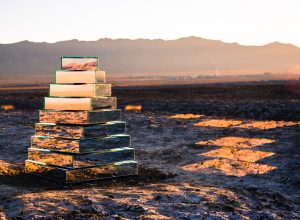
Shirin Abedinirad, Evocation, 2013. Land art, Central Desert, Iran. Using mirrored circles partially buried in sand, the work conjures the illusion of water in the desert, reflecting the sky across the dunes and transforming absence into mirage, longing, and wonder. Artwork courtesy of featured artist Shirin Abedinirad.