


1
Gates
The driver’s holler awakens me as we arrive at JFK. The sun hasn’t yet come up. I hadn’t slept the whole night until I sat in the Uber—my anxiety kept me up, replaying the plane plunging into the Atlantic. It has taken me years of exposure therapy; I can now board a plane with a gram of Xanax and a couple of litres of positive self-talk.
TSA employees push us through security. I imagine I am Ismaeil, being escorted to the brick where he is to rest his head and await his slaughter. People in front of us argue with loud voices, going back and forth with the agents. The sun is just appearing in the terminal windows when an agent kicks a woman out of line, unlatching the black queue pole as she moves past him. He refuses to look at her. Yusra asks me what I think that was about, and I tell her I do not know. I learned, in my years of teaching high schoolers, that the barrier to annoyance is thin until at least ten a.m.
I hold my brown duffle bag, which has been at my side for over a decade, with only a few thobes and shorts, and undergarments inside. I smile at the TSA agent as I hand him my passport, then place my bags on the conveyor belt as it slowly begins to roll toward the large scanners. I wonder if we’ll be pulled in for questioning, especially since we’re going to Saudi Arabia, but we’re let through without any hindrance.
Our phones buzz. Yusra’s brothers, Taaha and Wisam, text that they are entering the terminal right now. We go to the airport cafeteria and save a couple of tables for whoever hasn’t arrived yet. My mother texts me to have a safe flight. My father called the night before and asked me to pray for him. My sisters didn’t ask anything of me, but I wrote down every wish I ache to grant them.
The rest of the group slowly trickles in: my brothers-in-law and a friend we’ve known for years—Humza—who’s married to a cousin. They drop their bags, and we head over to get coffee to keep us awake a little longer before we board. Humza then asks me if I’ve ever been to Umrah. I say no, never. He says the same. He’s glad we’ll at least have one another for our first time.
I’m turning thirty in a couple of months and wonder why it’s taken me so long to go on this pilgrimage. I don’t like to think of myself as a fearful person, but lately fear trickles onto my bare skin as if the clouds above me were punctured with worry. I am not scared of planes going down or of being pummeled under worshippers’ feet, my skin smeared on the white-tiled marble. I fear my fear. I fear the unknowing of myself.
All of my friends who’ve gone talk about seeing the Kaaba for the first time—the black-sheathed cube Muslims pray towards five times a day, almost haunting in the way the wind moves the elegant cloth that blankets the pale bricks. They speak of it the way a new parent talks about having a child for the first time, as if a part of them has been unlocked and a new emotion discovered. I have heard my father speak of the Kaaba more lovingly than he speaks of me.
I fear God not allowing me discovery.
I like to think I am honest, oftentimes brutal with myself. I’ve fought with my faith since 2019. Bouts of agnosticism and half-willed practice seesawing over months, wondering where my belief has run off to, why it decided to leave me.
As a kid, I found God in my father’s laugh, his scraggly beard, his ocean eyes. Since we don’t have tangible evidence of God in this life, the closest thing I could grasp was my father’s holiness. I held onto it past my infancy and kept holding on until my dad’s prophetic facade plummeted around me.
Even through my parents’ divorce in my teen years, I found myself going to my childhood masjid to escape my turbulent home: reading Quran, praying Salaah, sleeping in the building where I found love between its old, musty red carpets and spending years after school loudly reciting Arabic. I believed its walls held my voice.
Then they kicked me out. Twenty years old, barred from prayers for the last ten nights of Ramadan.
My feelings are still raw a decade later.
My father and the other board members had discovered that one of their friends, a board member himself, was skimming money off the top of the donations. The man caught wind that my father would report him to the authorities, and the next morning the keys my father held didn’t open a single door.
It was Ramadan. The last ten nights. The masjid was filled with vocal violence—uncles yelling after prayer, anger seeping into our worship. They kicked my father that night, and who better to ban alongside him than his son? My face was plastered on the mosque’s exterior to keep me out. I tried to reenter once and was met by three disproportionately muscled bodyguards posted at the newly fenced entrance, who held me back. The cops came and told us this wasn’t right, but we couldn’t do much because of legal shit. After some tackling and commotion that first night, I stayed away.
I am honest with myself. My only shortcoming, then, and even now, is that I am his son.
I don’t cry in front of people. I refuse to. The only time Yusra sees me cry is when I have panic attacks over my words not sounding right, over having no money for, well, anything. The only time my friends have seen me cry was after the cops told me I wasn’t allowed back to the masjid—a restraining order had been filed. I spent forty minutes trying to push back, to explain myself out of a situation that didn’t make sense to me. I got nowhere.
I remember those tears. My friends and I had spent the day together, and I remember feeling happier than I had in a long while —the cruelty of it is that the day had been good right up until the blue suits made it clear the masjid was closed to me for good. We left after asr prayer and slowly piled into my small car, and with the sticky heat of June at the bottom of our lungs, I wept ugly. With tears and snot trailing down my lips, I felt both my boys’ heavy, gentle hands on my shoulders, them only mustering, it’s okay, it’s okay. With an uncertain tone, a hushed cadence, as if people were around us, their ears latched onto the metal frame, aching to hear. As if my boys hadn’t comforted anyone in their young lives.
I made sure to leave my sadness so damn quickly then. Wiped my face on my shirt and told them, “Let’s go home. Let’s forget this happened.”
In other words: please, don’t love me right now. I can’t deserve it. I will never deserve it.
I spent those last ten nights of Ramadan, the holiest nights, curled up on my bed, refusing to leave my room. I was my father’s son. I will never escape it.
2
Musafir
I have a bad habit. I often get up before I need to. I stand and walk to our gate well before boarding, just to make sure everything is in place, and nothing is amiss. Even when we eventually begin boarding, I’m slow. I crawl to the back of my mind and sit in a place where even I cannot find myself. My body is operating, yet my mind chooses absence.
I sit in the aisle seat, at the edge of a four-seater. Yusra sits beside me. Next to her is our newlywed sister-in-law, Hafsa, and next to Hafsa is her husband, Taaha, who is also my wife’s brother.
The smell of pressurized air is still one I’m not used to. The booming engines as I pop a Xanax into my mouth. It’s an unnatural thought—flying when our bodies aren’t meant to. My headphones over my ears as Two Trees by Ludovico Einaudi drowns out the engines’ roar. I feel my chest sink deeper into the seat.
We all have habits. Yusra holds my hands in her lap throughout the ascent, as she has on every flight we’ve taken since we married five years ago. With my eyes tightly closed, I recite every dua that begs for release, my lips wet. Even after my body lifts off the ground, the prayers do not stop. My hand is still held tightly.
I find that I become a staunch believer as I draw closer to heaven.
Before our marriage, I had only been on one flight. In 2007, I sat in a PIA plane travelling to Lahore, Pakistan, with a stop in London. I remember my father handing me a piece of gum. He told me the part that scared him most was when he felt weightless, his ears popping from these unnatural feats.
He went every year, a habit, no, a ritual. Packing a large cardboard box with popcorn, hot sauce, makeup, the latest iPhones and tech his siblings and their kids would ask for. Countless hours spent sitting by the JFK terminal check-in, shifting items, storing them in other bags, until the cardboard box met the weight limit. Every year he would spend his money and ask nothing in return from his family. He told us it was out of love, and I wondered why, when it came to us, money was always tight.
In 2007, I was eleven, and I agreed to go with him only because I knew I hadn’t hit puberty yet, so my sins wouldn’t count. I knew that if the plane crashed, hell would not lay a finger on me—it could not.
Now, eighteen years later, I don’t think I care much about the religious outcomes of death. I just don’t like the feeling of being off the ground, in this metal tube, with control taken from me.
I’m not a fan of my obsessive thoughts, either. This plane will not crash, but my mind believes it will.
I sink deeper into my seat. I tell myself I do not exist; I am not real. Slowly, but surely, as the Xanax kicks in, I dissipate into whatever particles this ascent holds.
3
Medina
It’s been a couple of days in Medina. Our hotel smells old, and the shower doesn’t work properly—we have to sit down and bathe ourselves by filling a cup from the faucet. Wherever I go, I am surrounded by calls to prayer. I drag myself into the mosque courtyard and try to pray. Afterwards, I make sure to get Spanish lattes from the coffee shop down the sandy street.
Since it was my first Umrah, we went with a group affiliated with Rutgers University. Yusra’s brothers, Taaha and Wisam, and one of her cousins were already going with them, so after months of back-and-forth, we decided to join them. We were given red knapsacks so we could spot one another in the bustling crowds.
I speak to some people in our group from time to time—they’re loving being in the Prophet’s Mosque for all their prayers and extra worship. We drink Zamzam as our main water source, a metallic-tasting rarity in the States, but here it tastes like gold. I can’t remember the last time I prayed all five prayers in a day. I was never good at prayer, but I’m in the holy land, so I might as well give religion a chance. I find myself in the mosque early in the mornings and late at night, just to be around this magnificence.
But still, my heart refuses to soften. People all around me look at the towering umbrellas and the large prayer congregations with a sense of marvel. I’m happy for them, angry at myself, but happy for them—angry because I cannot feel this wonder fully. I make an effort to find comfort in what I like: bittersweet coffee, bartering with shopkeepers, and spending late hours with Yusra and her brothers. I find the serenity of the Prophet’s Mosque comforting. The solitude of the living city before its gates is inexplicable, something one must experience. Inside, it’s so quiet. Just a sprinkling of chatter, mostly from us.
Yusra tells me this is also a calling. I am here, still, and perhaps God is guiding me to notice.
We arrive on the roof in the early-morning cold to pray a bit before Fajr and to stay for the sunrise. The city’s noise then fades, disappears, and I am left only with my thoughts.
I found myself being brutally honest here. I had been feeling like an outcast, an unworthy child, overwhelmed by the emotions that had flooded me since entering this city. On the rooftop of the mosque at four a.m., I told Humza the truth when he asked me about my faith. Both Taaha and Wisam, Yusra’s brothers, sat close by—I was careful about what I was attempting to say.
God has left me. Skipped me over in the roulette of believers. No matter how much I had prayed, fasted, or tried and tried and tried, cried, even faked crying, and exhausted myself with thoughts of what the fuck is wrong with me, why can everyone else feel this faith holding them but me—I will never truthfully believe. God will point at me on the day of judgment and, despite my knowing the truth of faith, he will chain my ankle with fire and smoke and condemn me for my failure.
When I tell you I’ve tried, believe me, please.
It feels as if God hasn’t chosen me to believe. Call it the devil’s whispers; even when he’s locked behind the heaviest doors, he’s still speaking into my ears.
Humza asked me if prayer helped. I shook my head at him. Even at your lowest? I shook it again. “At least I have that,” he said. “Even at my lowest, I know I can sit down and pray, no matter how long it’s been, and I know it’ll be okay.” Then how, I thought, had I felt nothing for over a decade whenever I presented myself to God?
Over the years, I’ve realized that the one thing that connects me to faith is the laughter I share with those I love.
Later in the day, I’m with Taaha and Wisam, whom I accept as my own since I don’t have any brothers. We eat KFC and Pizza Hut on the marble floor of the second holiest mosque, trying to get this fried goodness down before the next prayer. A worker comes up to us and asks for our leftovers. I learn in that moment that every worker I’ve been seeing over the last couple of days does not get paid, and that hammers a pit in my stomach. We give him our leftover fries. I reach for sanitizer, cross my legs, and wait for the athan to finish. I raise my hands in front of God and hope he is witnessing me in the disappointment I know I am.
I don’t feel much. No, I don’t think spirituality is for me. But I feel this—I see God’s existence in these people I hold desperately close to me.
4
Medina—New Jersey
When I walk out of the hotel in Medina, I see a man kick a stray calico cat resting on the sandy marble floor. I find the disconnect in my mind rampant here—here we are, in a holy city, and this is all meant to be for peace. God’s eyes are on us more heavily now, and a man kicks this cat, and I feel this anger or helplessness that resides deep in my body. I know I cannot do anything here but feel. How do we hurt something innocent? How do we hurt ourselves when we do not mean to?
Back in New Jersey, the first foster we ever rescued, Suki, a skinny tortie, died of stage-three kidney failure. She was only two years old. A year after we took her in, we took her to the vet to figure out why she was still seven pounds and why she wasn’t eating anymore. Yusra and I held our breath all week until a text arrived one morning, asking us to forgive the clinic for letting us down. Only God knows how much we truly loved her. We were waiting for her blood panel to come back and had bought kidney disease remedies hours before she passed in the night.
I couldn’t shake the memory of the first night we brought her home. She was a stray on my older sister’s street after her hoarder owner died. One day during Ramadan, Suki ran up to Yusra, begging for food. She’d camp outside my sister’s home, waiting for more. We managed to trap her a week later.
Those first nights, we’d give her medicine and sleep by the door beside her so she wouldn’t feel lonely. She grew to hate me after I took her to be spayed, but I remember the many ways she’d play around our small apartment. My cats didn’t get along with her, but she always made it clear she didn’t like them either.
After every prayer in Medina, the Imam stands and prays a jinaza for someone who died on the mosque property, to be buried in the Al-Baqi cemetery growing outside the premises. I’ve almost cried handfuls of times since I heard the news of Suki’s passing, only to force myself to think of something else, anything really, to hold back the tears. I walk away and surrender my grief to whatever higher being there may be. I raise my palms to my ears. I can only think of the little tortie who refused to sit with me, slapped me whenever I got close, and the long scar that dances down Yusra’s left wrist.
The day after she passed, we donated all of Suki’s medicine, which had been intended to heal her. We couldn’t bear the reminder that we couldn’t help her anymore, but knew we could help someone else.
5
Medina—Makkah
We put our ihram over our boxers, just to make sure that if there’s an accidental droppage, we don’t end up exposing ourselves. Two white towels with embossed patterns cover our bodies. At times, there is a nakedness that is more bare than being nude, and I feel it now. I tuck my brother-in-law’s cloth into his bottom half and show him how to tighten it. Afterwards, I’m in the bathroom, and my boxers are gone. I’m entirely nude, and I put one leg up on the cold marble counter. I take handfuls of Vaseline and lather the inside of my reddening thighs. Embarrassment passes over me as God watches. There is no one else in the room. The top half of my ihram is already slipping, exposing the hair on my chest, and I start to worry about the bottom half, which is wrapped tightly, but I’m still insecure about its security. My father has done this numerous times. I think of everything I’ve learned myself through trial and error, or had to teach him when I was younger.
My first trimmer was his first trimmer. He copied the pyjamas I wore after he got angry with me for wearing white shalwars to bed. I didn’t know my strength until I was sixteen; my parents were sleeping in separate beds, and the days were filled with shouting, finger-pointing, and silence. In the hours between angry outbursts, he called me by my nickname in his husky tone and asked me to bring my red and black tie to him to tie it around his neck. He hasn’t worn a suit in as long as I can remember. I stand face to face with him, the currents in his eyes avoiding mine. I bury the fact that he just blamed me for his wife’s distrust of him. I bury the tears in the garden growing in my room; I’m its only admirer.
We breathe each other in. I’m almost taller than he is. I stand past his shoulders. His beard is longer than mine. He tilts his head up, and I watch his scruffy Adam’s apple bob as he gulps. I lift his white collar so I can don this pride on him. Even now, he tells me he keeps one pre-tied so he doesn’t have to go through this humiliating ritual again—facing me, his budding son, as I attempt to turn him into more of a man.
I learned to tie a simple knot from a Google image, but I won’t tell him that.
And now I’m boarding this train to Mecca, and I feel naked, lonely, and angry after seeing a father wrap the white cloth around his teenage son, making sure it’s tight, as a witness to his son’s journey. For the entire hour-long train ride, filled with chants and loud, profound proclamations, I wonder why I was not worthy of such love. Why did I have to learn to tie my own tie, and then tie his on him? Why is my ihram sliding down my torso?
6
Umrah
We begin Umrah on one of the busiest nights in Islam. My wife and brothers-in-law hold my hand as they guide me towards the Kaaba, yelling over the bustling crowd to keep my eyes lowered, fixed on the white marble beneath my bare feet. The first look—how holy it is. A prayer is promised with your virgin gaze.
We follow the masses, the guides yelling “Hajji” every so often to keep us moving, even as we bump into one another. We are cattle.
It’s been a long day. Waking up, catching the bullet train between the two cities, then going straight into a pilgrimage has left my body aching and my mind barren of thought. Still, I am in awe of this city, which refuses to sleep no matter the time. The aggression from those moving past us and from the guards is something that shocks me. We are nothing to them.
I feel my bareness. How two wrapped white sheets are all I have on. I smell of nothing, and no one next to me smells of anything. We are told this is how we prepare our bodies for death.
There is a smell of deep musk in the air, and Yusra holds my hand tighter as we walk down the stairs. She keeps telling me to keep my eyes down, and I do. Until we gather at the bottom and our group’s Mutawwif begins leading a prayer, we join in, our hands cupped. A guard interrupts us, telling us to move a bit to the side, and then she finally says, look up, look up.
I cannot say what I prayed for, but I know what I felt. Nothing. I’ve found more joy in writing a poem with an ounce of potential and in shooting a basketball with proper form. I stare at this black-clothed cube I’ve thought of my whole life—the same as the photos hung around the walls of my childhood home and at the masjid. The bustle around me quiets. This is what I had waited for, and yet I felt the same as I always had. But I still prayed, for what reason I do not know. Maybe a Hail Mary for faith, wide open in the end zone with the ball rocketing towards my hands—that I’d come down with the briefest understanding of God in my palms and know, for once, whatever all of this means.
On one of the most crowded nights of Umrah, the seven rounds of tawaf took us three hours. My father told me he had heard it was almost as bad as the Hajj rush.
We went in as one group, our red knapsacks strapped to our backs, and the waves of crowds quickly separated us. I lost my brother-in-law Taaha and his wife, and even the cousins we had come with were suddenly out of sight. Wisam stuck with us until we began to slow down towards the third round. We waved him on to push ahead without us, and we lost sight of him seconds later.
The devices we wore to hear our Umrah guide throughout our rounds began transmitting a Turkish guide’s words instead. I kept mine in for some time, hoping our guide’s voice would come back, but the Turkish stayed longer. I took the headphones out of my ears.
We had completed five rounds when Yusra’s discs failed. She had had surgery a little over a year earlier to replace her C5/C6 discs. We discussed her health before we committed to going to Umrah. She said that going on Umrah together, especially with family, would be good for us, even though she was still dealing with the repercussions of the surgery—constant numbness in her hands and recurrent back pain.
The bottom floor was packed with so many people, groups of them with linked arms, trying to stay together. People were desperate to get past us to find God. Yusra was in front of me; I held her up with my arms as best I could. Her grip dug into my forearms as I whispered affirmations into her covered ears, and she began to tear up, discoloured bruising on her legs coming into view.
We were lucky to find ourselves behind two older, stocky women walking arm in arm. They wore yellow bandanas around their necks with the letters “I.R. IRAN.” We hobbled behind them for a round as they pushed the people in front of them aside.
As we finished, I carried Yusra to the entrance of the next stage of the pilgrimage. She slunk down against a marble pillar and began to cry as her brothers came over to hold her. I leaned my head against the marble, caught my breath, and felt more annoyed than angry or sad. Annoyed with my lack of belief in the presence of a higher being. How unholy I felt in the holiest city.
My purpose dawned on me then as I left to buy a wheelchair and push it through the Zamzam puddles. I believe I now understood: I was only there to help her finish her pilgrimage, even if it meant mine didn’t matter or wouldn’t count. I was only there for hers.
A young woman I had taught in high school, now a college graduate, came over to Yusra with cups of water. I got up from the pillar to find Taaha, Wisam, and other stragglers from our group. I stopped at a small prayer area and raised my palms to pray. I thought about how I’d been feeling, the lack of anything, the wanting to feel but coming up entirely barren. Wouldn’t it make sense if I were here to be a vessel, or a means for someone I love to finish their Umrah? As I sat and recited the last bits of prayer, even if it wasn’t the truth, I came to accept that I wanted it to be. That I didn’t care how God sees me now, but I care how he sees her. Whether my Umrah counted or not, I don’t think that bothered me—all I wanted was for hers to count, to be accepted.
I greeted the angels on my shoulders, filled a cup with Zamzam, drank a bit, then spilled the rest over my sweaty, matted hair. If this is my purpose, if that is why I’m on this earth, let it be so.
We helped Yusra into the wheelchair before we began Saiee, the run between the two mountains. Amid the chaos of paying for the wheelchair and trying to navigate through the crowds with Yusra, who was now semi-paralyzed from the hips down, the one thing that kept me going was the fact that we could move freely, or at least with enough grace to ram into people who got in our way or moved too slowly. I’d be lying if I said I didn’t smile whenever the wheelchair bounced off the ankles of those cutting in front of us or those who suddenly slowed down.
Joining us was a grandma in our group being pushed in a wheelchair by Humza. She held out her wrinkled palms and grasped Yusra’s hands, smiling at her, before telling Humza to run faster, to be merciless.
7
Makkah, After Tawaf
As the barber sprayed his holy water and ran his thick fingers through my hair, I realized the time. Six a.m. We had started our Umrah at ten p.m.—close to eight hours from the first round to this chair. I finally let go of my neck and let it fall, the barber shoving my head around as he pleased. Blade in hand, he began shaving my head. Hair raining down around me, as if it hadn’t taken me years to grow and perfect it. Hair falling off as if it had always wanted to leave me. I may not feel anything spiritually, but I feel this loss. And maybe I have come to realize, in this barber’s chair, that I was only placed on this earth to be a servant to those I love.
At fajr, a couple of minutes beforehand, Humza and I washed our dirty feet, but the grime had tainted our skin as if it were now somehow part of us. I knelt in the prayer area of our hotel, still wrapped in my white cloths, tired and borderline delirious. Humza sat beside me, his hands over his face. I rested my palm on his back and moved it up and down. I asked how he felt, and he pulled his hands away from his face, the bags under his eyes heavy.
“Nothing. Maybe it’ll take time to sink in,” he said, finally looking at me.
“Maybe I’m just too tired right now.”
The barber shoves my head down, and I see the once-pure white cloths covered with thick hair that I cannot put back on my head. I know the time, and I’m too tired. My feet are still black, and my body is sore, but I’ll allow this baptism.
For just a moment, I feel holy. I am one with the boys around me, all of us getting our heads shaved. I have become like my father, a man who’s done this more times than I can ever know.
Take me in for who I am. Accept me. This plea is a proclamation of my never-ending love for you. I hope you can see that. I hope you can always see that it was out of love. I love you. I’m still trying to forgive you.
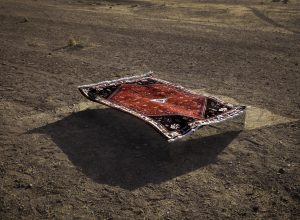
Shirin Abedinirad, Magic Carpet, 2022. Land art and fiber art, Tehran, Iran. Inspired by the enchanted carpet of One Thousand and One Nights, the work uses mirrored surfaces to create the magical illusion of flight, evoking a passage into wonder, longing, and transformation “in the twinkling of an eye.” Suspended between earthbound reality and imagined escape, the installation invites viewers to dream beyond the visible world. Artwork courtesy of featured artist Shirin Abedinirad.