


Where the Blind See God
1

In the heat of night, a Bedouin woman slept,
and a voice like rain in a desert said:
"Grieve not, for your womb shall carry two rivers-
one of sight, one of blindness.
One that sees the sun, one that sees the moon."

When morning broke,
she awoke weeping
for she knew not whether blindness was a gift or a grief.

2

The blind were born as whispers of God,
their eyes were sealed caskets,
but their hands were scriptures.

They traced the Quran on wooden tablets,
memorized the ink of revelation,
saw the unseen with fingers dipped in sacred dye.

One’s feet kissed the desert and could taste where water slept.
One’s hands read the stars like the poet of night.

Another, when asked, "What do you wish to see?"
answered, "The origin of beauty: Al-Nur."

Some longed to behold the moonlit face of the Prophet,
some wished to flip the Quran’s script with their eyes,
none wept for the world of men.

3

A man with sight, blind in his vision,
wandered into the desert.

He was a foreigner draped in empire,
a man who measured wisdom in ink on treaties,
who saw the Sahara as barren,
its people, lost and inferior.

"Are you not a Muhammadan imprisoned in darkness?" he asked.

A blind Berber scholar laughed.
"What prison is a world without deceit?"
"We see the world by its scent."
"We drink knowledge in its silence."
"We hear Allah’s voice where others hear only wind."

The seeker’s mouth twisted.
He had come expecting sorrow,
but found men who feared nothing-
not blindness, not poverty, not death.

"But if you could see my empire, would you not rejoice?"
he asked, clinging to reason.

A blind Tuareg nomad smiled.
"And if you could close your eyes and see the throne of Allah,
would you not weep?"

4

The desert wind pressed the seeker’s throat like a debtor.
The sand beneath him no longer felt naked.

He thought of his empire-
of men who conquered but did not know.

He had walked into the desert with the arrogance of sight,
but now stood humbled by the weight of the blind.

At last, he asked, "What is contentment?"

A blind Nubian merchant answered:
"Contentment is the well with no bottom-
Drink, and thirst never kisses your lips."

The seeker, who once recited them a dirge,
fell to his knees, forehead pressed to the sand.

For he-the colonialist-
was the blind one.
Nubian Woman
She entered like the wind through a cracked door,
a Nubian woman, her hands carved from dust
bearing the burden of the sand,
the burden of the stars,
the gift of the desert:
sweetened dates from its lips,
wild honey from the acacia's skin-
bearing and abundance in the bowl of her palms.

I called her, I need all of it.

Her eyes were the first breath of dusk,
the liquid strength of a woman
who holds the Nile in her bones,
the silent whispers of kingdoms long gone.

She found a vessel,
and with hands older than the stars
poured her labor into it-
the gold of dunes, the grain of Nubian fields,
the incense that whispered through temples,
her fingers woven into the land.

But just as I stepped forward to drink,
the earth convulsed-
a flickering dust storm,
wind lifting like a Sufi’s whirl.

Her voice held the wind,
chanting the incantations of untold stories:
of the Nubian merchant who sailed the Red Sea,
of the priestess who anointed Pharaohs with sacred myrrh oils,
of the healer whose palms revived the dead soil,
with sidr and black seed.

The Nubian woman carries them all,
each grain of sand a memory,
each memory of sand a legacy,
each legacy dissolved from songs,
that no longer live on tongue.

And though her gift is honey from the tongue,
it is not for the fleeting heart-
for the desert never forgets

I wake-
gripped by a thirst I cannot name,
as if the earth had swallowed me whole
and the winds whisper back,
"Do not swallow the dream,
for the desert takes what the earth forsakes."
I’ll bear witness
When the nomads wrap me in linen,
they feed my bones to the funeral of the earth,
and leave my name at the teeth of the grave-
I'll bear witness: the afterlife is full.

Full of those who bowed their heads to foreign gods,
bent their camels upon borrowed sand,
folding their legs like a supplication to thrones not their own.

But the wind does not forget,
it carries the grains of lineage
as birds recite an elegy
through
the indigo veils of the Tuareg,
the embroidered silence of the Moors,
the hennaed fingers of the Berbers,
the fire-lit praise of the Hausas,
to the ocean floor of remembrance,
to the rib of the sea.

An elegy for those
who did not trade their ancestral dialects for foreign tongues-
for the Berber widow who shaped her pottery
in the portrait of the oppressed,
for the Moorish poet who bled a verse
into the veins of the exiled,
for the Saharan nomad who rode his camel
in honor of expulsion.

I'll bear witness: the afterlife is full-
full of names written in stars,
full of names erased in nights.

And in this vacant space between death and revival,
where time folds like linen over forgotten names,
the dead are alive-
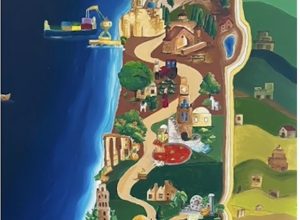
Artwork courtesy of our featured artist, Youssef ElNahas